
Joint Appendix JA11 provides the qualification requirements for photovoltaic (PV) system to meet the prescriptive or performance standards set forth in Title 24, Part 6, Sections 140.1, 140.10, 150.1(b),150.1(c), 170.1, 170.2(f), and 170.2(g).
PV systems or strings with module pitches greater than 2:12 or 10 degrees shall be installed with azimuth range between 90 to 300 degrees measured clockwise from true north. PV systems or strings with module pitches smaller than 2:12 or 10 degrees can be installed with any azimuth range.
When the California Flexible Installation (CFI) 1 is selected in the performance calculation, the PV array shall be installed with an azimuth range between 150 to 270 degrees from true north, and with all modules at the same tilt as the roof for pitches up to 7:12.
When the CFI2 is selected in the performance calculation, the PV array shall be installed with an azimuth range between 105 to 300 degrees from true north, and with all modules at the same tilt as the roof for pitches up to 7:12.
If the PV array does not meet either CFI1 or CFI2, then the actual orientation of the PV array shall be described.
Shading on the PV array from obstructions shall be eliminated or avoided as necessary to meet performance requirements under the performance approach or the prescriptive limit on shading under the prescriptive approach (stated in JA11.3.1). Any obstruction located north of all points on the array need not be considered as shading obstructions. Obstructions to consider include:
-
Any vent, chimney, architectural feature, mechanical equipment, or other obstruction that is on the roof or any other part of the building.
-
Any part of the neighboring terrain.
-
Any tree that is mature at the time of installation of the PV system.
-
Any tree that is planted on the building lot or neighboring lots or planned to be planted as part of landscaping for the building. (The expected shading shall be based on the mature height of the tree.)
-
Any existing neighboring building or structure.
-
Any planned neighboring building or structure that is known to the applicant or building owner.
-
Any telephone or other utility pole that is closer than 30 feet from the nearest point of the array.
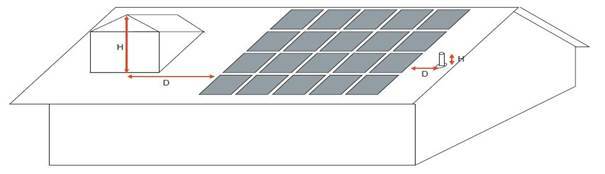
If the PV system does not qualify for exception 1 of section 150.1(c)14, then the weighted average annual solar access by panel count shall be equal or greater than 98 percent.
A certified solar assessment tool shall be used to demonstrate the shading condition of the actual installation of the PV module is consistent with compliance with JA11.3.1, the shading condition modeled in the performance method as indicated on the CF1R-PRF-01, and qualification to exceptions in 150.1(c)14.
Solar assessment tools shall be certified to the Executive Director according to the following requirements:
- The solar assessment tool shall calculate the annual solar access percentage of each individual solar array and a weighted average of the PV system as a whole. The calculation shall include all known obstructions, including any tree that is planted on the building lot or neighboring lots or planned to be planted as part of landscaping for the building.
- The solar assessment tool shall not include horizon shading in the calculation by default.
- The solar assessment tool shall produce a shade report with a summary of the PV system, including the address of the project, individual array panel count, orientation, annual solar access percentage, and a weighted average of the PV system as a whole.
- If the solar assessment tool model shading condition based on satellite or aerial images, the annual solar access percentage values shall be comparable to on-site measurements. Documentation shall be provided to CEC as proof.
The PV system shall have a web-based portal and a mobile device application that at a minimum provide the building owner, manager, or dwelling occupants access to the following information:
- The nominal kW rating of the PV system.
- Number of PV modules and the nominal watt rating of each module.
- Hourly (or 15-minute interval), daily, monthly, and annual kWh production in numeric and graphic formats.
- Running total of daily kWh production.
- Daily kW peak power production.
- Current kW production of the entire PV system.
The installed inverters shall be tested in accordance with the applicable requirements in UL1741 and UL1741 Supplement A. The PV system and the associated components, including inverters, shall comply with all applicable requirements specified in Rule 21 as adopted by the California Public Utilities Commission (CPUC).
The PV installer shall certify on the CF2R-PVB-01-E, Certificate of Installation for Photovoltaic System that all provisions of JA11 are met and provide a solar assessment report meeting one of the following conditions:
- The satellite, drone or other digital image used in the solar assessment report must be created and dated after the installation of the photovoltaic system.
- If the satellite, drone or other digital image used in the solar assessment report is dated before the installation of the photovoltaic system, additional on-site pictures must be attached to clearly show that the installed system matches the system modeled in the solar assessment report.
The Certificate of Installation shall be available on the building site for inspections.
The local enforcement agency shall verify that the CF2R-PVB-01-E Certificate of Installation is complete and correct, and uploaded into a Commission-approved registry.