
Exception to Section 160.4(d)3: Boilers with steady state full-load thermal combustion efficiency 90 percent or higher.
All piping for multifamily domestic hot water systems , shall be insulated toand meet the applicable requirements 1 through 3 below:
A. The first 8 feet of inlet cold water piping from the storage tanks, including piping between a storage tank and a heat trap shall be insulated.
B. Insulation on the piping and domestic hot water system appurtenances shall be continuous.
C. Pipe supports, hangers, and pipe clamps shall be attached on the outside of rigid pipe insulation to prevent thermal bridges.
D. All pipe insulation seams shall be sealed.
E. Insulation for pipe elbows shall be mitered, preformed, or site fabricated with PVC covers.
F. Insulation for tees shall be notched, preformed, or site fabricated with PVC covers.
G. Extended stem isolation valves shall be installed.
H. All plumbing appurtenances on hot water piping from a heating source to heating plant, at the heating plant, and distribution supply and return piping shall be insulated to meet the following requirements:
i. Where the outer diameter of the appurtenance is less than the outer diameter of the insulated pipe that it is attached to, the appurtenance shall be insulated flush with the insulation surrounding the pipe.
ii. Where the outer diameter of the appurtenance is greater than the outer diameter of the insulated pipe that it is attached to, the appurtenance shall be insulated with a minimum thickness of 1 inch.
iii. The insulation shall be removable and re-installable to ensure maintenance or replacement services can be completed.
iv. Valves shall be fully functional without impediment from the insulation.
2. Insulation Thickness. All piping for multifamily domestic hot water systems shall meet the insulation thickness requirements specified in Table 160.4-A.
A. For insulation conductivity in the range shown in Table 160.4-A for the applicable fluid temperature range, the insulation shall have the applicable minimum thickness or R-value shown in Table 160.4-A.
B. if the insulation conductivity falls outside the range provided in Table 160.4-A applicable fluid temperature range, the insulation shall meet a minimum R-value as indicated in Table 160.4-A. Or, it can have a thickness determined using Equation 160.4-A.
Equation 160.4-A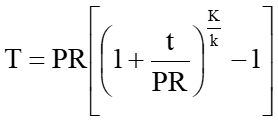
Where:
T = Minimum insulation thickness for material with conductivity K, inches. PR = Pipe actual outside radius, inches.
t = Insulation thickness from Table 160.4-A, inches.
K = Conductivity of alternate material at the mean rating temperature indicated in Table 160.4-A for the applicable fluid temperature range, in Btu-inch per hour per square foot per °F.
k = The lower value of the conductivity range listed in Table 160.4-A for the applicable fluid temperature range, Btu-inch per hour per square foot per °F.
C. Insulation conductivity shall be determined in accordance with ASTM C335 at the mean temperature listed in Table 160.4-A, and shall be rounded to the nearest 1/100 Btu-inch per hour per square foot per °F.
Exception 1 to Section 160.4(e): Piping that penetrates framing members shall not be required to have pipe insulation for the distance of the framing penetration. Piping that penetrates metal framing shall use grommets, plugs, wrapping or other insulating material to ensure that no contact is made with the metal framing. Insulation shall abut securely against all framing members.
Exception 2 to Section 160.4(e): Piping installed in interior or exterior walls shall not be required to have pipe insulation if all of the requirements are met for compliance with quality insulation installation (QII) as specified in Reference Residential Appendix RA3.5.
Exception 3 to Section 160.4(e): Piping surrounded with a minimum of 1 inch of wall insulation, 2 inches of crawl space insulation or 4 inches of attic insulation shall not be required to have pipe insulation.
| Fluid Operating Temperature Range (°F) | Insulation Conductivity (Btu·in/h·ft2 °F) | Insulation Conductivity Mean Rating Temp. (°F) | Nominal Pipe Diameter (in inches) < 1 |
Nominal Pipe Diameter (in inches) 1 to < 1.5 |
Nominal Pipe Diameter (in inches) 1.5 to < 4 |
Nominal Pipe Diameter (in inches) 4 to < 8 |
Nominal Pipe Diameter (in inches) 8 and larger |
| 105-1401 | 0.22-0.28 | 100 | 1.0 (R 7.7) | 1.5 (R 12.5) | 2.0 (R 16) | 2.0 (R 12.5) | 2.0 (R 11) |
Footnote to TABLE 160.4-A:
1 Multifamily and hotel/motel domestic hot water systems with water temperature above 140°F shall use the row in table 120.3-A for the applicable water temperature.
- Pipe and appurtenance insulation exposed to weather shall be protected by a cover suitable for outdoor service. The cover shall be water retardant and provide shielding from solar radiation that can cause degradation of the material. Appurtenance insulation covers shall be removable and able to be reinstalled. Adhesive tape shall not be used to provide this protection.
- Pipe insulation covering chilled water piping and refrigerant suction piping located outside the conditioned space shall include, or be protected by, a Class I or Class II vapor retarder. All penetrations and joints shall be sealed.
- Pipe insulation buried below grade must be installed in a waterproof and noncrushable casing or sleeve.
Note: Authority: Sections 25213, 25218, 25218.5, 25402 and 25402.1, Public Resources Code. Reference: Sections 25007, 25008, 25218.5, 25310, 25402, 25402.1, 25402.4, 25402.5, 25402.8, and 25943, Public Resources Code.