
RA3.1 contains procedures for measuring the air leakage in forced air distribution systems as well as procedures for verifying duct location, duct surface area, duct R-value, return duct design, return grille design, and air filter installation.
RA3.1 applies to air distribution systems in both new and existing single-family and multifamily residential buildings.
RA3.1 provides required procedures for installers, ECC-raters and others who are required to perform field verification of air distribution systems.
Table RA3.1-1 is a summary of the tests and criteria included in RA3.1.
Table RA3.1-2 Provides compliance criteria for the duct leakage test protocols in Section RA3.1.4.3.
Verification/Diagnostic | Description | Procedure |
Duct Location, Surface Area and R-value | Verify duct system was installed according to the specifications on the Certificate of Compliance or in accordance with an approved duct system design layout. | |
Verified Duct System Design | Procedure for duct system design layout approval and field verification | |
Duct Leakage | Verify that duct leakage is less than or equal to the compliance criteria given in Table RA3.1-2. | |
Return Duct Design | Verify compliance with the return duct and return grill sizing requirements of Table 150.0-B or TABLE 150.0-C ). | |
Air Filter Device Design | Verify compliance with the requirements in 150.0(m)12 . | |
Verification of Prescriptive Bypass Duct Requirements | Verification to confirm zonally controlled systems comply with the bypass duct requirements in 150.1(c)13 | |
Verification of Space-Conditioning System Airflow Supply to All Habitable Spaces | Verify that all habitable spaces in the dwelling unit receive space-conditioning system airflow. | |
Verification of Ductless Space-Conditioning System Indoor Units Located Entirely in Conditioned Space | Verify that ductless indoor units are located entirely in conditioned space. |
The instrumentation for the air distribution diagnostic measurements shall conform to the following specifications:
All pressure measurements shall be measured with measurement systems (i.e. sensor plus data acquisition system) having an accuracy equal to or better than ± 1% of pressure reading or ± 0.2 Pa. (0.0008 inches water) (whichever is greater). All pressure measurements within the duct system shall be made with static pressure probes such as Dwyer A303 or equivalent.
Duct leakage airflow rates during duct leakage testing shall be measured with a duct leakage airflow rate measurement apparatus that has a duct leakage airflow rate measurement accuracy equal to or better than ± 3 percent of reading or ± 1 cfm (whichever is greater).
All instrumentation used for duct leakage diagnostic measurements shall be calibrated according to the manufacturer’s calibration procedure to conform to the accuracy requirement specified in Section RA3.1.2
The apparatus for fan pressurization duct leakage measurements shall consist of a duct pressurization and flow measurement device meeting the specifications in Section RA3.1.2.
The apparatus for measuring duct leakage to outside shall include a fan that is capable of maintaining the pressure within the conditioned spaces in the house at 25 Pa (0.1 inches water) relative to the outdoors. The fan most commonly used for this purpose is known as a “blower door” and is typically installed within a temporary seal of an open exterior doorway.
The apparatus for determining leakage in and verifying sealing of all accessible leaks in existing duct systems provide means for introducing controllable amounts of non-toxic visual/theatrical smoke into the duct pressurization apparatus for identifying leaks in accessible portions of the duct system. The means for generating smoke shall have sufficient capacity to ensure that any accessible leaks will emit visibly identifiable smoke.
This section describes the procedures used to verify compliance with the mandatory and performance compliance requirements for air distribution systems.
The performance compliance calculations allow credit for duct systems that are designed to be in advantageous locations, that have reduced duct surface areas, and/or that provide higher R-values or portions of the system. This section specifies procedures for verification of duct systems for conformance with the requirements for the performance compliance credits. When indicated on the Certificate of Compliance, the Installer shall certify compliance with the applicable procedures in RA3.1.4.1 on a Certificate of Installation, and an ECC-rater shall verify compliance on a Certificate of Verification.
An installed duct system meets the Verified Duct System Design compliance criteria if it is field verified by a ECC-rater to be in conformance with a duct design layout that meets all applicable duct design and documentation requirements given in Section RA3.1.4.1.1. The duct design layout shall be approved by the enforcement agency.
The duct system design shall be documented on the Duct Design Layout, a scaled layout drawing that identifies the location of the space conditioning equipment, all supply and return registers/grilles, the size, R-value, and location of each duct segment. The Duct Design Layout shall incorporate all other duct details reported on the registered Certificate of Compliance.
The duct system design shall be based on an industry standard design methodology such as ACCA Manual D, or an equivalent, and shall take into account: the available external static pressure from the air handler, the equivalent length or pressure drop of external devices, and the pressure drop of the duct runs accounting for size, type and configuration of the ducts and fittings. The duct system shall be designed to meet the required system airflow rate with the manufacturer-specified available external static pressure for the specified system air handler at that airflow. The duct system design shall include calculations that indicate the duct system will operate at equal to or greater than 0.0292 cfm/Btu (350 cfm/12000 Btu) in cooling speed (350 cfm per nominal ton of condensing unit cooling capacity specified by the manufacturer) or, if heating only, equal to or greater than 16.8 cfm per 1000 Btu/hr furnace nominal output specified by the manufacturer.
The Duct Design Layout shall be included with the building design plans and the registered Certificate of Compliance submitted to the enforcement agency in conjunction with the application for the building permit. A copy of the Duct Design Layout approved by the enforcement agency shall be posted or made available with the building permit(s) issued for the building, and shall be made available to the enforcement agency, installing contractor, and ECC-rater for use during the installation work and for all applicable inspections.
The location of all supply and return registers shall be verified by inspection of the interior of the dwelling unit. The location of the space conditioning equipment and the size, R-value, and location of each duct segment shall be verified by observation in the spaces where they are located. Deviations from the approved Duct Design Layout shall not be allowed without a revised a Duct Design Layout approved by the enforcement agency.
A visual inspection shall confirm space conditioning systems with air handlers located outside the conditioned space have 12 linear feet or less of duct located outside the conditioned space including air handler and plenum. If the space conditioning system has more than 12 feet of duct outside of conditioned space, the system does not pass.
A visual inspection shall confirm space conditioning duct systems are located entirely in conditioned space. If any part of the space conditioning duct system is outside of conditioned space, the system does not pass.
Compliance with Verified Duct System Design procedures specified in RA3.1.4.1.1 are prerequisite for compliance with the Duct Surface Area Reduction compliance credit. A visual inspection shall on confirm the installed duct system layout conforms to the Duct Design Layout.
Compliance with Verified Duct System Design procedures specified in RA3.1.4.1.1 is prerequisite for compliance with the Buried Ducts on the Ceiling compliance credit. A visual inspection shall confirm the installed duct system layout conforms to the Duct Design Layout. This procedure shall be carried out prior to covering the ducts with insulation.
Ducts designed to be buried shall be insulated to R4.2 or greater. In addition, ducts designed to be in contact with the ceiling shall be not more than 3.5 inches from the ceiling drywall. A sign shall be hung near the attic access that displays a warning: “Caution: Buried Ducts. Markers indicate location of buried ducts.” All ducts that will be completely buried shall have vertical markers that are visible after insulation installation, placed at least every 8 feet of duct length and at the beginning and end of each duct run.
Compliance with Verified Duct System Design procedures specified in RA3.1.4.1.1 is prerequisite for compliance with the Deeply Buried Ducts compliance credit. A visual inspection shall confirm the installed duct system layout conforms to the Duct Design Layout. This procedure shall be carried out prior to covering the ducts with insulation.
Ducts designed to be buried shall be insulated to R4.2 or greater. In addition, ducts designed to be in contact with the ceiling shall be not more than 3.5 inches from the ceiling drywall. A sign shall be hung near the attic access that displays a warning: “Caution: Buried Ducts. Markers indicate location of buried ducts.” All ducts that will be completely buried shall have vertical markers that are visible after insulation installation, placed at least every 8 feet of duct length and at the beginning and end of each duct run.
A visual inspection shall confirm that all habitable spaces in the dwelling unit receive space-conditioning system airflow either by use of a ductless space-conditioning system indoor unit located on the wall, ceiling, or floor of the habitable space, or by use of space-conditioning system air supply registers located in the habitable space that use ductwork connected from the register directly to the supply air outlet of a ducted space-conditioning system air handling unit. Refer to Standards Section 100.1 for the definition of habitable space. Transfer fans that move air from one space in the dwelling to a different space in the dwelling, but do not heat or cool the air transferred, do not meet the requirement for providing space-conditioning system airflow.
A visual inspection shall confirm that ductless indoor units are located entirely in conditioned space in accordance with the following requirements:
- Ductless indoor unit types that mount entirely on the interior surface of dwelling unit walls, ceilings, or floors shall be considered to be entirely in conditioned space. Penetrations in the wall, ceiling or floor surface necessary for the indoor unit refrigerant piping, condensate drain, or electrical connections shall be allowed, provided the penetrations are sealed.
- Ductless indoor units that penetrate the interior surface of dwelling unit walls, ceilings, or floors, and protrude through cut-out openings in the dwelling unit walls, ceilings, or floors shall be inspected to determine whether the indoor unit is installed inside both the thermal boundary and the air barrier of the dwelling according to the following criteria as applicable:
- Ductless indoor units that protrude through the air barrier into unconditioned spaces (including but not limited to attics, crawl spaces, garages, or outdoors) are not located entirely in conditioned space.
- Ductless indoor units that protrude into indirectly conditioned spaces (including but not limited to drop ceilings, or floor assemblies in a single family or multifamily multi-story building) that are wholly inside both the thermal boundary and the air barrier of the dwelling are located entirely in conditioned space. Note: Verification at an early stage of building construction may be necessary for visual verification to be possible.
If field verification according to RA3.1.4.1.8 determines the installed system's ductless indoor units are not located entirely in conditioned space, then the system does not comply with the VCHP compliance option eligibility requirements.
For use in establishing the target duct leakage rate compliance criteria, the system air handler airflow shall be calculated using RA3.1.4.2.1, RA3.1.4.2.2, or RA3.1.4.2.3 as applicable.
Default air handler airflow may be used for any one of the following conditions:
- for heating-only systems, or
- when a duct system is being tested prior to installation of the air conditioning or heating system equipment, or
- when the space conditioning system equipment specification is not known.
Default air handler airflow shall be a calculated value equal to 0.5 CFM per ft² of Conditioned Floor Area.
Nominal air handler airflow shall be calculated according to one of the following methods as applicable:
- For heating-only systems, the nominal air handler airflow shall be 21.7 CFM per kBtu/hr of rated heating output capacity.
- For split or packaged cooling systems with only one indoor unit, the nominal air handler airflow shall be 400 CFM per nominal ton of outdoor condensing unit cooling capacity as specified by the manufacturer.
- For small duct high velocity systems, the nominal air handler airflow shall be 250 CFM per nominal ton of outdoor condensing unit cooling capacity as specified by the manufacturer.
- For multiple-split systems that provide cooling, the nominal air handler airflow for each indoor unit shall be 350 CFM per nominal ton of indoor unit cooling capacity as specified by the manufacturer.
The system airflow shall be as measured according to a procedure in Section RA3.3.3. The system airflow can be used as the air handler airflow for the purpose of establishing duct leakage percentage.
Diagnostic duct leakage measurement is used by installers and raters to verify that total leakage meets the criteria for any sealed duct system specified in the compliance documents.
When central fan integrated (CFI) indoor air quality ventilation system air ducts, or central fan ventilation cooling system (CFVCS) air ducts connect to space conditioning system ducts, the ventilation duct branch openings shall not be sealed/taped off during space conditioning system duct leakage testing. However, the ventilation system motorized dampers that open only when ventilation airflow is required and close when ventilation airflow is not required may be closed during space conditioning system duct leakage testing.
Table 3.1-2 summarizes the leakage test procedures that may be used to demonstrate compliance.
Verification Description | User Application | Procedure(s) |
Sealed and tested new duct systems in single family homes and townhomes | Installer Testing at Final ECC Rater Testing | |
Sealed and tested new duct systems in single family homes and townhomes | Installer Testing at Rough-in, Air Handling Unit Installed | |
Sealed and tested new duct systems in single family homes and townhomes | Installer Testing at Rough-in, Air Handling Unit Not Installed | |
Sealed and tested new duct systems in multifamily homes regardless of duct system location. | Installer Testing at Final ECC Rater Testing | |
Sealed and tested new duct systems in multifamily homes regardless of duct system location. | Installer Testing at Final ECC Rater Testing | |
Verification of Low Leakage Air Handler with Sealed and Tested Duct System Compliance Credit | Installer Testing at Final ECC Rater Testing | |
Verification of low leakage ducts located entirely in conditioned space | Installer Testing ECC Rater Testing | |
Sealed and tested altered existing duct systems | Installer Testing ECC Rater Testing | |
Sealed and tested altered existing duct systems | Installer Testing ECC Rater Testing | |
Sealed and tested altered existing duct systems | Installer Testing and Inspection ECC Rater Testing and Verification |
The objective of this procedure is for an installer to determine or a rater to verify the total leakage of a new or altered duct system. The total duct leakage shall be determined by pressurizing the entire duct system to a positive pressure of 25 Pa (0.1 inches water) with respect to outside. The following procedure shall be used for the fan pressurization tests:
- Verify that the air handler, supply and return plenums and all the connectors, transition pieces, duct boots and registers are installed and sealed. The entire duct system shall be included in the total leakage test.
- For newly installed or altered ducts, verify that cloth backed rubber adhesive duct tape has not been used and if a platform or other building cavity used to house the air distribution system has been newly installed or altered, it contains a duct or is ducted with duct board or sheet metal.
- Seal all the supply registers and return grilles except for one large centrally located return grille or the air handler cabinet access panel. Floor registers on carpeted floors may be removed and the opening sealed to the floor under the carpet. If allowed by the equipment manufacturer, the air-handling unit blower compartment access panel may be sealed with an approved tape - do not use mastic or other permanent sealing material.
- Attach the fan flowmeter device to the duct system at the unsealed return grille or the air handler cabinet access panel. Ensure that the air filter has been removed.
- Install a static pressure probe at a supply register located close to the air handler, or at the supply plenum.
- Adjust the fan flowmeter to produce a positive 25 Pa (0.1 inches water) pressure at the supply register or the supply plenum with respect to the outside or with respect to the building space with the entry door open to the outside.
- Record the flow through the flowmeter; this is the leakage flow at 25 Pa (0.1 inches water).
- Divide the leakage flow by the total air handler airflow determined by the procedure in Section RA3.1.4.2 and convert to a percentage. If the leakage flow percentage is equal to or less than the compliance criterion required by the Standards, the system passes.
Installers may determine duct leakage in newly constructed buildings by using diagnostic measurements at the rough-in building construction stage prior to installation of the interior finishing. When using this measurement technique, the installer shall complete additional inspection (as described in section RA3.1.4.3.3) of duct integrity after the finishing wall has been installed. In addition, after the finishing wall is installed, spaces between the register boots and the wallboard shall be sealed. Cloth backed rubber adhesive duct tapes shall not be used to seal the space between the register boot and the wall board.
The duct leakage measurement at rough-in construction stage shall be performed using a fan pressurization device. The duct leakage shall be determined by pressurizing both the supply and return ducts to 25 Pa (0.1 inches water). The following procedure (either RA3.1.4.3.2.1 or RA3.1.4.3.2.2) shall be used:
For total leakage:
- Verify that supply and return plenums and all the collars, connectors, transition pieces, duct boots, and return boxes have been installed. If a platform or other building cavity is used to house portions of the air distribution system, it shall contain a duct, be lined with duct board or sheet metal, and all duct connectors and transition parts shall be installed and sealed. The platform, ducts, and connectors shall be included in the total leakage test. All joints shall be inspected to ensure that no cloth backed rubber adhesive duct tape is used.
- Seal all the supply duct boots and return boxes except for one return duct box.
- Attach the fan flowmeter device at the unsealed return duct box.
- Insert a static pressure probe at one of the sealed supply duct boots located close to the supply plenum or at the supply plenum.
- Adjust the fan flowmeter to maintain a positive 25 Pa (0.1 inches water) pressure in the duct system with respect to the outside, or with respect to the building space with the entry door open to the outside.
- Record the flow through the flowmeter; this is the leakage flow at 25 Pa (0.1 inches water).
- Divide the leakage flow by the total air handler airflow determined by the procedure in Section RA3.1.4.2 and convert to a percentage. If the leakage flow percentage is less than or equal to the compliance criterion required by the Standards, the system passes.
For total leakage:
- Verify that supply and return plenums and all the collars, connectors, transition pieces, duct boots, and return boxes have been installed. If a platform or other building cavity is used to house portions of the air distribution system, it shall contain a duct, be lined with duct board or sheet metal, and all duct connectors and transition parts shall be installed and sealed. The platform, ducts and connectors shall be included in the total leakage test. All joints shall be inspected to ensure that no cloth backed rubber adhesive duct tape is used.
- Supply and return leaks may be tested separately, or the supply and return plenums may be connected together using suitable temporary air-tight means to facilitate testing the total system. If the supply and return systems are to be tested separately, the opening to the supply or return plenums shall be sealed to prevent leakage unless used as the point of attachment for the fan flowmeter.
- Seal all the supply duct boots and/or return duct boxes except for a location where the fan flowmeter device will be attached.
- Attach the fan flowmeter device at the unsealed location.
- Insert a static pressure probe at one of the sealed supply duct boots, or return duct boxes, located at a point in the system close to the fan flowmeter.
- Adjust the fan flowmeter to produce a positive 25 Pa (0.1 inches water) pressure at the supply plenum with respect to the outside or with respect to the building space with the entry door open to the outside.
- Record the airflow through the flowmeter; this is the leakage flow at 25 Pa (0.1 inches water).
- If the supply and return ducts are tested separately, repeat items 4 through 6 with the flow meter attached to the unsealed return box and the static pressure probe in the return duct boxes, located at a point in the system close to the fan flowmeter, then add the two leakage rates together to get a total leakage flow.
- Divide the leakage flow by the total air handler airflow determined by the procedure in Section RA3.1.4.2 and convert to a percentage. If the leakage flow percentage is less than or equal to the compliance criterion required by the Standards, the system passes.
After installing the interior finishing drywall, or other finishing material, and verifying that one of the above rough-in tests was completed, the following procedure shall be used:
- Remove at least one supply and one return register, and verify that the spaces between the register boot and the interior finishing wall are properly sealed.
- If the house rough-in duct leakage test was conducted without an air handler installed, inspect the connection points between the air handler and the supply and return plenums to verify that the connection points are properly sealed.
- Inspect all joints to ensure that no cloth backed rubber adhesive duct tape is used.
The objective of this test is to determine the amount of duct leakage to outside the air barrier for the conditioned space. This measurement is utilized to verify that duct systems are located entirely within conditioned space. The procedure is also utilized to provide an alternate leakage measurement for situations when it is likely that a portion of the total duct leakage is inside the air barrier for the conditioned space. The duct leakage to outside shall be determined by pressurizing the ducts and the conditioned space of the house to 25 Pa (0.1 inches water) with respect to outside. The following procedure shall be used for the fan pressurization test of leakage to outside:
- Seal all the supply registers and return grilles except for one large centrally located return grille or the air handler cabinet access panel.
- Attach the fan flowmeter device to the duct system at the unsealed return grille or the air handler cabinet access panel.
- Install a static pressure probe at the supply plenum.
- Attach a blower door to an external doorway. If the door between the dwelling and the garage is used, the garage car-bay doors must be open.
- If any ducts are located in an unconditioned basement, all doors or accesses between the conditioned space and the basement shall be closed, and at least one operable door or window (if it exists) between the basement and outside shall be open during the test.
- If the ducts are located in a conditioned basement, any door between the basement and the remaining conditioned space shall be open, and any basement doors or windows to outside must be closed during the test.
- Adjust the blower door fan to provide positive 25 Pa (0.1 inches of water) pressure in the conditioned space with respect to outside.
- Adjust the fan/flowmeter to maintain a zero pressure difference (plus or minus 0.5Pa (.002 inches water)) between the ducts and the conditioned space, and adjust the blower door fan to maintain a positive 25 Pa (0.1 inches of water) pressure in the conditioned space with respect to outside. This step may require several iterations.
- Record the flow through the flowmeter; this is the duct leakage flow to outside at 25 Pa (0.1 inches water). If the leakage flow is less than or equal to the applicable compliance criteria required by the Standards, the system passes.
- If required for compliance, divide the leakage flow by the system air handler airflow determined by the procedure in Section RA3.1.4.2 , and convert to a percentage. If the leakage flow percentage is less than or equal to the criterion required by the Standards, the system passes.
For altered existing duct systems that are unable to pass either the Fan Pressurization of Ducts test (RA3.1.4.3.1), or the Duct Leakage to Outside test (RA3.1.4.3.4), the objective of this test is to verify that all accessible leaks are sealed. The following procedure shall be used:
- Complete the leakage test specified in Section RA3.1.4.3.1 to measure the leakage before commencing duct sealing.
- Seal all accessible ducts.
- After sealing is complete, again use the procedure in RA3.1.4.3.1 to measure the leakage after duct sealing.
- Complete the Smoke Test as specified in RA3.1.4.3.6.
- Complete the Visual Inspection as specified in RA3.1.4.3.7.
For altered existing ducts that fail the leakage tests, the objective of the smoke test is to confirm that all accessible leaks have been sealed. The following procedure shall be used:
- Inject either theatrical or other non-toxic smoke into a fan pressurization device that is maintaining a duct pressure difference of 25 Pa (0.1 inches water) relative to the duct surroundings, with all grilles and registers in the duct system sealed.
- Visually inspect all accessible portions of the duct system during smoke injection.
- The system shall pass the test if one of the following conditions is met:
1. No visible smoke exits the accessible portions of the duct system.
2. Smoke only emanates from the furnace cabinet which is gasketed and sealed by the manufacturer and no visible smoke exits from the accessible portions of the duct system.
The objective of this inspection in conjunction with the smoke test (RA3.1.4.3.6) is to confirm that all accessible leaks have been sealed. Visually inspect to verify that the following locations have been sealed:
- Connections to plenums, evaporator coils, and other connections to the forced air unit.
- Refrigerant lines, p-traps and other penetrations into the forced air unit.
- Air handler door panel (do not use permanent sealing material, metal tape is acceptable).
- Register boots sealed to surrounding material at all registers and grilles.
- Connections between lengths of duct, as well as connections to takeoffs, wyes, tees, and splitter boxes.
A visual inspection shall confirm the duct system location as specified by Section RA3.1.4.1.3. Additionally, ducts shall be confirmed to have less than or equal to 25 cfm leakage to outside when measured as specified by Section RA3.1.4.3.4.
An additional performance compliance credit is available for verified low leakage ducts if a qualified low leakage air-handling unit is installed. The low leakage air-handling unit cabinet (furnace, or heat pump fan and inside coil) shall conform to the qualification requirements given in Reference Joint Appendix JA9 and shall be included in the list of low leakage air handling units published by the Energy Commission. The qualified air handler must be connected to a sealed and tested new duct system to receive the credit.
In order to comply with this credit, the duct system shall be verified to leak less than or equal to the leakage rate specified on the Certificate of Compliance using the methods in Section RA3.1.4.3.1, and the air handler manufacturer make and model number shall be verified to be a model certified to the Energy Commission as qualified for credit as a low leakage air handler.
Verification shall consist of a visual inspection to confirm that the duct design conforms to the criteria given in Table 150.0-B or Table 150.0-C.
Verification shall consist of a visual inspection to confirm that the air filter devices conform to the requirements given in Section 150.0(m)12.
When a zonally controlled forced air system is installed, a visual inspection shall confirm:
-
That bypass ducts are not used to deliver conditioned supply air directly to the space conditioning system return duct airflow; or
-
That the Certificate of Compliance indicates an allowance for use of bypass ducts.
When compliance requires verification that a ducted system's indoor unit air filters have been sized in accordance with a maximum face velocity specification, the following procedure shall be used.
- Indoor unit design airflow rate. Record the design airflow rate for the indoor unit in CFM as specified by the system designer. The design airflow rate shall be equal to or greater than the minimum airflow rate required for compliance with the standards. Alternatively, if the design airflow rate for the indoor unit is not available, calculate and record the nominal air handler airflow rate for the indoor unit in accordance with the specifications in RA3.1.4.2.2.
- Air filter design airflow rate. Determine the air filter design airflow rate. For indoor units with only one filtered return air inlet, the air filter design airflow rate in CFM is equal to the indoor unit design airflow rate determined in step (a). For indoor units with more than one filtered return air inlet, the system designer shall determine what portion of the total indoor unit airflow is equal to the air filter design airflow for each air filter, ensuring that the sum total of all individual air filter design airflow rates is equal to the total indoor unit design airflow rate determined in step (a).
- Air filter grille/rack sticker. Compare the air filter design airflow rate calculated in step (b) to the design airflow rate on the filter grille or rack. Standards Section 150.0(m)12Biv requires that air filter installation locations shall have the air filter design airflow rate, and maximum allowable clean-filter pressure drop at the design airflow rate posted on a label/sticker, inside or near the location of the filter grille/rack such that this information will be visible to a person replacing the air filter.
If the air filter installation location does not have the required information marked on a label or sticker, the indoor unit does not comply. - Air filter maximum face velocity allowed. Record the maximum allowable face velocity value in ft/min required for compliance for each air filter.
- Minimum air filter face area allowed. For each air filter, divide the air filter design airflow rate in ft3/min by the maximum allowable face velocity in ft/min. The result is the minimum allowable total air filter face area in ft2 for the air filter. Convert the calculated face area from square feet to square inches by multiplying the face area in square feet by 144.
Note: the air filter face area is the nominal area of the side of the air filter that is perpendicular to the direction of the airflow through the air filter. - Installed air filter nominal dimensions. Measure and record the installed nominal length dimension in inches and nominal width dimension in inches for the side of the filter that is perpendicular to the direction of the airflow through the air filter installed in the return air grille/rack of the indoor unit. If there is more than one filtered return air inlet for the indoor unit, measure and record the length dimension and width dimension of each of the air filters.
- Installed air filter face area. For each of the filtered return air inlets for the indoor unit, multiply the nominal air filter length dimension by the nominal air filter width dimension to calculate the nominal air filter face area in square inches.
- Determining compliance. For each of the filtered return air inlets for the indoor unit, if the installed air filter face area is greater than or equal to the minimum air filter face area allowed as determined in step (e), then the air filter complies. All of the indoor unit air filters that are required be sized and verified according to a face velocity specification shall comply, otherwise the indoor unit does not comply.
When compliance requires field verification to confirm that a ducted system's indoor unit air filter(s) comply with a minimum clean filter pressure drop requirement, the following steps shall be followed. When there is more than one filtered return air inlet for the indoor unit, all of the indoor unit's air filter devices shall be field verified.
- Indoor unit design airflow rate. Record the design airflow rate for the indoor unit in CFM as specified by the system designer. The design airflow rate shall be equal to or greater than the minimum airflow rate required for compliance with the standards. Alternatively, if the design airflow rate for the indoor unit is not available, calculate and record the nominal air handler airflow rate for the indoor unit in accordance with the specifications in RA3.1.4.2.2.
- Air filter design airflow rate. For indoor units with only one filtered return air inlet, the air filter design airflow rate in CFM is equal to the indoor unit design airflow rate determined in step (a). For indoor units with more than one filtered return air inlet, the system designer shall determine what portion of the total indoor unit airflow is equal to the air filter design airflow for each air filter, ensuring that the sum total of all individual air filter design airflow rates is equal to the total indoor unit design airflow rate determined in step (a).
- Air filter grille/rack sticker. Standards Section 150.0(m)12Biv requires that air filter installation locations shall have the air filter design airflow rate, and maximum allowable clean-filter pressure drop at the design airflow rate posted on a label/sticker, inside or near the location of the filter grille/rack such that this information will be visible to a person replacing the air filter.
Field inspection shall verify that each air filter installation location has the required sticker. If the air filter installation location does not have the required sticker, the indoor unit does not comply. - Air filter manufacturer's performance rating label. Standards section 150.0(m)12E requires that the air filter placed in the filter grille/rack shall be labeled by the air filter manufacturer to disclose the clean filter pressure drop performance determined according to ASHRAE Standard 52.2 or AHRI Standard 680. The required air filter label information includes clean filter pressure drop ratings at a range of airflow rates. Field inspection shall verify that the air filter installed in the filter grille/rack has the required performance rating label. If an installed air filter does not have the required manufacturer's performance rating label, then the indoor unit does not comply.
- Determining clean filter pressure drop compliance. Inspection of the air filter manufacturer's performance rating label shall verify that the air filter is rated to provide a clean filter pressure drop less than or equal to the value required for compliance, at an airflow rate greater than or equal to the design airflow for the filter. Interpolation of the manufacturer's airflow and pressure drop rating values published on the air filter performance rating label is allowed when determining compliance. Field diagnostic pressure measurements of operating indoor units to determine the pressure drop of installed air filters are not required for demonstrating compliance.
If all of the indoor unit air filters are rated to operate at a pressure drop less than or equal to the value required for compliance, and at an airflow rate greater than or equal to the design airflow for the air filter, then the indoor unit complies.
-
The procedures in Appendix RA3.2 are for use for residential air-cooled air conditioners and air-source heat pumps to verify the systems have the required refrigerant charge.
-
For dwelling units with multiple air conditioners or heat pumps, the procedures shall be applied to each system separately.
-
Sections 150.1(c)7 and 150.2(b)1F specify the requirements for minimum system airflow rates to be verified in conjunction with the refrigerant charge verification.
-
Failure to follow the manufacturer’s installation and charging instructions may result in significant refrigeration system faults that may invalidate refrigerant charge and metering device verification results. The installer shall certify that he/she has conformed to the manufacturer’s instructions and specifications for charging the system prior to proceeding with the verification procedures in this appendix.
-
In the case where the Energy Commission has approved an alternative protocol as described in RA1, the HVAC Installer and ECC-Rater may choose to perform the alternative refrigerant charge verification procedure.
- The procedures in Section RA3.2.2 are applicable to ducted split system air-cooled air conditioners and ducted split system air-source heat pumps, and may be applicable to packaged air-cooled air conditioners and packaged air-source heat pumps.
- The procedures in Section RA3.2.2 require verification of the applicable minimum system airflow rate across the cooling coil when refrigerant charge is verified.
- The procedures in Section RA3.2.2 require verification (for applicable systems) that the metering device is operating properly.
- The procedures in Section RA3.2.2 may be used when the outdoor air temperature is 55°F or above.
- When refrigerant charge verification is required for compliance, the applicable procedures in Section RA3.2.2 shall be used by the HVAC installer after installing a new HVAC system or after altering refrigerant-containing components in an existing HVAC system, and after charging the air conditioner or heat pump system in accordance with the manufacturer's instructions and specifications.
- The applicable procedures in Section RA3.2.2 shall always be used by the ECC-Rater for verification of the system's refrigerant charge when verification is required for compliance unless an applicable alternate procedure is available in Reference Residential Appendix RA1, or the Standards specify the Section RA3.2.3.2 procedure (observation of weigh-in) as mandatory for compliance, or as an available option for compliance and the HVAC installer elects to use the RA3.2.3.2 procedure for verification.
- When the procedures in Section RA3.3.3.1.5 (alternative to compliance with minimum system airflow) are utilized for compliance, verification compliance shall not use group sampling.
- The procedures in Section RA3.2.3 are applicable to air-cooled air conditioners or air-source heat pumps.
- The weigh-in charging procedure is an acceptable method for demonstrating compliance at any outdoor temperature.
- Use of the Section RA3.2.3 procedure does not change the obligation for the system to comply with all applicable minimum airflow rate verification requirements.
- When the procedures in Section RA3.2.3 are utilized by the HVAC installer, verification compliance shall not use group sampling.
- The procedures in Section RA3.2.3.1 shall be used by HVAC installers when refrigerant charge verification is required for compliance when the outdoor air temperature is below 55°F, and there is no applicable alternative refrigerant charge verification protocol in Reference Residential Appendix RA1 available for use with the system for outdoor temperatures below 55°F.
- The procedures in Section RA3.2.3.1 shall be used by HVAC installers when refrigerant charge verification is required for compliance when the standard charge verification procedure in RA3.2.2 is not applicable to the system that must demonstrate compliance, and there is no applicable alternative refrigerant charge verification protocol in Reference Residential Appendix RA1 available for use with the system.
- The procedures in Section RA3.2.3.1 shall not be utilized by ECC-Raters for verification of refrigerant charge.
- The procedures in Section RA3.2.3.2 shall be utilized by ECC-Raters for verification of refrigerant charge only when the Standards specify that the RA3.2.3.2 procedure shall be used for verification compliance, otherwise only when the Standards specify the RA3.2.3.2 procedure is an available option, and the HVAC installer elects to use the RA3.2.3.2 procedure for verification compliance.
This section specifies the standard charge verification procedure. Under this procedure, the refrigerant charge is verified using the "superheat charging method" for systems with fixed metering devices, or the "subcooling charging method" for systems with thermostatic expansion valves (TXV) or electronic expansion valves (EXV).
The following sections describe the required instrumentation; required calibration for the instrumentation; required diagnostic measurements; and the required calculations to determine results that must be compared to the criteria in Table RA3.2-1 to determine compliance.
Refrigerant charge verification utilizing the procedures in Section RA3.2.2 requires compliance with a minimum airflow rate across the cooling coil at the time of charge verification, as specified by Standards Sections 150.1(c)7Aib and 150.2(b)1Fiia as applicable.
Table RA3.2-1 summarizes the standard charge verification protocols and defines the corresponding compliance criteria that shall be used by system installers and ECC-Raters.
Case | User Application | Compliance Criteria | Procedure(s) |
Standard Charge Verification Procedure - Fixed Metering Device Systems | Installer Testing at Final | 55°F ≤ Outdoor Air Dry-bulb Temp ≤ 115°F Return Air Dry-bulb Temp ≥ 70°F Return Air Wet-bulb Temp ≤ 76°F Superheat tolerance ±5°F of the specified target | |
Standard Charge Verification Procedure - Fixed Metering Device Systems | ECC-Rater Testing | 55°F ≤ Outdoor Air Dry-bulb Temp ≤ 115°F Return Air Dry-bulb Temp ≥ 70°F Return Air Wet-bulb Temp ≤ 76°F Superheat tolerance±8°F of the specified target | |
Standard Charge Verification Procedure - Variable Metering Device Systems | Installer Testing at Final | 55°F ≤ Outdoor Air Dry-bulb Temp ≤ 120°F Return Air Dry-bulb Temp ≥ 70°F Subcooling tolerance ±3°F of the manufacturer-specified target1 Metering Device tolerance: Superheat meets the Manufacturer's specifications or 4°F ≤ Superheat ≤ 25°F | |
Standard Charge Verification Procedure - Variable Metering Device Systems | ECC-Rater Testing | 55°F ≤ Outdoor Air Dry-bulb Temp ≤ 120°F Return Air Dry-bulb Temp ≥ 70°F Subcooling tolerance ±6°F of the manufacturer-specified target1 and Subcooling ≥2°F Metering Device tolerance: Superheat meets the Manufacturer's specifications or 3°F ≤ Superheat ≤ 26°F |
Note:
1. If a manufacturer-specified subcooling target value is not available or cannot be determined, the Executive Director may provide additional guidance for compliance.
The standard charge verification procedure detailed in this section may be used to demonstrate compliance when the outdoor temperature is within the manufacturer's specified temperature range, or the outdoor temperature is 55°F or higher, after the HVAC installer has installed and charged the system in accordance with the manufacturer’s specifications. The return dry bulb temperature shall be maintained above 70°F during the test.
This procedure does not relieve the installing contractor from any obligation to conform to the manufacturers’ specifications for installation, refrigerant charge, or system operation. This procedure is used to determine compliance with Title 24, Part 6.
Persons who use this procedure to demonstrate compliance with Title 24 Part 6 shall be qualified to perform the following:
- Obtain accurate system pressure and saturation temperature readings utilizing digital refrigeration gauges.
- Obtain accurate temperature readings utilizing a digital thermometer and temperature sensors.
- Check calibration of digital refrigerant gauges using a known reference pressure.
- Check calibration of digital thermometer and temperature sensors using a known reference temperature.
- Determine the required or best location for temperature measurements in duct systems and on refrigerant lines.
- Calculate the measured superheat and subcooling.
- Determine the required superheat, based on the conditions present at the time of the test.
- Determine if measured values are accurate.
Instrumentation for the procedures described in this section shall conform to the following specifications:
Temperature measurements shall be made utilizing digital temperature measurement instrumentation (combined sensor plus device for data acquisition, processing, and reporting) that shall have dual channel capability in Celsius or Fahrenheit and conform to the following specifications:
Air temperature measurements made of supply or return airflow and the outdoor air entering the condensing unit shall meet the following specifications:
- Accuracy: ± 2°F.
- Resolution: 0.2°F.
Air temperature measurements made of return airflow using the wetted wick method shall use a temperature sensor and a clean cotton wick wetted with distilled water. Temperature measurements using this method shall meet the following specifications:
- Accuracy: ± 2°F.
- Resolution: 0.2°F.
Air temperature measurements made of return airflow using a digital hygrometer device shall have a probe that is a minimum of 3 inches in length, and be capable of measurements for both dry-bulb and wet-bulb temperature. Dry-bulb and wet-bulb temperature measurements made with digital hygrometer devices shall meet the following specifications:
- Accuracy: ± 2°F wet-bulb temperature; or a calculated wet-bulb temperature based on accuracies of ± 3% RH and ± 2.0 degree F Dry bulb temperature.
- Resolution: 0.2°F.
Temperature measurement of suction or liquid refrigerant lines using sensor mounting styles such as pipe-clamp sensors, Velcro strap-on, or an equivalent sensor device or sensor mounting method shall meet the following specifications:
- Accuracy: ± 2°F.
- Resolution: 0.2°F.
Measurements for verification of refrigerant charge require air temperature sensors that pass the following qualifying test:
-
Using a test enclosure or test environment that is maintained at known dry bulb temperature T1;
-
The temperature sensor subjected to the qualifying test shall be placed outside the test enclosure or test environment until its temperature has stabilized at a drybulb temperature T2;
-
The absolute value of (T1 minus T2 ) shall be greater than 40ºF; and
-
The sensor shall have a response time that produces the accuracy specified in Section RA3.2.2.2.1 within 90 seconds of insertion into the test enclosure or test environment.
Measurements for verification of refrigerant charge require two (2) pipe temperature sensors that pass the following qualifying test:
-
Using test pipes in six sizes (1/4” dia., 3/16” dia., 3/8” dia., 3/4” dia., 7/8” dia., 1 1/8” dia.) that are maintained at a known temperature T1 in a test enclosure or test environment that is maintained at a known dry-bulb temperature T2;
-
The absolute value of (T1 minus T2 ) is greater than 40ºF;
-
The temperature sensor subjected to the qualifying test shall be placed in the test enclosure or test environment until its temperature has stabilized at T2;
-
The sensor shall have a response time that produces the accuracy specified in Section RA3.2.2.2.1.4 within 90 seconds of application of the sensor to one of the test pipes; and
-
A sensor may be used for more than one pipe size if it passes the above test for each pipe size for which it is used.
Refrigerant pressure measurements shall be made utilizing digital measurement instrumentation. Measurements made with digital refrigerant pressure measurement devices shall meet the following specifications:
-
Accuracy: ± 7.0 psi liquid line pressure
-
Accuracy: ± 3.5 psi suction pressure
As an alternative, two saturation pressure measurement sensors (SPMS) may be permanently installed by the equipment manufacturer, or in a manner and location approved by the equipment manufacturer for use for measuring the saturation pressure of the refrigerant in the evaporator coil and in the condenser coil. Refer to Reference Joint Appendix JA6.2 for additional specification for SPMS.
When required for compliance by Standards Section 150.1(c)7Aia, or when return plenum measurements are necessary for compliance with refrigerant charge verification requirements, a 5/8 inch (16 mm) diameter hole shall be provided as shown in Figure RA3.2-1.
Return plenum temperature measurements shall be taken at the location specified in Figure RA3.2-1 when performing the procedures in RA3.2. The measurement access shall be sealed to prevent leakage after the measurements have been completed.
The hole location shown in Figure RA3.2-1 can be applied to any one of the four sides of the return plenum. The hole location shall be labeled "Title 24 – Return Plenum Measurement Access" in at least 12-point type.
For air-handling units with the return located entirely within conditioned space (such as when an up-flow air handler is mounted on a pedestal in a closet in the dwelling, or when the return grille is an integral part of the air-handling unit), the return plenum measurement access hole is not required, and in this case the return air temperature measurements shall be taken at the return grill when performing the procedures in RA3.2.
Systems that cannot conform to the specifications for the hole location shown in Figure RA3.2-1 shall not be required to have holes as described in Figure RA3.2-1; however, if return plenum measurements are required for compliance, an alternate location that provides access for making an accurate return plenum measurement shall be used.
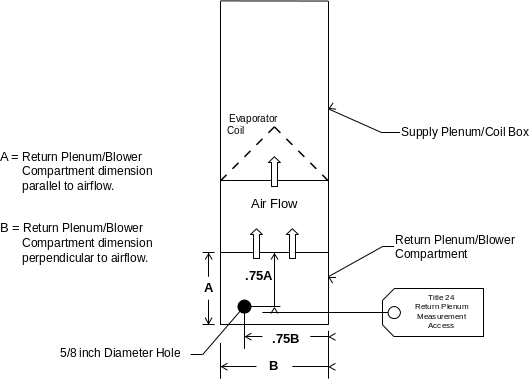
Figure RA3.2-1 Measurement Access Hole
The accuracy of instrumentation shall be maintained using the following procedures. A sticker with the calibration check date shall be affixed to each instrument calibrated.
Thermometers with their temperature sensors shall be calibrated monthly to ensure that they are reading accurate temperatures.
The following procedure shall be used to check thermometer/temperature sensor calibration:
- Fill an insulated cup (foam) with crushed ice from distilled water. The ice shall completely fill the cup. Add distilled water to fill the cup.
- Insert two sensors into the center of the ice bath and attach them to the digital thermometer.
- Let the temperatures stabilize. The temperatures shall be 32 degrees Fahrenheit (plus or minus 1 degrees Fahrenheit). If the temperature is off by more than 1 degrees Fahrenheit make corrections according to the manufacturer’s instructions. Any sensors that are off by more than 2 degrees Fahrenheit shall be replaced.
- Switch the sensors and ensure that the temperatures read on both channels are still within plus or minus 1 degrees Fahrenheit of 32 degrees Fahrenheit.
- Affix sticker with calibration check date onto sensor.
- Repeat the process for all sensors.
Refrigerant gauges shall be checked monthly to ensure that the gauges are reading the correct pressures and corresponding temperatures. The following procedure shall be used to check gauge calibration:
- Place a refrigerant cylinder in a stable temperature environment and let it acclimate for 4 hours minimum to stabilize to the ambient conditions.
- Attach a calibrated temperature sensor to the refrigerant cylinder using tape so that there is good contact between the cylinder and the temperature sensor.
- Insulate over the temperature sensor connection to the cylinder.
- Zero the low side and high side refrigerant gauges with all ports open to atmospheric pressure (no hoses attached).
- Re-install the hoses, attach the high side gauge to the refrigerant cylinder, and open the valves to measure the pressure in the refrigerant cylinder.
- Read the temperature of the sensor on the refrigerant cylinder.
- Using a pressure/temperature chart for the refrigerant, look up the pressure that corresponds to the temperature measured.
- If gauge does not read the correct pressure corresponding to the temperature, the gauge is out of calibration and needs to be recalibrated.
- Close the valve to the refrigerant cylinder, and bleed off a small amount of refrigerant to lower the high side pressure to give a corresponding temperature to between 45°F and 55°F.
- Open the valves between the high side gauge and low side gauge.
- If the two gauges corresponding refrigerant temperatures do not read within 1°F of each other, the low side gauge is out of calibration and needs to be recalibrated.
- Affix sticker with calibration check date onto refrigerant gauge.
Digital hygrometers shall be calibrated according to the manufacturer's recommended procedures. When the manufacturer certifies the calibration for a limited time, the digital hygrometer shall be recalibrated according to the manufacturers required procedure when the calibration period expires.
The following procedure shall be used to obtain measurements necessary to verify the required refrigerant charge.
-
Follow the manufacturer’s directions and adhere to the manufacturer's limitations on indoor ambient air temperature (Tindoor air) and outdoor ambient air temperature (Toutdoor air) applicable to this procedure. Ensure that the return air dry bulb temperature remains equal to or greater than 70°F prior to and while performing the measurements.
-
Verify that a liquid line filter drier has been installed if required per outdoor condensing unit manufacturer's instructions, and installed with the proper orientation with respect to refrigerant flow, if applicable.
-
Connect the refrigerant gauges to the service ports, taking normal precautions to not introduce air into the system.
-
Attach one pipe temperature sensor to the suction line near the suction line (low side) service valve and attach one pipe temperature sensor to the liquid line near the liquid line (high side) service valve. The sensors should be positioned to make good contact with the surface of the refrigerant line.
-
Attach a temperature sensor to measure the condenser entering air dry-bulb temperature. The sensor shall be placed so that it records the average condenser air entering temperature and is shaded from direct sun.
-
Insert a dry-bulb temperature sensor into the return plenum at the "Title 24 – Return Plenum Measurement Access" detailed in Section RA3.2.2.3.
-
Be sure that all cabinet panels that affect airflow are in place before making measurements. The temperature sensors shall remain attached to the system until the final charge is determined.
-
Operate the air conditioner in cooling mode for 15 minutes to allow the temperatures and pressures to stabilize before taking any measurements. While the system is stabilizing, proceed with setting up the remaining temperature sensors if used.
-
If used, place the cotton wick wet-bulb temperature sensor in distilled water, and ensure it is saturated. Do not get the dry-bulb temperature sensors wet.
-
If the system has a fixed metering device, at 12 minutes, insert a wet-bulb temperature sensor into the return plenum at the "Title 24 – Return Plenum Measurement Access" detailed in Section RA3.2.2.3.
-
If the system has a fixed metering device, after the system has operated for 15 minutes, and when the return plenum wet-bulb temperature has stabilized, using the temperature sensor already in place, measure and record the return (evaporator entering) air wet-bulb temperature (Treturn, wb).
-
Using the temperature sensor already in place, measure and record the return (evaporator entering) air dry-bulb temperature (Treturn, db).
-
Using the refrigerant gauge or saturation pressure measurement sensor already attached, measure and record the suction line (low side) pressure, and record the refrigerant saturation temperature corresponding to the measured low side pressure (Tevaporator, sat).
-
Using the refrigerant gauge or saturation pressure measurement sensor already attached, measure and record the liquid line (high side) pressure, and record the refrigerant saturation temperature corresponding to the measured high side pressure (Tcondenser, sat).
-
Using the pipe temperature sensor already in place, measure and record the suction line temperature (Tsuction,).
-
Using the pipe temperature sensor already in place, measure and record the liquid line temperature (Tliquid).
-
Using the dry-bulb temperature sensor already in place, measure and record the condenser (entering) air dry-bulb temperature (Tcondenser, db).
The above measurements shall be used to verify the refrigerant charge as described in following sections.
The following steps describe the calculations to determine if the system meets the required refrigerant charge and metering device function using the measurements determined in Section RA3.2.2.5. If a system fails, then remedial actions must be taken by the HVAC system installer. Be sure to run the air conditioner for 15 minutes after the final adjustments before taking any measurements.
The Superheat Charging Method is used only for systems equipped with fixed metering devices. These include capillary tubes and piston-type metering devices.
- Calculate Actual Superheat as the suction line temperature minus the evaporator saturation temperature.
Actual Superheat = Tsuction, – Tevaporator, sat - Determine and record the Target Superheat using Table RA3.2-2 or the manufacturer's superheat chart using the return air wet-bulb temperature (Treturn, wb) and condenser air dry-bulb temperature (Tcondenser, db).
- If a dash mark is read from Table RA3.2-2, the target superheat is less than 5°F. Note that a valid refrigerant charge verification test cannot be performed under these conditions. A severely undercharged unit will show over 9°F of superheat. However overcharged units cannot be detected from the superheat method under these conditions. The usual reason for a target superheat determination of less than 5°F is that outdoor conditions are too hot, and the indoor conditions are too cool. One of the following is needed so a target superheat value can be obtained from Table RA3.2-2 either 1) turn on the space heating system and/or open the windows to warm up indoor temperature; or 2) retest at another time when conditions are different.
- Calculate the difference between actual superheat and target superheat (Actual Superheat - Target Superheat).
- In order to allow for inevitable differences in measurements, the Pass/Fail criteria are different for the Installer and the ECC-Rater.
- For the Installer, if the difference is within the tolerance given as compliance criteria in Table RA3.2-1, then the system passes the required refrigerant charge criterion.
- For the ECC-Rater inspecting the system, if the difference is within the criteria in Table RA3.2-1, then the system passes the required refrigerant charge criterion.
- For the Installer, if the system fails to meet the criteria, refrigerant needs to be added if the superheat is too high and refrigerant needs to be removed if it is too low. The installer needs to remain aware of other potential system faults. Adjust refrigerant charge and check the measurements as many times as necessary to pass the test. After the final adjustment has been made, allow the system to run 15 minutes before completing the final measurement procedure.
The Subcooling Charging Method is used for systems equipped with variable metering devices. These include Thermostatic Expansion Valves (TXV) and Electronic Expansion Valves (EXV). The amount of refrigerant is set based on the measured subcooling value, and the measured superheat value determines whether the metering device is working properly.
- Calculate Actual Subcooling as the condenser saturation temperature minus the liquid line temperature. Actual Subcooling = Tcondenser, sat – Tliquid.
- Determine the Target Subcooling specified by the manufacturer.
- Calculate the deviation of the actual subcooling value from the target subcooling value. Subcooling Deviation = Actual Subcooling - Target Subcooling.
In order to allow for inevitable differences in measurements, the Pass/Fail criteria are different for the Installer than for the ECC Rater. - If the Subcooling Deviation is within the subcooling tolerance allowed by Table RA3.2-1, then the system complies with the subcooling criterion, otherwise the system does not comply.
- For the HVAC installer, if the system does not comply, and if the Actual Subcooling value is greater than the Target Subcooling value, the Installer shall remove refrigerant. If the Actual Subcooling value is less than the Target Subcooling value, the Installer shall add refrigerant. The Installer shall determine whether there are other system faults that may affect the validity of the refrigerant charge verification procedure, and make any needed system repairs or adjustments to clear system faults prior to completion of the refrigerant charge verification procedure. The Installer shall adjust the refrigerant charge and check the measurements as many times as necessary to pass the test. After the final adjustment has been made, the Installer shall allow the system to run 15 minutes before completing the final measurement procedure.
- Calculate Actual Superheat as the suction line temperature minus the evaporator saturation temperature. Actual Superheat = Tsuction, – Tevaporator, sat.
- If possible, determine the Superheat Range specified by the manufacturer.
- In order to allow for inevitable differences in measurements, the Pass/Fail criteria are different for the Installer than for the ECC-Rater.
If the superheat is within the tolerance allowed by Table RA3.2-1, then the system complies with the metering device criterion, otherwise the system does not comply.
For the HVAC installer, if the system does not comply remedial actions must be undertaken to ensure the TXV or EXV is operating properly.
This section specifies the weigh-in charging procedure in which the weight of the required refrigerant charge is determined by using the manufacturer's specifications for a standard refrigerant charge weight and taking into account adjustment factors such as deviations in refrigerant line length and diameter. The calculated weight of refrigerant is then installed using a refrigerant scale. RA3.2.3 provides two procedures: Section RA3.2.3.1 shall be used by the HVAC installer when the weigh-in procedure is required by the Standards for compliance. Section RA3.2.3.2 shall be used by the ECC-Rater when the Standards specify use of the procedure for compliance or specify it as an optional procedure for compliance. The weigh-in charging procedure is an acceptable method for demonstrating compliance at any outdoor temperature, however if the weigh-in charging procedure is used, verification of compliance cannot use group sampling.
HVAC installers shall use the weigh-in charging procedure in accordance with the space conditioning system manufacturer’s specifications.
Both the HVAC installer and the ECC-Rater shall test the system airflow as specified by Standards Sections 150.1(c)7Aib and 150.2(b)1Fiia as applicable.
Split system air conditioners and heat pumps are shipped from the factory charged with a standard amount of refrigerant as indicated on the nameplate. The manufacturer-supplied refrigerant charge is expected to be the correct amount for the system based on a standard liquid line length and diameter. It is the responsibility of the HVAC installer to ensure that the charge is correct for each air conditioner and to adjust the charge based on liquid line dimensions that deviate from the manufacturer's standard line specification.
There shall be two options for compliance using the weigh-in charging procedure:
This option is applicable to a new system or existing system when a new outdoor unit is installed (with factory charge in outdoor unit). The HVAC installer shall weigh in lineset and indoor coil charge adjustment after evacuation of lineset and indoor coil. The documentation shall include the calculated charge adjustment for the lineset.
This option is applicable to all systems. The installer shall weigh in the total system charge after refrigerant recovery and evacuation of the entire system. The total system charge includes the nameplate charge for the outdoor unit and any adjustment for the lineset dimensions and indoor coil in accordance with the manufacturer’s instructions. The documentation shall include the nameplate charge and the calculated lineset adjustment.
Persons who use this procedure to demonstrate compliance with Title 24, Part 6 shall be qualified to perform the following:
- Calculate the correct system charge based on the Manufacturer's standard charge and adjustments to the standard charge based on lineset dimensions and indoor coil.
- Obtain accurate refrigerant charge weight.
Instrumentation for the procedures described in this section shall conform to the following specifications:
An electronic refrigerant scale having an accuracy equal to or better than ±0.5 oz or ± 0.5% of the measured value shall be used.
The accuracy of instrumentation shall be maintained using the following procedures. A sticker with the calibration check date shall be affixed to each instrument calibrated.
Refrigerant scales shall be calibrated according to the manufacturer's recommended procedures. When the manufacturer certifies the calibration for a limited time, the refrigerant scale shall be recalibrated according to the manufacturers required procedure when the calibration period expires.
The weigh-in procedure shall be performed in accordance with all manufacturer specifications to document and confirm:
- Liquid line filter drier has been installed if required per outdoor condensing unit manufacturer's instructions, and installed with the proper orientation with respect to refrigerant flow.
- If refrigerant line connections require welding, the system is braised with dry nitrogen in the lines and indoor coil.
- In all cases where the OEM instructions call for checking for gas leaks with vacuum, the system is evacuated to 500 microns or less and, when isolated, rises no more than 300 microns over five minutes.
- In all cases where the OEM instructions call for checking for gas leaks with nitrogen gas, the system is pressurized to the manufacturer’s specified pressure and if the pressure cannot be maintained, leaks shall be located and fixed.
- The calculated weight adjustment for lineset length is based on the length and diameter of the lineset.
- The calculated weight adjustment for coil size is based on manufacturer instructions.
- The actual total weight adjustment is equal to the sum of the calculated weight adjustments for lineset and coil size.
- The calculated and actual total weights of refrigerant in the system are recorded on or near the nameplate label, in indelible ink or other permanent means.
The HVAC Installer shall certify on the Certificate of Installation that the manufacturer's specifications for these procedures have been met. This shall be verified through on-site observation using procedures in RA 3.2.3.2.
When the Standards indicate this procedure is required, or is an option for compliance, the ECC-Rater shall coordinate with the HVAC Installer to observe the weigh-in charging procedure.
ECC-Rater shall observe and confirm:
- Observe and confirm Vacuum and Pressurization tests:
- In all cases where the OEM instructions call for checking for gas leaks with vacuum, the system is evacuated to 500 microns or less and, when isolated, rises no more than 300 microns over five minutes.
- In all cases where the OEM instructions call for checking for gas leaks with nitrogen gas, the system was pressurized to the manufacturer’s specified pressure and if the pressure could not be maintained, leaks were located and fixed.
- No fittings (other than the fitting to the compressor) are compression or flare fittings.
Return Air Wet-Bulb Temperature (°F) (T return, wb)
Condenser Air Dry-Bulb Temperature (°F)(T cond., db) | 50 | 51 | 52 | 53 | 54 | 55 | 56 | 57 | 58 | 59 | 60 | 61 | 62 | 63 | 64 | 65 | 66 | 67 | 68 | 69 | 70 | 71 | 72 | 73 | 74 | 75 | 76 |
55 | 8.8 | 10.1 | 11.5 | 12.8 | 14.2 | 15.6 | 17.1 | 18.5 | 20.0 | 21.5 | 23.1 | 24.6 | 26.2 | 27.8 | 29.4 | 31.0 | 32.4 | 33.8 | 35.1 | 36.4 | 37.7 | 39.0 | 40.2 | 41.5 | 42.7 | 43.9 | 45.0 |
56 | 8.6 | 9.9 | 11.2 | 12.6 | 14.0 | 15.4 | 16.8 | 18.2 | 19.7 | 21.2 | 22.7 | 24.2 | 25.7 | 27.3 | 28.9 | 30.5 | 31.8 | 33.2 | 34.6 | 35.9 | 37.2 | 38.5 | 39.7 | 41.0 | 42.2 | 43.4 | 44.6 |
57 | 8.3 | 9.6 | 11.0 | 12.3 | 13.7 | 15.1 | 16.5 | 17.9 | 19.4 | 20.8 | 22.3 | 23.8 | 25.3 | 26.8 | 28.3 | 29.9 | 31.3 | 32.6 | 34.0 | 35.3 | 36.7 | 38.0 | 39.2 | 40.5 | 41.7 | 43.0 | 44.2 |
58 | 7.9 | 9.3 | 10.6 | 12.0 | 13.4 | 14.8 | 16.2 | 17.6 | 19.0 | 20.4 | 21.9 | 23.3 | 24.8 | 26.3 | 27.8 | 29.3 | 30.7 | 32.1 | 33.5 | 34.8 | 36.1 | 37.5 | 38.7 | 40.0 | 41.3 | 42.5 | 43.7 |
59 | 7.5 | 8.9 | 10.2 | 11.6 | 13.0 | 14.4 | 15.8 | 17.2 | 18.6 | 20.0 | 21.4 | 22.9 | 24.3 | 25.7 | 27.2 | 28.7 | 30.1 | 31.5 | 32.9 | 34.3 | 35.6 | 36.9 | 38.3 | 39.5 | 40.8 | 42.1 | 43.3 |
60 | 7.0 | 8.4 | 9.8 | 11.2 | 12.6 | 14.0 | 15.4 | 16.8 | 18.2 | 19.6 | 21.0 | 22.4 | 23.8 | 25.2 | 26.6 | 28.1 | 29.6 | 31.0 | 32.4 | 33.7 | 35.1 | 36.4 | 37.8 | 39.1 | 40.4 | 41.6 | 42.9 |
61 | 6.5 | 7.9 | 9.3 | 10.7 | 12.1 | 13.5 | 14.9 | 16.3 | 17.7 | 19.1 | 20.5 | 21.9 | 23.3 | 24.7 | 26.1 | 27.5 | 29.0 | 30.4 | 31.8 | 33.2 | 34.6 | 35.9 | 37.3 | 38.6 | 39.9 | 41.2 | 42.4 |
62 | 6.0 | 7.4 | 8.8 | 10.2 | 11.7 | 13.1 | 14.5 | 15.9 | 17.3 | 18.7 | 20.1 | 21.4 | 22.8 | 24.2 | 25.5 | 27.0 | 28.4 | 29.9 | 31.3 | 32.7 | 34.1 | 35.4 | 36.8 | 38.1 | 39.4 | 40.7 | 42.0 |
63 | 5.3 | 6.8 | 8.3 | 9.7 | 11.1 | 12.6 | 14.0 | 15.4 | 16.8 | 18.2 | 19.6 | 20.9 | 22.3 | 23.6 | 25.0 | 26.4 | 27.8 | 29.3 | 30.7 | 32.2 | 33.6 | 34.9 | 36.3 | 37.7 | 39.0 | 40.3 | 41.6 |
64 | - | 6.1 | 7.6 | 9.1 | 10.6 | 12.0 | 13.5 | 14.9 | 16.3 | 17.7 | 19.0 | 20.4 | 21.7 | 23.1 | 24.4 | 25.8 | 27.3 | 28.7 | 30.2 | 31.6 | 33.0 | 34.4 | 35.8 | 37.2 | 38.5 | 39.9 | 41.2 |
65 | - | 5.4 | 7.0 | 8.5 | 10.0 | 11.5 | 12.9 | 14.3 | 15.8 | 17.1 | 18.5 | 19.9 | 21.2 | 22.5 | 23.8 | 25.2 | 26.7 | 28.2 | 29.7 | 31.1 | 32.5 | 33.9 | 35.3 | 36.7 | 38.1 | 39.4 | 40.8 |
66 | - | 6.3 | 7.8 | 9.3 | 10.8 | 12.3 | 13.8 | 15.2 | 16.6 | 18.0 | 19.3 | 20.7 | 22.0 | 23.2 | 24.6 | 26.1 | 27.6 | 29.1 | 30.6 | 32.0 | 33.4 | 34.9 | 36.3 | 37.6 | 39.0 | 40.4 | |
67 | - | - | 5.5 | 7.1 | 8.7 | 10.2 | 11.7 | 13.2 | 14.6 | 16.0 | 17.4 | 18.8 | 20.1 | 21.4 | 22.7 | 24.1 | 25.6 | 27.1 | 28.6 | 30.1 | 31.5 | 33.0 | 34.4 | 35.8 | 37.2 | 38.6 | 39.9 |
68 | - | - | - | 6.3 | 8.0 | 9.5 | 11.1 | 12.6 | 14.0 | 15.5 | 16.8 | 18.2 | 19.5 | 20.8 | 22.1 | 23.5 | 25.0 | 26.5 | 28.0 | 29.5 | 31.0 | 32.5 | 33.9 | 35.3 | 36.8 | 38.1 | 39.5 |
69 | - | - | - | 5.5 | 7.2 | 8.8 | 10.4 | 11.9 | 13.4 | 14.8 | 16.3 | 17.6 | 19.0 | 20.3 | 21.5 | 22.9 | 24.4 | 26.0 | 27.5 | 29.0 | 30.5 | 32.0 | 33.4 | 34.9 | 36.3 | 37.7 | 39.1 |
70 | - | - | - | - | 6.4 | 8.1 | 9.7 | 11.2 | 12.7 | 14.2 | 15.7 | 17.0 | 18.4 | 19.7 | 20.9 | 22.3 | 23.9 | 25.4 | 27.0 | 28.5 | 30.0 | 31.5 | 33.0 | 34.4 | 35.9 | 37.3 | 38.7 |
71 | - | - | - | - | 5.6 | 7.3 | 8.9 | 10.5 | 12.1 | 13.6 | 15.0 | 16.4 | 17.8 | 19.1 | 20.3 | 21.7 | 23.3 | 24.9 | 26.4 | 28.0 | 29.5 | 31.0 | 32.5 | 34.0 | 35.4 | 36.9 | 38.3 |
72 | - | - | - | - | - | 6.4 | 8.1 | 9.8 | 11.4 | 12.9 | 14.4 | 15.8 | 17.2 | 18.5 | 19.7 | 21.2 | 22.8 | 24.3 | 25.9 | 27.4 | 29.0 | 30.5 | 32.0 | 33.5 | 35.0 | 36.5 | 37.9 |
73 | - | - | - | - | - | 5.6 | 7.3 | 9.0 | 10.7 | 12.2 | 13.7 | 15.2 | 16.6 | 17.9 | 19.2 | 20.6 | 22.2 | 23.8 | 25.4 | 26.9 | 28.5 | 30.0 | 31.5 | 33.1 | 34.6 | 36.0 | 37.5 |
74 | - | - | - | - | - | - | 6.5 | 8.2 | 9.9 | 11.5 | 13.1 | 14.5 | 15.9 | 17.3 | 18.6 | 20.0 | 21.6 | 23.2 | 24.8 | 26.4 | 28.0 | 29.5 | 31.1 | 32.6 | 34.1 | 35.6 | 37.1 |
75 | - | - | - | - | - | - | 5.6 | 7.4 | 9.2 | 10.8 | 12.4 | 13.9 | 15.3 | 16.7 | 18.0 | 19.4 | 21.1 | 22.7 | 24.3 | 25.9 | 27.5 | 29.1 | 30.6 | 32.2 | 33.7 | 35.2 | 36.7 |
76 | - | - | - | - | - | - | - | 6.6 | 8.4 | 10.1 | 11.7 | 13.2 | 14.7 | 16.1 | 17.4 | 18.9 | 20.5 | 22.1 | 23.8 | 25.4 | 27.0 | 28.6 | 30.1 | 31.7 | 33.3 | 34.8 | 36.3 |
77 | - | - | - | - | - | - | - | 5.7 | 7.5 | 9.3 | 11.0 | 12.5 | 14.0 | 15.4 | 16.8 | 18.3 | 20.0 | 21.6 | 23.2 | 24.9 | 26.5 | 28.1 | 29.7 | 31.3 | 32.8 | 34.4 | 36.0 |
78 | - | - | - | - | - | - | - | - | 6.7 | 8.5 | 10.2 | 11.8 | 13.4 | 14.8 | 16.2 | 17.7 | 19.4 | 21.1 | 22.7 | 24.4 | 26.0 | 27.6 | 29.2 | 30.8 | 32.4 | 34.0 | 35.6 |
79 | - | - | - | - | - | - | - | - | 5.9 | 7.7 | 9.5 | 11.1 | 12.7 | 14.2 | 15.6 | 17.1 | 18.8 | 20.5 | 22.2 | 23.8 | 25.5 | 27.1 | 28.8 | 30.4 | 32.0 | 33.6 | 35.2 |
80 | - | - | - | - | - | - | - | - | - | 6.9 | 8.7 | 10.4 | 12.0 | 13.5 | 15.0 | 16.6 | 18.3 | 20.0 | 21.7 | 23.3 | 25.0 | 26.7 | 28.3 | 29.9 | 31.6 | 33.2 | 34.8 |
81 | - | - | - | - | - | - | - | - | - | 6.0 | 7.9 | 9.7 | 11.3 | 12.9 | 14.3 | 16.0 | 17.7 | 19.4 | 21.1 | 22.8 | 24.5 | 26.2 | 27.9 | 29.5 | 31.2 | 32.8 | 34.4 |
82 | - | - | - | - | - | - | - | - | - | 5.2 | 7.1 | 8.9 | 10.6 | 12.2 | 13.7 | 15.4 | 17.2 | 18.9 | 20.6 | 22.3 | 24.0 | 25.7 | 27.4 | 29.1 | 30.7 | 32.4 | 34.0 |
83 | - | - | - | - | - | - | - | - | - | - | 6.3 | 8.2 | 9.9 | 11.6 | 13.1 | 14.9 | 16.6 | 18.4 | 20.1 | 21.8 | 23.5 | 25.2 | 26.9 | 28.6 | 30.3 | 32.0 | 33.7 |
84 | - | - | - | - | - | - | - | - | - | - | 5.5 | 7.4 | 9.2 | 10.9 | 12.5 | 14.3 | 16.1 | 17.8 | 19.6 | 21.3 | 23.0 | 24.8 | 26.5 | 28.2 | 29.9 | 31.6 | 33.3 |
85 | - | - | - | - | - | - | - | - | - | - | - | 6.6 | 8.5 | 10.3 | 11.9 | 13.7 | 15.5 | 17.3 | 19.0 | 20.8 | 22.6 | 24.3 | 26.0 | 27.8 | 29.5 | 31.2 | 32.9 |
86 | - | - | - | - | - | - | - | - | - | - | - | 5.8 | 7.8 | 9.6 | 11.3 | 13.2 | 15.0 | 16.7 | 18.5 | 20.3 | 22.1 | 23.8 | 25.6 | 27.3 | 29.1 | 30.8 | 32.6 |
87 | - | - | - | - | - | - | - | - | - | - | - | 5.0 | 7.0 | 8.9 | 10.6 | 12.6 | 14.4 | 16.2 | 18.0 | 19.8 | 21.6 | 23.4 | 25.1 | 26.9 | 28.7 | 30.4 | 32.2 |
88 | - | - | - | - | - | - | - | - | - | - | - | - | 6.3 | 8.2 | 10.0 | 12.0 | 13.9 | 15.7 | 17.5 | 19.3 | 21.1 | 22.9 | 24.7 | 26.5 | 28.3 | 30.1 | 31.8 |
89 | - | - | - | - | - | - | - | - | - | - | - | - | 5.5 | 7.5 | 9.4 | 11.5 | 13.3 | 15.1 | 17.0 | 18.8 | 20.6 | 22.4 | 24.3 | 26.1 | 27.9 | 29.7 | 31.5 |
Table RA3.2-2 Target Superheat (Suction Line Temperature - Evaporator Saturation Temperature)
Return Air Wet-Bulb Temperature (°F) (T return, wb)
Condenser Air Dry-Bulb Temperature (°F)(T cond., db) | 50 | 51 | 52 | 53 | 54 | 55 | 56 | 57 | 58 | 59 | 60 | 61 | 62 | 63 | 64 | 65 | 66 | 67 | 68 | 69 | 70 | 71 | 72 | 73 | 74 | 75 | 76 |
90 | - | - | - | - | - | - | - | - | - | - | - | - | - | 6.8 | 8.8 | 10.9 | 12.8 | 14.6 | 16.5 | 18.3 | 20.1 | 22.0 | 23.8 | 25.6 | 27.5 | 29.3 | 31.1 |
91 | - | - | - | - | - | - | - | - | - | - | - | - | - | 6.1 | 8.1 | 10.3 | 12.2 | 14.1 | 15.9 | 17.8 | 19.7 | 21.5 | 23.4 | 25.2 | 27.1 | 28.9 | 30.8 |
92 | - | - | - | - | - | - | - | - | - | - | - | - | - | 5.4 | 7.5 | 9.8 | 11.7 | 13.5 | 15.4 | 17.3 | 19.2 | 21.1 | 22.9 | 24.8 | 26.7 | 28.5 | 30.4 |
93 | - | - | - | - | - | - | - | - | - | - | - | - | - | - | 6.8 | 9.2 | 11.1 | 13.0 | 14.9 | 16.8 | 18.7 | 20.6 | 22.5 | 24.4 | 26.3 | 28.2 | 30.1 |
94 | - | - | - | - | - | - | - | - | - | - | - | - | - | - | 6.2 | 8.7 | 10.6 | 12.5 | 14.4 | 16.3 | 18.2 | 20.2 | 22.1 | 24.0 | 25.9 | 27.8 | 29.7 |
95 | - | - | - | - | - | - | - | - | - | - | - | - | - | - | 5.6 | 8.1 | 10.0 | 12.0 | 13.9 | 15.8 | 17.8 | 19.7 | 21.6 | 23.6 | 25.5 | 27.4 | 29.4 |
96 | - | - | - | - | - | - | - | - | - | - | - | - | - | - | - | 7.5 | 9.5 | 11.4 | 13.4 | 15.3 | 17.3 | 19.2 | 21.2 | 23.2 | 25.1 | 27.1 | 29.0 |
97 | - | - | - | - | - | - | - | - | - | - | - | - | - | - | - | 7.0 | 8.9 | 10.9 | 12.9 | 14.9 | 16.8 | 18.8 | 20.8 | 22.7 | 24.7 | 26.7 | 28.7 |
98 | - | - | - | - | - | - | - | - | - | - | - | - | - | - | - | 6.4 | 8.4 | 10.4 | 12.4 | 14.4 | 16.4 | 18.3 | 20.3 | 22.3 | 24.3 | 26.3 | 28.3 |
99 | - | - | - | - | - | - | - | - | - | - | - | - | - | - | - | 5.8 | 7.9 | 9.9 | 11.9 | 13.9 | 15.9 | 17.9 | 19.9 | 21.9 | 24.0 | 26.0 | 28.0 |
100 | - | - | - | - | - | - | - | - | - | - | - | - | - | - | - | 5.3 | 7.3 | 9.3 | 11.4 | 13.4 | 15.4 | 17.5 | 19.5 | 21.5 | 23.6 | 25.6 | 27.7 |
101 | - | - | - | - | - | - | - | - | - | - | - | - | - | - | - | - | 6.8 | 8.8 | 10.9 | 12.9 | 15.0 | 17.0 | 19.1 | 21.1 | 23.2 | 25.3 | 27.3 |
102 | - | - | - | - | - | - | - | - | - | - | - | - | - | - | - | - | 6.2 | 8.3 | 10.4 | 12.4 | 14.5 | 16.6 | 18.6 | 20.7 | 22.8 | 24.9 | 27.0 |
103 | - | - | - | - | - | - | - | - | - | - | - | - | - | - | - | - | 5.7 | 7.8 | 9.9 | 11.9 | 14.0 | 16.1 | 18.2 | 20.3 | 22.4 | 24.5 | 26.7 |
104 | - | - | - | - | - | - | - | - | - | - | - | - | - | - | - | - | 5.2 | 7.2 | 9.3 | 11.5 | 13.6 | 15.7 | 17.8 | 19.9 | 22.1 | 24.2 | 26.3 |
Table RA3.2-2 Target Superheat (Suction Line Temperature - Evaporator Saturation Temperature)
Return Air Wet-Bulb Temperature (°F) (T return, wb)
Condenser Air Dry-Bulb Temperature (°F)(T cond., db) | 50 | 51 | 52 | 53 | 54 | 55 | 56 | 57 | 58 | 59 | 60 | 61 | 62 | 63 | 64 | 65 | 66 | 67 | 68 | 69 | 70 | 71 | 72 | 73 | 74 | 75 | 76 |
90 | - | - | - | - | - | - | - | - | - | - | - | - | - | 6.8 | 8.8 | 10.9 | 12.8 | 14.6 | 16.5 | 18.3 | 20.1 | 22.0 | 23.8 | 25.6 | 27.5 | 29.3 | 31.1 |
91 | - | - | - | - | - | - | - | - | - | - | - | - | - | 6.1 | 8.1 | 10.3 | 12.2 | 14.1 | 15.9 | 17.8 | 19.7 | 21.5 | 23.4 | 25.2 | 27.1 | 28.9 | 30.8 |
92 | - | - | - | - | - | - | - | - | - | - | - | - | - | 5.4 | 7.5 | 9.8 | 11.7 | 13.5 | 15.4 | 17.3 | 19.2 | 21.1 | 22.9 | 24.8 | 26.7 | 28.5 | 30.4 |
93 | - | - | - | - | - | - | - | - | - | - | - | - | - | - | 6.8 | 9.2 | 11.1 | 13.0 | 14.9 | 16.8 | 18.7 | 20.6 | 22.5 | 24.4 | 26.3 | 28.2 | 30.1 |
94 | - | - | - | - | - | - | - | - | - | - | - | - | - | - | 6.2 | 8.7 | 10.6 | 12.5 | 14.4 | 16.3 | 18.2 | 20.2 | 22.1 | 24.0 | 25.9 | 27.8 | 29.7 |
95 | - | - | - | - | - | - | - | - | - | - | - | - | - | - | 5.6 | 8.1 | 10.0 | 12.0 | 13.9 | 15.8 | 17.8 | 19.7 | 21.6 | 23.6 | 25.5 | 27.4 | 29.4 |
96 | - | - | - | - | - | - | - | - | - | - | - | - | - | - | - | 7.5 | 9.5 | 11.4 | 13.4 | 15.3 | 17.3 | 19.2 | 21.2 | 23.2 | 25.1 | 27.1 | 29.0 |
97 | - | - | - | - | - | - | - | - | - | - | - | - | - | - | - | 7.0 | 8.9 | 10.9 | 12.9 | 14.9 | 16.8 | 18.8 | 20.8 | 22.7 | 24.7 | 26.7 | 28.7 |
98 | - | - | - | - | - | - | - | - | - | - | - | - | - | - | - | 6.4 | 8.4 | 10.4 | 12.4 | 14.4 | 16.4 | 18.3 | 20.3 | 22.3 | 24.3 | 26.3 | 28.3 |
99 | - | - | - | - | - | - | - | - | - | - | - | - | - | - | - | 5.8 | 7.9 | 9.9 | 11.9 | 13.9 | 15.9 | 17.9 | 19.9 | 21.9 | 24.0 | 26.0 | 28.0 |
100 | - | - | - | - | - | - | - | - | - | - | - | - | - | - | - | 5.3 | 7.3 | 9.3 | 11.4 | 13.4 | 15.4 | 17.5 | 19.5 | 21.5 | 23.6 | 25.6 | 27.7 |
101 | - | - | - | - | - | - | - | - | - | - | - | - | - | - | - | - | 6.8 | 8.8 | 10.9 | 12.9 | 15.0 | 17.0 | 19.1 | 21.1 | 23.2 | 25.3 | 27.3 |
102 | - | - | - | - | - | - | - | - | - | - | - | - | - | - | - | - | 6.2 | 8.3 | 10.4 | 12.4 | 14.5 | 16.6 | 18.6 | 20.7 | 22.8 | 24.9 | 27.0 |
103 | - | - | - | - | - | - | - | - | - | - | - | - | - | - | - | - | 5.7 | 7.8 | 9.9 | 11.9 | 14.0 | 16.1 | 18.2 | 20.3 | 22.4 | 24.5 | 26.7 |
104 | - | - | - | - | - | - | - | - | - | - | - | - | - | - | - | - | 5.2 | 7.2 | 9.3 | 11.5 | 13.6 | 15.7 | 17.8 | 19.9 | 22.1 | 24.2 | 26.3 |
105 | - | - | - | - | - | - | - | - | - | - | - | - | - | - | - | - | - | 6.7 | 8.8 | 11.0 | 13.1 | 15.2 | 17.4 | 19.5 | 21.7 | 23.8 | 26.0 |
106 | - | - | - | - | - | - | - | - | - | - | - | - | - | - | - | - | - | 6.2 | 8.3 | 10.5 | 12.6 | 14.8 | 17.0 | 19.1 | 21.3 | 23.5 | 25.7 |
107 | - | - | - | - | - | - | - | - | - | - | - | - | - | - | - | - | - | 5.7 | 7.9 | 10.0 | 12.2 | 14.4 | 16.6 | 18.7 | 21.0 | 23.2 | 25.4 |
108 | - | - | - | - | - | - | - | - | - | - | - | - | - | - | - | - | - | 5.2 | 7.4 | 9.5 | 11.7 | 13.9 | 16.1 | 18.4 | 20.6 | 22.8 | 25.1 |
109 | - | - | - | - | - | - | - | - | - | - | - | - | - | - | - | - | - | - | 6.9 | 9.1 | 11.3 | 13.5 | 15.7 | 18.0 | 20.2 | 22.5 | 24.7 |
110 | - | - | - | - | - | - | - | - | - | - | - | - | - | - | - | - | - | - | 6.4 | 8.6 | 10.8 | 13.1 | 15.3 | 17.6 | 19.9 | 22.1 | 24.4 |
111 | - | - | - | - | - | - | - | - | - | - | - | - | - | - | - | - | - | - | 5.9 | 8.1 | 10.4 | 12.6 | 14.9 | 17.2 | 19.5 | 21.8 | 24.1 |
112 | - | - | - | - | - | - | - | - | - | - | - | - | - | - | - | - | - | - | 5.4 | 7.6 | 9.9 | 12.2 | 14.5 | 16.8 | 19.1 | 21.5 | 23.8 |
113 | - | - | - | - | - | - | - | - | - | - | - | - | - | - | - | - | - | - | - | 7.2 | 9.5 | 11.8 | 14.1 | 16.4 | 18.8 | 21.1 | 23.5 |
114 | - | - | - | - | - | - | - | - | - | - | - | - | - | - | - | - | - | - | - | 6.7 | 9.0 | 11.4 | 13.7 | 16.1 | 18.4 | 20.8 | 23.2 |
115 | - | - | - | - | - | - | - | - | - | - | - | - | - | - | - | - | - | - | - | 6.2 | 8.6 | 10.9 | 13.3 | 15.7 | 18.1 | 20.5 | 22.9 |
RA3.3 contains procedures for:
- Verification of improved system airflow rate (cfm) in ducted split system and packaged space conditioning systems serving single-family and multifamily residential buildings.
- Verification of reduced fan power (Watt) draw achieved through improved air distribution system design, including more efficient motors and ducts that have less resistance to airflow.
- Determination of fan efficacy (Watt/cfm) utilizing simultaneous measurement of system Watt draw and airflow rate.
The instrumentation for the diagnostic measurements shall conform to the following specifications:
All pressure measurements shall be performed with measurement systems (i.e., sensor plus data acquisition system) having an accuracy of ± 1% of pressure reading or ± 0.2 Pa (.0008 inches water) (whichever is greater). All pressure measurements within the duct system shall be made with static pressure probes such as Dwyer A303 or equivalent.
When required for compliance with Standards Section 150.0(m)13A, or when supply plenum pressure measurements are used for plenum pressure matching or flow grid measurements, a 5/16 inch (8 mm) diameter hole for a static pressure probe (HSPP) or a permanently affixed static pressure probe (PSPP) shall be provided as shown in Figure RA3.3-1.
When supply plenum pressure measurements are used for plenum pressure matching or flow grid measurements, the supply plenum pressure measurement shall be taken at the supply plenum measurement access location as shown in Figure RA3.3-1.
The hole location shown in Figure RA3.3-1 can be applied to any one of the four sides of the coil box or supply plenum. The hole location shall be labeled "Title 24 – Supply Plenum Measurement Access" in at least 12-point type.
Systems that cannot conform to the specifications for the hole location shown in Figure RA3.3-1 shall not be required to have holes as described in Figure RA3.3-1; however if supply plenum pressure measurements are required for compliance, an alternate location that provides access for making an accurate supply plenum pressure measurement shall be used.
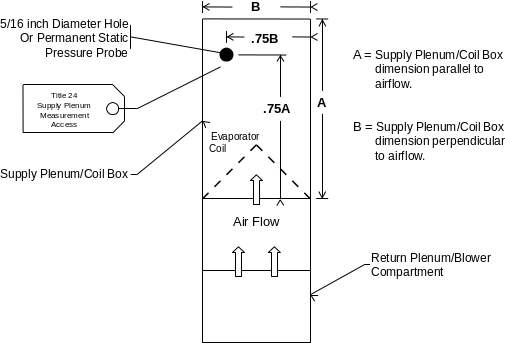
Figure RA3.3-1 Hole for the Placement of a Static Pressure Probe (HSPP) or Permanently Installed Static Pressure Probe (PSPP)
All measurements of system airflow rates shall be made with an airflow rate measurement apparatus (i.e., sensor plus data acquisition system) having an accuracy of ± 7% of reading or ± 5 cfm whichever is greater.
All measurements of air handler Watt draws shall be made with true power measurement systems (i.e., sensor plus data acquisition system) having an accuracy of ± 2% of reading or ± 10 watts whichever is greater.
Forced air system airflow rate shall be measured using one of the apparatuses listed in Section RA3.3.2. The apparatus shall produce airflow rate measurements that conform to the accuracy requirements specified in Section RA3.3.1.2 for measurements of residential forced air system airflow at system return grilles of single and multiple return duct systems.
The airflow rate measurement apparatus manufacturers shall publish in their product documentation, specifications for how their airflow measurement apparatuses are to be used for accurately measuring residential system airflow at system return grilles of single and multiple return duct systems.
The airflow measurement apparatus manufacturers shall certify to the Energy Commission that use of the apparatus in accordance with the specifications given in the manufacturer's product documentation will produce measurement results that are within the accuracy required by Section RA3.3.1.2.
For the airflow measurement apparatuses that are certified to the Commission as meeting the accuracy required by Section RA3.3.1.2, the following information will be posted on the Energy Commission website, making the information available to all people involved in the airflow verification compliance process:
-
The product manufacturers' model numbers for the airflow measurement apparatuses.
-
The product manufacturers' product documentation that gives the specifications for use of the airflow measurement apparatuses to accurately measure residential system airflow at system return grilles of single and multiple return duct systems.
A manufacturer's certification to the Commission of the accuracy of the airflow measurement apparatus, and submittal to the Commission of the product documentation that specifies the proper use of the airflow measurement apparatus to produce accurate airflow rate measurements shall be prerequisites for allowing the manufacturer's airflow measurement apparatus to be used for conducting the system airflow verification procedures in Section RA3.3 for demonstrating compliance with Part 6.
The apparatus for measuring the system airflow rate shall consist of a duct pressurization and airflow measurement device (subsequently referred to as a fan flowmeter) that meets all applicable instrumentation specifications in Section RA3.3.1, and a static pressure measurement device that meets the specifications in Section RA3.3.1.1. The fan flowmeter shall be attached at the inlet to a return duct from the conditioned space. If the system is not a multi-zoned automatic dampered system, the fan flowmeter may be attached at the air handler blower compartment door as an alternative to placement at the inlet to a return duct from conditioned space. The fan flowmeter shall be attached at a point where all the airflow through the system will flow through it. When the air handler blower compartment door attachment alternative is used, an air barrier must be placed between the return duct system and the air handler inlet(s). All registers shall be in their normal operating condition. The static pressure probe shall be fixed to the supply plenum at the location specified in Section RA3.3.1.1 so that it is not moved during this test.
The apparatus for measuring the system airflow rate shall consist of a flow measurement device (subsequently referred to as a flow grid) that meets all applicable instrumentation specifications in RA3.3.1 and a digital pressure measurement device that meets the specifications in Section RA3.3.1.1. The flow grid shall be attached at a point where all the fan airflow will flow through the flow grid. All registers shall be in their normal operating condition. The static pressure probe shall be fixed to the supply plenum at the location specified in Section RA3.3.1.1 so that it is not moved during this test.
A powered and pressure balanced flow capture hood (subsequently referred to as a Powered Flow Hood1) that has the capability to balance the flow capture static pressure difference between the room and the flow capture hood enclosure to 0.0 ± 0.2 Pa (.0008 inches water) and meets the applicable instrumentation specifications in Section RA3.3.1 may be used to verify the system airflow rate at the return grille(s) if the powered flow hood has a flow capture area at least as large as the return grille in all dimensions. The fan adjustment needed to balance the flow capture static pressure difference between the room and the flow capture hood enclosure to 0.0 ± 0.2 Pa (.0008 inches water) shall be provided by either an automatic control or a manual control operated in accordance with the apparatus manufacturer's instructions specified in the manufacturer's product documentation. All supply registers shall be in their normal operating position. Measurement(s) shall be taken at the return grille(s).
A traditional flow capture hood2 meeting the applicable instrumentation specifications in Section RA3.3.1 may be used to verify the system airflow rate at the return grille(s) if the device has a capture area at least as large as the return grille in all dimensions. All registers shall be in their normal operating position. Measurement(s) shall be taken at the return grille(s).
1 Also known as "active" flow hood, or "fan assisted" flow hood.
2 Also known as "non-powered" flow hood, "standard" flow hood, "commercially available" flow hood, or "passive" flow hood.
The air handler watt draw shall be measured using one of the following apparatuses.
The apparatus for measuring the air handler watt draw shall consist of a wattmeter meeting the applicable instrumentation specifications in RA3.3.1. The measuring device shall be attached to measure the air handler fan watt draw. All registers and blower access panel(s) shall be in their normal operating condition.
When required to measure fan watt draw in packaged and heat pump units, it is recommended to use portable true power clamp-on meters to provide flexibility for isolating the correct fan wires serving in packaged or heat pump units. Note: Higher voltage clamp-on meters may be required for packaged and heat pump units.
The apparatus for measuring the air handler watt draw shall consist of the utility revenue meter meeting the applicable instrumentation specifications in RA3.3.1 and a stopwatch that provides measurements in units of seconds. All registers and blower access panel(s) shall be in their normal operating condition.
The apparatus for measuring the air handler watt draw shall consist of the digital utility revenue meter meeting the applicable instrumentation specifications in RA3.3.1 that provides direct digital display of the Watt draw. All registers and blower access panel(s) shall be in their normal operating condition.
When required for compliance, the installed system's airflow shall be diagnostically tested using one of the methods specified in this section.
For systems utilizing an intentional ducted ventilation airflow from outside the conditioned space into the return system, the outside airflow may be included in the system airflow if that flow occurs in all operating modes of the HVAC system.
Diagnostic system airflow rate measurement values shall be converted to fan cfm/ton by dividing the measured system airflow rate (Qah) by the nominal tons of condensing unit cooling capacity for the air conditioner.
The measured airflow rate shall be expressed in cubic feet per minute of standard air (standard air has a density of 0.075 lb/ft³). When the airflow measurement is made at altitudes significantly different from sea level or at temperatures significantly different from 70°F, the airflow indicated on the device gauge may differ from the standard CFM by as much as 15 percent. Corrections from indicated to standard CFM shall be made using the procedure specified by the airflow measurement device manufacturer.
This system airflow measurement shall be performed using the following procedures:
-
If the fan flowmeter is to be connected to the air handler outside the conditioned space, then the door or access panel between the conditioned space and the air handler location shall be opened.
-
With the system fan on at the maximum speed used in the installation (the cooling speed when air conditioning is present), measure the pressure difference (in Pa) between the supply plenum and the conditioned space (Psp). Psp is the target pressure to be maintained during the system airflow tests. Place the pressure probe in the Supply Pressure Measurement Location described in Section RA3.3.1.1. Adjust the probe to achieve the highest pressure and then firmly attach the probe to ensure that it does not move during the system airflow test.
-
If the fan flowmeter is to be connected to the air handler at the access, block the return duct system from the plenum upstream of the air handler fan and the fan flowmeter. Filters are often located in an ideal location for this blockage.
-
Attach the fan flowmeter to the duct system at the inlet to one return duct from the conditioned space with the grille and filter removed (if there is more than one system return grille, block off all return grilles other than the one used for this measurement. Alternatively, the fan flowmeter may be placed at the air handler.
-
Turn on the system fan and the fan flowmeter, adjust the fan flowmeter until the pressure between supply plenum and conditioned space matches Psp.
-
Record the flow through the fan flowmeter (Qah, cfm) - this is the diagnostic system airflow. In some systems, system fan and fan flowmeter combinations may not be able to produce enough flow to reach Psp. In this case record the maximum flow (Qmax, cfm) and pressure (Pmax) between the supply plenum and the conditioned space. The following equation shall be used to correct measured system flow and pressure (Qmax and Pmax) to operating condition at operating pressure (Psp).
Qah = Qmax x (Psp/Pmax) ^0.5
The system airflow measurement shall be performed using the following procedures:
-
With the system fan on at the maximum speed used in the installation (the cooling speed when air conditioning is present), measure the pressure difference (in Pa) between the supply plenum and the conditioned space (Psp). Place the pressure probe in the Supply Pressure Measurement Location described in Section RA3.3.1.1. Adjust the probe to achieve the highest pressure and then firmly attach the probe to ensure that it does not move during the system airflow test.
-
The flow grid shall be attached at a point where all the system air flows through the flow grid. If there are multiple return grilles in the duct system, flow grids may be used to measure airflow at the return grilles, but only by installing a flow grid in each return grill and making simultaneous measurements of all return grill airflows.
-
Re-measure the system operating pressure with the flow grid in place.
-
Measure the airflow through the flow grid (Qgrid) and the test pressure (Ptest). If multiple flow grids are used Qgrid is the sum of the flows through each of the flow grids.
-
The following equation for air handler flow shall be used to correct flow through the flow grid and pressure (Qgrid and Ptest) to operating condition at operating pressure (Psp).
Qah = Qgrid x (Psp/Ptest) ^0.5
The system airflow measurement shall be performed using the following procedures: all registers shall be fully open, and the air filter shall be installed. Turn on the system fan at the cooling speed and measure the airflow at the return grille(s) with a calibrated powered flow hood to determine the total system return airflow. Operation of the powered flow hood shall conform to the specifications in the manufacturer's product documentation. For multiple return systems, the total system return airflow (Qah, cfm) shall be the sum of the airflow measurements at each of the system's return grilles.
The system airflow measurement shall be performed using the following procedures: all registers shall be fully open, and the air filter shall be installed. Turn on the system fan at the cooling speed and measure the airflow at the return grille(s) with a calibrated traditional flow capture hood to determine the total system return airflow. For multiple return systems, the total system return airflow (Qah, cfm) shall be the sum of the airflow measurements at each of the system's return grilles.
When an altered space conditioning system is unable to demonstrate compliance with the applicable minimum system airflow rate across the cooling coil required for refrigerant charge verification compliance, the system shall instead comply with Section RA3.3.3.1.5.1 below. If the remedial actions in Section RA3.3.3.1.5.1 fail to bring the system into compliance with the applicable minimum system airflow rate, the installer shall complete the refrigerant charge verification utilizing the highest system airflow rate attainable.
The installer shall attempt to correct non-compliant system airflow by performing the following remedial actions:
- Check to determine that the air filter media is clean. If the air filter media is dirty, then replace it with clean filter media.
- Open all registers and dampers and remove any obstructions.
- Replace crushed, blocked, or restricted ducts if possible.
- Check to determine that the evaporator coil is clean, or that there are no obstructions to airflow through the evaporator coil. If the evaporator coil is dirty or blocked with debris, if possible, clean the evaporator coil using a method approved by the manufacturer.
- Set the air handler fan to high speed for cooling, and ensure that the blower wheel and motor are operating properly, within manufacturer’s specifications.
- Check to determine whether the return duct system or return filter grille is sized too small for the installed system. If the return duct or return grille is sized too small, if possible, perform applicable alterations work on the return duct system or return grille in order to improve the system airflow rate.
When performing these remedial actions determines that there is a fault, a corrective action shall be performed if possible. In many cases, airflow can be improved by adding a return duct and filter grille or enlarging the existing return duct or filter grille. Alteration of the return duct system is an alternative that shall be considered if applicable to the existing system, and if other remedial actions do not improve the airflow. Alteration of the return duct system to bring the system airflow rate into compliance is expected to be attainable for systems with ducts in an attic space with sufficient clearances for accommodating improvements to the return duct system.
For each of the listed remedial actions, the HVAC installer shall certify that the remedial action was performed and indicate whether the action was completed successfully or was not completed successfully. When a remedial action was not completed successfully the installer shall indicate on the installation certificate the reason the action was not completed successfully.
The ECC-Rater shall review the information submitted on the installation certificate and perform follow-up communications with the HVAC installer or the homeowner. The system complies if the ECC-Rater determines the remedial actions have been performed, and the information reported on the installation certificate is valid.
The diagnostic air handler watt draw shall be measured using one of the following methods:
The air handler watt draw measurement shall be performed using the following procedures: all registers shall be fully open, and the air filter shall be installed. Turn on the system fan at the maximum speed used in the installation (usually the cooling speed when air conditioning is present; usually the cooling speed with outdoor air introduction if ventilation is provided through the return duct system) and measure the fan watt draw (Wfan).
When required to measure fan watt draw in packaged and heat pump units, it is recommended to use portable true power clamp-on meters to provide flexibility for isolating the correct fan wires serving in packaged or heat pump units.
Note: Higher voltage clamp-on meters may be required for packaged and heat pump units.
The air handler watt draw measurement shall be performed using the following procedures: all registers shall be fully open, and the air filter shall be installed. Turn on the system fan at the maximum speed used in the installation (usually the cooling speed when air conditioning is present; usually the cooling speed with outdoor air introduction if ventilation is provided through the return duct system) and turn off every circuit breaker except the one exclusively serving the air handler. Record the Kh factor on the revenue meter, count the number of full revolutions of the meter wheel over a period exceeding 90 seconds. Record the number of revolutions (Nrev) and time period (trev, seconds). Compute the air handler watt draw (Wfan) using the following formula:
Wfan = (Kh x Nrev x 3600) / trev
Return all circuit breakers to their original positions.
The air handler watt draw measurement shall be performed using the following procedures: all registers shall be fully open, and the air filter shall be installed. Turn on the system fan at the maximum speed used in the installation (usually the cooling speed when air conditioning is present; usually the cooling speed with outdoor air introduction if ventilation is provided through the return duct system) and turn off every circuit breaker except the one exclusively serving the air handler. Read the Watt draw from the digital utility meter digital display. Return all circuit breakers to their original positions.
Demonstrating compliance with fan efficacy requirements requires simultaneous measurement of the system airflow rate using Section RA3.3.3.1 procedures and fan Watt draw using Section RA3.3.3.2 procedures. The results of the simultaneous airflow rate and fan Watt draw measurements are used for calculation of a value for the forced air system fan efficacy as follows:
-
The measured value for fan Watt draw (Watt) shall be divided by the measured value for airflow rate (cfm) to determine the fan efficacy (Watt/cfm).
Compliance with the requirements for improved airflow or for improved fan efficacy both require simultaneous measurement of airflow and fan Watts. The simultaneous measurements shall be used to calculate the following values used to determine compliance:
For packaged systems, and for split systems with only one indoor unit, the measured value for airflow (cfm) shall be converted to cfm per ton by dividing the measured system airflow rate by the nominal tons of condensing unit cooling capacity.
For indoor units of multiple-split systems, the measured value for airflow in cfm shall be converted into cfm per ton by dividing the measured indoor unit airflow rate by the nominal tons of indoor unit cooling coil capacity.
The measured value for fan Watt draw (Watt) shall be divided by the measured value for airflow rate (cfm) to determine the fan efficacy (Watt/cfm).
In order to comply with either the fan efficacy requirement, or the system airflow requirement, the following criteria shall be met:
- The system airflow (cfm/ton) shall meet or exceed the system airflow compliance criteria specified in the Standards or on the Certificate of Compliance as applicable.
- The calculated value for fan efficacy (Watt/cfm) shall be equal to or less than the fan efficacy compliance criterion specified in the Standards or on the Certificate of Compliance as applicable.
When field verification and diagnostic testing of a central fan ventilation cooling system is required for compliance credit for the performance standards set forth in Standards Section 150.1(b), the CFVCS shall be verified according to the procedures in this section. Central fan ventilation cooling is not applicable to multifamily buildings.
The CFVCS airflow shall be verified according to the applicable procedures specified in RA3.3.3.1, to measure and record the following system airflow rates:
a. The system airflow at high fan speed as required for compliance with Standards Section 150.0(m)13.
b. The system airflow rate at the speed used for ventilation cooling as specified on the Certificate of Compliance for the CFVCS.
The CFVCS airflow shall be verified according to the applicable procedures specified in RA3.3.3.2, to measure and record the following system airflow Watt draw values:
-
The system Watt draw at high fan speed as required for compliance with Standards Section 150.0(m)13.
-
The system Watt draw at the speed used for ventilation cooling as specified on the Certificate of Compliance for the CFVCS.
Demonstrating compliance with fan efficacy requirements requires simultaneous measurement of the system airflow rate using Section RA3.3.4.1 procedures and fan Watt draw using Section RA3.3.4.2 procedures. The results of the simultaneous airflow rate and fan Watt draw measurements shall be used for calculation of a value for the forced air system fan efficacy as follows:
-
The measured value for fan Watt draw (Watt) at high fan speed shall be divided by the measured value for airflow rate (cfm) at the high fan speed to determine the fan efficacy (Watt/cfm) for the CFVCS at high fan speed.
-
The measured value for fan Watt draw (Watt) at the ventilation fan speed shall be divided by the measured value for airflow rate (cfm) at the ventilation fan speed to determine the fan efficacy (Watt/cfm) for the CFVCS at ventilation fan speed.
Compliance with the requirements for airflow rate and fan efficacy require that the Watt draw and airflow rate measurements are made simultaneously at both high speed and ventilation speed. The simultaneous measurements shall be used to calculate the following values used to determine compliance:
The measured value for fan Watt draw (Watt) shall be divided by the measured value for airflow rate (cfm) to determine the fan efficacy (Watt/cfm).
In order for the CFVCS to comply, the requirements in both subsections a and b below shall be met:
-
The system airflow (cfm/ton) shall meet or exceed the system airflow compliance criteria specified on the Certificate of Compliance at both the high fan speed, and the ventilation fan speed.
-
The calculated value for fan efficacy (Watt/cfm) shall be equal to or less than the fan efficacy compliance criterion specified on the Certificate of Compliance at both the high fan speed, and the ventilation fan speed.
The purpose of these procedures is to verify that residential space cooling systems and heat pumps have the required components to achieve the energy efficiency claimed in the compliance documents. The procedures apply when a Fault Indicator Display (FID) is specified for split system equipment, or when an HSPF2, SEER2, or EER2 higher than the default is claimed. For dwelling units with multiple systems, the procedures shall be applied to each system separately.
The installer shall certify on the Certificate of Installation that the components required for compliance have been installed.
When a system rating specification includes a time delay relay, the installation of the time delay relay shall be verified.
The procedure shall be:
- Turn the thermostat down until the compressor and indoor fan are both running.
- Turn the thermostat up so the compressor stops running.
- Verify that the indoor fan continues to run for at least 30 seconds.
This section defines procedures for field verification of installed HVAC systems.
When installation of specific matched system equipment is necessary for compliance with requirements for higher than minimum values for system HSPF2, SEER2, or EER2, the installed system equipment shall be verified according to the procedure specified in this section. The verification shall utilize certified rating data from the AHRI Directory of Certified Product Performance at http://www.ahridirectory.org or another directory of certified product performance ratings approved by the Energy Commission for determining compliance.
The procedure shall consist of visual verification of installation of the following system equipment components and confirmation that the installed equipment is rated to achieve the required HSPF2, SEER2 or EER2 rating:
- The manufacturer name and the model number of the outdoor unit or package unit.
- The manufacturer name and the model number of the inside coil if applicable.
- The name of the product directory used to certify the system performance.
- The certification number of the installed system if certification numbers for listed products are published by the product directory.
- The HSPF2, SEER2 or EER2 value published by the product directory.
- The manufacturer name and the model of the furnace or air handler when a specific furnace or air handler is necessary to achieve the SEER2, or EER2 rating.
- The specified metering device when a specific refrigerant metering device (such as a TXV or an EXV) is necessary to achieve the high efficiency rating.
- When a system rating specification includes a time delay relay, the installation of the time delay relay shall be verified according to the procedure in Section 3.4.3.
When heat pump systems are installed, and verification of the installed heat pump system capacity is required, the installed heat pump equipment shall be verified according to the procedure specified in this section. The verification shall utilize certified rating data from the AHRI Directory of Certified Product Performance at http://www.ahridirectory.org or another directory of certified product performance ratings approved by the Energy Commission for determining compliance (product directory).
The procedure shall consist of visual verification of the model numbers of the installed system equipment and confirmation that the installed equipment is rated to provide the required heating capacity:
- Record the manufacturer name and the model number of the outdoor unit or package unit.
- Record the manufacturer name and the model number of the inside coil if applicable.
- Record the name of the product directory used to certify the system performance.
- Record the certification number of the installed system if certification numbers for listed products are published by the product directory.
- Record the system's rated heating capacity at 47 degrees F published by the product directory.
- Record the system's rated heating capacity at 17 degrees F if the value is published by the product directory.
If the installed system rated heating capacities at 47 degrees F and 17 degrees F are equal to or greater than the values specified on the Certificate of Compliance, the system complies. If the product directory does not publish capacity ratings at 17 degrees F, then compliance with capacity at 17 degrees F is not required.
When a performance certificate of compliance indicates a space conditioning system requires verification of the variable capacity heat pump (VCHP) compliance option eligibility requirements, the installed VCHP system shall be field verified to confirm compliance with the eligibility requirements as specified in this subsection RA3.4.4.3.
If field verification determines the VCHP does not comply with all eligibility requirements in this section, then the dwelling in which the VCHP is installed shall not be eligible to claim the VCHP performance compliance credit for that space conditioning system.
Compliance with Section 150.0(m)11 (Duct System Sealing and Leakage Testing) is not required for systems that use this VCHP performance compliance option. However, there are requirements to verify that VCHP system indoor unit ducts are located entirely in conditioned space that are specified as eligibility requirements for this compliance option.
Compliance with Section 150.0(m)13 is not required for systems that use this VCHP performance compliance option. However there are requirements for verification of minimum airflow rates for VCHP system indoor units that are specified as eligibility requirements for this compliance option.
- Low-static system certification for ducted systems. The manufacturer of ducted indoor units shall certify to the Energy Commission that the system is a VCHP that meets the definition of a low-static system as defined in 10 CFR Parts 429 and 430, Docket No. EERE–2016–BT–TP–0029, Federal Register Vol. 82, No. 3, January 5, 2017). The manufacturer's model number(s) shall be included in listings of certified-to-the-Energy Commission low-static pressure VCHP systems which will be published on the Energy Commission's website.
If the installed VCHP system has ducted indoor units, then verification of the Energy Commission listings of certified VCHP systems shall confirm the installed system is included in the Energy Commission listings of certified low static systems.
If the VCHP model is not included in the Energy Commission listings of certified low static systems, then the system does not comply with the VCHP compliance option eligibility requirements. - Non-continuous default fan operation certification for ducted systems. The manufacturer may elect to certify to the Energy Commission that their ducted indoor unit + outdoor unit combination does not operate the indoor unit fan continuously by default. This certification is required in order to receive credit for the non-continuous fan operation component of the VCHP compliance option credit.
If the installed VCHP system has ducted indoor units, and the certificate of compliance indicates credit has been taken for non-continuous default fan operation, then visual inspection of the Energy Commission listings of certified VCHP systems shall confirm the installed system is included in the Energy Commission listings and the certification indicates the system is a type with indoor units that does not run the fan continuously during periods when there is no call for conditioning.
If the model is not included in the Energy Commission listings of certified low static systems as a type with indoor units that does not run the fan continuously during periods when there is no call for conditioning, then the system does not comply with the VCHP compliance option eligibility requirements.
A revised certificate of compliance may be submitted to the enforcement agency that does not specify credit for non-continuous default fan operation. - Refrigerant charge verification. The installed system shall have refrigerant charge verified in accordance with applicable procedures in RA3.2, as specified in Standards Sections 150.1(c)7A and 150.2(b)1Fii, or 150.2(b)1Fiii.
If the system does not meet the refrigerant charge verification requirements, then the system does not comply with the VCHP compliance option eligibility requirements. - Low leakage ducts located entirely in conditioned space verification. Ducted indoor units shall be verified in accordance with the Verified Low Leakage Ducts in Conditioned Space procedure in Section RA3.1.4.3.8.
If the system does not meet the RA3.1.4.3.8 requirements, then the system does not comply with the VCHP compliance option eligibility requirements. - Ductless space conditioning system indoor units located entirely in conditioned space verification. Ductless systems shall be verified in accordance with the ductless space conditioning system indoor units located entirely in conditioned space procedure in RA3.1.4.1.8 to visually confirm ductless indoor units are located entirely in conditioned space.
If the system is not considered to be entirely in conditioned space according to RA3.1.4.1.8 requirements, then the system does not comply with the VCHP compliance option eligibility requirements. - Space-Conditioning System Airflow Supply to All Habitable Spaces. Field verification according to the procedure in RA3.1.4.1.7 shall confirm that airflow is supplied to all habitable spaces in a dwelling that specifies use of the VCHP compliance option.
If space conditioning system airflow is not supplied to all habitable spaces in the dwelling as determined by the procedure in RA3.1.4.1.7, then the system does not comply with the VCHP compliance option eligibility requirements. - Wall mounted thermostat in zones > 150 ft2. Field verification according to the procedure in RA3.4.5 shall confirm that VCHP space conditioning zones in the dwelling that are greater than 150 ft2 are controlled by a permanently installed wall-mounted thermostat.
If a zone area served by an indoor unit is greater than 150 ft2, and the indoor unit is not controlled by a permanently installed wall-mounted thermostat located in the zone served by the indoor unit as determined according to the procedure in RA3.4.5, then the system does not comply with the VCHP compliance option eligibility requirements. - Non-continuous fan operation - field verification. If non-continuous indoor unit fan operation is specified for improved compliance credit for ducted VCHP systems in the CBECC-Res model, and thus the certificate of compliance indicates field verification of non-continuous indoor unit fan operation is required, then the system shall be field verified in accordance with the procedures in RA3.4.6 to confirm that the installed system's indoor unit + outdoor unit combination does not operate the fan continuously when the system thermostat is not calling for conditioning.
If field verification according to RA3.4.6 determines the installed system's indoor unit + outdoor unit combination operates the fan continuously when the system thermostat is not calling for conditioning, then the system does not comply with the VCHP compliance option eligibility requirements.
A revised certificate of compliance may be submitted to the enforcement agency that does not specify credit for non-continuous default fan operation. - Minimum airflow rate verification. Each new ducted indoor unit shall have airflow verified in accordance with the procedures in RA3.3 to confirm the airflow at full capacity in cooling mode is equal to or greater than 350 cfm/ton of nominal cooling capacity. 300 cfm/ton shall be verified for altered systems if required for compliance with the refrigerant charge verification procedure.
For indoor units of single-split systems, the measured value for airflow in cfm shall be converted into cfm per ton by dividing the measured indoor unit airflow rate by the nominal tons of outdoor unit cooling capacity.
For indoor units of multiple-split systems, the measured value for airflow in cfm shall be converted into cfm per ton by dividing the measured indoor unit airflow rate by the nominal tons of indoor unit cooling capacity.
If the indoor unit does not meet or exceed the 350 cfm/ton minimum airflow rate required for new systems, or the 300 cfm/ton required for altered systems meeting the refrigerant charge minimum airflow rate, then the system does not comply with the VCHP compliance option eligibility requirements. - Air filter sizing. Ducted low-static VCHP indoor units with any length of duct shall have the air filters for the return air inlets verified to confirm the air filter sizing conforms to the procedures in i or ii below as applicable.
- Nominal 2-inch or greater depth air filters shall be sized by the system designer to accommodate a maximum allowable clean-filter pressure drop of 0.1 inch wc at the air filter's design airflow rate. Field verification of the system designers sizing methodology shall not be required for nominal 2-inch or greater depth air filters, however verification that the installed 2-inch or greater depth air filter is rated to meet a clean filter pressure drop of less than or equal to 0.1 inch wc at the air filter's design airflow rate shall conform to the procedures in RA3.1.4.8.
If any of the indoor unit's applicable nominal 2-inch or greater depth air filters fails to meet the maximum 0.1 inch wc. clean filter pressure drop requirement as verified according to the procedure in RA3.1.4.8, then the system does not comply with the VCHP compliance option eligibility requirements. - Nominal one-inch minimum depth air filters shall be allowed if the filter face area is sized based on a maximum face velocity of 150 ft. per minute at the air filter design airflow rate according to the procedures in RA3.1.4.7.
All of the indoor unit air filters that are required to be sized and verified according to a face velocity specification shall comply with this subsection ii. If any of the indoor unit's applicable nominal 1-inch depth air filters has a face area less than the required face area determined according to the procedures in RA3.1.4.7, then the system does not comply with the VCHP compliance option eligibility requirements.
- Air filter maximum pressure drop. Ducted low-static VCHP indoor units with any length of duct shall have the air filters for the return air inlets verified according to the procedures in RA3.1.4.8 to confirm the air filter is rated to provide a clean filter pressure drop less than or equal to 0.1 inch wc., at an airflow rate greater than or equal to the air filter's design airflow rate.
If verification of the indoor unit's air filters according to the procedures in RA3.1.4.8 determines that one or more of the air filters does not provide clean filter pressure drop less than or equal to 0.1 inch wc., at an airflow rate greater than or equal to the air filter's design airflow rate, then the system does not comply with the VCHP compliance option eligibility requirements.
When compliance requires verification that a wall-mounted thermostat has been installed to control a space conditioning system's indoor unit operation, the system's indoor unit thermostat(s) shall be verified according to the following procedures. If a system has more than one indoor unit, then all of the system's indoor unit thermostats shall be verified according to this procedure.
- If the conditioned floor area (ft2) of the zone served by an indoor unit is not a criterion for determining the compliance requirement for wall-mounted thermostats, then skip to subsection (b) below.
Otherwise, if the conditioned floor area (ft2) of the zone served by an indoor unit is a criterion for determining the compliance requirements for wall-mounted thermostats in the zone, then record the value in square feet for conditioned floor area served by the indoor unit.- If the zone area size (ft2) criterion indicates that a wall-mounted thermostat is not required for the zone, then the indoor unit complies and no further thermostat verification is required for the zone served by the indoor unit.
- If the zone area size (ft2) criterion indicates that a wall-mounted thermostat is required for the zone, then perform the remaining steps (b) and (c).
- If possible, locate the wall-mounted thermostat that controls the indoor unit, and verify whether or not the thermostat controls the indoor unit by setting the thermostat to a cooling setpoint that is less than the room temperature, or alternatively by setting the thermostat to a heating setpoint that is greater than the room temperature.
If there is no wall-mounted thermostat installed in the zone that controls the indoor unit, then the indoor unit does not comply.
If there is a wall-mounted thermostat installed that controls the indoor unit, but it is not located within the zone served by the indoor unit, then the indoor unit does not comply. - For a wall-mounted thermostat installed in the zone that controls the indoor unit located in step (b), by visual inspection determine if the thermostat is mounted permanently to the wall. Wall-mounted brackets or other means that facilitate non-permanent attachment of handheld thermostats to the wall do not meet this requirement.
If the thermostat is not permanently mounted to the wall, then the indoor unit does not comply.
When compliance requires field verification that an installed space conditioning system indoor unit does not operate the air distribution fan during periods when the space does not require heating or cooling, the system's indoor unit operation shall be field verified according to the following procedures. If a system has more than one indoor unit, then all of the system's applicable indoor units shall be verified according to this procedure.
- If possible, locate the manufacturer's indoor unit + outdoor unit combination in the Energy Commission listing of systems that have been certified by the manufacturer as systems that do not operate the air distribution fan during periods when the space does not require heating or cooling, which is located at: https://www.energy.ca.gov/rules-and-regulations/building-energy-efficiency/manufacturer-certification-building-equipment.
Record the result of the search for the system model(s). If the manufacturer's indoor unit + outdoor unit combination is not included in the CEC listing, then the indoor unit does not comply. - Switch the system to heating mode.
- Switch on the heating system by setting the thermostat to a setpoint that is greater than the room temperature.
- Verify the thermostat activates the indoor unit airflow.
- Switch off the heating system by setting the thermostat to a setpoint that is less than the room temperature.
- Verify the indoor unit air circulation fan does not operate when the compressor is off, except for a fan overrun (fan off delay) of less than 10 minutes that may occur at the end of the compressor on cycle.
- Switch the system to cooling mode.
- Switch on the cooling system by setting the thermostat to a setpoint that is less than the room temperature.
- Verify the thermostat activates the indoor unit airflow.
- Switch off the cooling system by setting the thermostat to a setpoint that is greater than the room temperature.
- Verify the indoor unit air circulation fan does not operate the indoor fan when the compressor is off, except for a fan overrun (fan off delay) of less than 10 minutes that may occur at the end of the compressor on cycle.
If the system does not operate the indoor unit air distribution fan(s) during periods when the spaces served by the system do not require heating or cooling to meet the thermostat setpoint, then the system complies.
RA3.5 is a procedure for verifying the quality of insulation installation and air leakage control used in low-rise residential buildings. This procedure is to be followed by the insulation installer and an ECC-rater must verify its conformance for meeting the requirements of Sections 150.1(c), or 170.2(a)6, and 110.7 of the Standards.
The procedure applies to wood and metal construction of framed and non-framed envelope assemblies. Framed assemblies include wall stud cavities, roof/ceiling assemblies, and floors typically insulated with: (1) batts of mineral fiber and mineral wool; (2) loose-fill materials of mineral fiber, mineral wool, and cellulose; (3) spray polyurethane foam; and, (4) rigid board sheathing materials. Non-framed assemblies include wall, roof/ceiling, and floors constructed of structural insulated panels and insulated concrete forms.
Note 1: For newly constructed buildings, this procedure applies to the entire thermal envelope of the building. In many instances, residential homes will use several types of insulation material, even in the same framed assembly. Each insulation material and the integrity of air leakage control for the building's entire thermal envelope must be verified by the ECC-rater for the home to comply with the Standards.
Note 2: Structural bracing, tie-downs, and framing of steel or specialized framing used to meet structural requirements of the California Building Code (CBC) are allowed. These areas shall be called out on the building plans with diagrams and/or specific design drawings indicating the R-value amount and fastening method to be used. All structural framing areas shall be insulated in a manner that resists thermal bridging from the outside to the inside of the assembly separating conditioned from unconditioned space. The insulation and air barrier integrity shall be verified by the ECC-rater.
Continuous Air Barrier | A combination of interconnected materials and assemblies joined and sealed together to provide a continuous barrier to air leakage through the building envelope separating conditioned from unconditioned space, or adjoining conditioned spaces of different occupancies or uses. An air barrier is required in all thermal envelope assemblies to limit air movement between unconditioned/outside spaces and conditioned/inside spaces and must meet one of the following: 1. Using individual materials that have an air permeance not exceeding 0.004 cfm/ft2 under a pressure differential of 0.3 in. w.g. (1.57 psf) (0.02 L/s.m2 at 75 pa) when tested in accordance with ASTM E2178; or 2. Using assemblies of materials and components that have an average air leakage not to exceed 0.04 cfm/ft2 under a pressure differential of 0.3 in. w.g (1.57 psf) (0.2 L/s.m2 at 75 pa) when tested in accordance with ASTM E2357, ASTM E1677, ASTM E1680 or ASTM E283; or 3. Testing the completed building and demonstrating that the air leakage rate of the building envelope does not exceed 0.40 cfm/ft2 at a pressure differential of 0.3 in w.g. (1.57 psf) (2.0 L/s.m2 at 75 pa) in accordance with ASTM E779 or an equivalent approved method. Individual materials and assemblies of materials that can demonstrate compliance with the air barrier testing requirements must be installed according to the manufacturer's instructions and a ECC rater shall verify the integrity of the installation. Below are example materials meeting the air permeance testing performance levels of 1 above. Manufacturers of these and other product types must provide a specification or product data sheet showing compliance to the ASTM testing requirements to be considered as an air barrier. Plywood – minimum 3/8 inch Oriented strand board – minimum 3/8 inches Extruded polystyrene insulation board – minimum 1/2 inch Foil-back polyisocyanurate insulation board – minimum 1/2 inch Extruded polystyrene insulation board – minimum 1/2 inch Foil backed urethane foam insulation (1 inch) Closed cell spray polyurethane foam with a minimum density of 2.0 pcf and a minimum thickness of 2.0 inches Open cell spray polyurethane foam with a minimum density of 0.4 to1.5 pcf and a minimum thickness of 5½ inches Exterior or interior gypsum board - minimum 1/2 inch Cement board - minimum 1/2 inch Built up roofing membrane Modified bituminous roof membrane Particleboard – minimum 1/2 inch Fully adhered single-ply roof membrane Portland cement/sand parge, or gypsum plaster minimum 5/8 inch Cast-in-place and precast concrete Fully grouted uninsulated and insulated concrete block masonry Sheet steel or aluminum |
Air-tight | Limiting the passage of air either in or out of the building envelope. Note: Thermal envelope assemblies (such as wall assemblies) shall be built to minimize air movement. Air movement brings unconditioned air and moisture through or into the assembly. For these procedures, air-tight shall be defined as an assembly or air barrier with all openings caulked, or sealed with minimally expansive foam, or taping/sealing of adjoining surfaces of air barrier materials and assemblies. |
Compression | The improper placement of insulation in an assembly that results in an installation less than the product's nominal thickness. Batt insulation should be “lofted” and loose-fill and spray foam material properly field applied to the manufacturer’s specified density to achieve its full R-value. Limited compression is allowed at plumbing, vents, and other obstructions and in cavities of non-standard framing. Compression of insulation in these situations is limited to no more than 30% of its' nominal thickness. |
Delaminated | Separation of the insulation's full thickness to facilitate its installation around or between obstructions. Batt and blanket insulation are often split or delaminated to fit around electrical wires and plumbing runs through a wall cavity to prevent voids, or compression of the insulation. The delamination must ensure that the full thickness of the insulation is installed between the obstruction and the finish material covering the framing. For example, an electrical wire located one-third of the distance from the front of the cavity should have batt insulation delaminated so that two-thirds of the batt is installed towards the outside wall surface and one-third is installed towards the inside wall surface from the wire. |
Draft Stops | A material, device or construction installed to prevent the movement of air within open spaces of concealed areas of building components, such as crawl spaces, floor/ceiling assemblies, wall assemblies, roof/ceiling assemblies and attics. Note: Draft stops are important components of the air barrier and shall be airtight. Fire blocks constructed of porous insulation materials cannot serve as draft stops since they are not airtight. |
Friction Fit | A means of installing insulation within the framed cavity without the use of mechanical fasteners such that the material's full thickness in all directions is sufficient to keep the material in its intended position . In standard framing dimensions of 2x4 and 2x6 @ 16" oc and 24" oc batt and blanket insulation materials have enough side-to-side frictional force to hold the insulation in place without any other means of attachment. Note: Friction fitting of faced batt and blanket insulation, with or without an attachment flange, is allowed provided the insulation's installation integrity can be maintained. |
Gaps | Uninsulated areas at the edge of insulation where insulation is not in contact with framing members or other materials at the edge of the insulation. Gaps occur when insulation length and width is too short for the cavity. Gaps in insulation are avoidable and are not permitted. |
Hard Covers | Building materials, such as plywood or gypboard, which become part of the ceiling air barrier. Note: Hard covers shall be installed above areas where there is a drop ceiling. For example, a home with 10 ft ceilings may have an entry closet with a ceiling lowered to 8 ft. In this case, a hard cover is installed at the 10 ft level above the entry closet. Hard covers become part of the ceiling air barrier and shall be airtight. |
Inset Stapling | A method of attaching faced batt or blanket insulation to wood framing , where the flange of the insulation facing is pushed inside the face of the framing member and stapled . This method causes a void between the insulation and the air barrier. In windy areas installers often staple the flanges of faced batts to the sides of the stud to assure that the insulation remains in place until covered with drywall, particularly on the wall between the house and the garage where there isn't any exterior sheathing to help keep the insulation in place. The void created by the flange inset shall not extend more than two inches from the stud on each side. |
Insulation Types-- Framed Assemblies | There are four basic types of insulation, or insulation "systems", installed in residential buildings and their use varies based on the design and type of construction: 1. Batt and Blanket: Batt and blanket insulation is made of mineral fiber and mineral wool -- either processed fiberglass, rock, or slag wool -- and is used to insulate below floors, above ceilings, below roofs, and within walls. 2. Loose-fill: Loose-fill insulation includes loose fibers or fiber pellets that are blown into building cavities or attics using special equipment. Loose-fill insulations typically are produced using mineral fiber, mineral wool, or cellulose. They are installed in walls, floors, attics and below roofs using a dry-pack process or a moist-spray technique, and may include a netting material. 3. Rigid Board: Rigid board insulation sheathing is made from fiberglass, expanded polystyrene (EPS), extruded polystyrene (XPS), polyisocyanurate (PIR), or polyurethane (PUR). This type of insulation is used for above roof decks, exterior walls, cathedral ceilings, basement walls, as perimeter insulation at concrete slab edges, and to insulate special framing situations such as window and door headers, and around metal seismic bracing. Rigid board insulation may also be integral to exterior siding materials. 4. Spray Polyurethane Foam (SPF): A two-part liquid foamed plastic (such as polyurethane or modified urethane) material formed by the reaction of an isocyanurate and a polyol that uses a blowing agent to develop a cellular structure when spray applied onto a substrate. SPF insulation is a two-component reactive system mixed at a spray gun or a single-component system that cures by exposure to humidity. The liquid is sprayed through a nozzle into wall, roof/ceiling, and floor cavities. SPF insulation can be formulated to have specific physical properties (i.e., density, compressive strength, fire resistance and R-value). There are two types of SPF insulation: a. Low Density Open-Cell SPF (ocSPF) Insulation: A spray applied polyurethane foam insulation having an open cellular structure resulting in an installed nominal density of 0.4 to 1.5 pounds per cubic foot (pcf). b. Medium Density Closed-Cell SPF (ccSPF) Insulation: A spray applied polyurethane foam insulation having a closed cellular structure resulting in an installed nominal density of greater than 1.5 to less than 2.5 pounds per cubic foot (pcf). |
Insulation Types--Non-framed Assemblies | There are two basic types of insulation used and their use varies based on the design and type of construction: 1. Structural Insulated Panel (SIP): A composite building material consisting of an insulating layer of rigid polymer foam sandwiched between two layers of structural board. The board can be sheet metal, plywood, cement or oriented strand board (OSB) and the foam is either expanded polystyrene foam (EPS), extruded polystyrene foam (XPS) or polyurethane (PUR) foam. SIPs combine several components of conventional building, such as studs and joists, insulation, vapor barrier and air barrier. They can be used for many different applications, such as exterior walls, roofs, floors, and foundation systems. 2. Insulated Concrete Form (ICF): A system of formwork for concrete that stays in place as permanent building insulation and is used for cast-in-place, reinforced above and below-grade concrete walls, floors, and roofs. ICFs are interlocking modular units that can be dry-stacked (without mortar) and filled with concrete as a single concrete masonry unit (CMU). ICFs lock together externally and have internal metal or plastic ties to hold the outer layer(s) of insulation to create a concrete form for the structural walls, roof/ceilings, or floors of a building. ICFs are manufactured from several materials including: expanded and extruded polystyrene foam, polyurethane foam, cement-bonded wood fiber, and cement-bonded polystyrene beads. |
Minimally Expansive Foam Sealing Material | A single-component polyurethane foam system typically formulated in a handheld can or portable container to seal and fill construction gaps and crevices, holes, and cracks without distorting adjacent framing. These materials are not used for insulation purposes, rather as agents for air sealing of gaps and crevices that are too small to be insulated. |
Net Free-Area | The net free-area of a vent cover is equal to the total vent opening less the interference to airflow caused by a screen or louver used for ventilation. Screened or louvered vent opening covers are typically marked by the manufacturer with the "net free-area." For example a 22.5 in. by 3.5 in. eave vent screen with a total area of 78.75 square inches may have a net free-area of only 45 square inches. |
Non-Standard Framing | Standard framing consists of installation of framing members spaced at regular intervals (16" or 24" on center), where batt insulation products can be installed to the full dimensional width of the cavity between framing members. Non-Standard framing may include multiple framing members, framing members at unusual spacing, additional blocking within cavity, structural columns or beams, or metal structural connections that alter the cavity depth or width. |
Voids & Air Spaces | An uninsulated space within an enclosed building assembly created where the assembly has been insulated by partial filling of the framed cavity. The partial fill results in an air space (void) between the insulation surface and the assembly’s exterior or interior layers which form the assembly’s air barrier. |
These procedures detail the installation and inspection protocols necessary to qualify for Quality Insulation Installation (QII) of batt and blanket insulation. These procedures must be field verified before the building construction permit is finalized.
These procedures are to be followed by the insulation installer and an ECC-rater must verify its conformance to meet the requirements of Sections 150.1(c)1E or 170.2(a)6, and 110.7 of the Standards.
This insulation type is manufactured in different widths, lengths, and thicknesses and is available with or without a facing. Faced batts and blanket insulation material are also available with or without an attachment flange. Specific product R-values are readily available from the manufacturer for the specific materials being installed and the R-value of the product is marked on the face of the product (faced or unfaced material). The installed insulation must meet the R-value stated on the compliance documentation.
- Materials shall comply with, and be installed in conformance with, all applicable building codes for building. California Building Code (including, but not limited to, California Electric Code Section 719) and installed to meet all applicable fire codes.
- Materials shall meet California Quality Standards for Insulating Material, Title 24, Part 12, Chapter 4, Article 3, listed in the California Department of Consumer Affairs Consumer Guide and Directory of Certified Insulating Materials.
- Materials shall comply with flame spread rating and smoke density requirements of Chapter 26 and Section 706 of the Title 24, Part 2: all installations with exposed facings must use fire retardant facings which have been tested and certified not to exceed a flame spread index (FSI) of 25 and a smoke development index (SDI) of 450. Insulation facings that do not touch a ceiling, wall, or floor surface, and faced batts on the undersides of roofs with an air space between the ceiling and facing are considered exposed applications.
- Materials shall be installed according to manufacturer specifications and instructions.
- Batt and blanket insulation shall be correctly sized to fit snugly at the sides and ends.
- Batt and blanket insulation shall be installed so that they will be in contact with the air barrier.
- Where necessary, batt and blanket insulation shall be cut to fit properly - there shall be no gaps, nor shall the insulation be doubled-over or compressed.
- When batt and blanket insulation are cut to fit a non-standard cavity, they shall be snuggly fitted to fill the cavity without compression.
- Batt and blanket insulation shall be cut to butt-fit around wiring and plumbing, or be split (delaminated) so that one layer can fit behind the wiring or plumbing, and one layer fit in front.
The ECC-rater shall verify the installed thickness of insulation in all assemblies and locations on walls, roof/ceilings, and floors, and to ensure that insulation levels and installation integrity meet the R-value specified on the Certificate of Compliance, and all other required compliance documentation.
All provisions of Residential Appendix RA2 shall be met. All Insulation Certificates of Installation signed by the insulation installer shall be provided stating the installation is consistent with the Certificate of Compliance, plans and specifications for which the building permit was issued. The insulation installer shall complete all applicable sections of the Certificate of Installation form and attach a product specification or data sheet for every insulation material used.
All provisions of Residential Appendix RA2 shall be met. The Insulation Certificate of Installation, with insulation material labels or specification/data sheets attached, signed by the insulation installer, shall be available on the building site for each of the ECC-rater's verification inspections. Note: The ECC-rater cannot verify compliance credit without these completed forms.
- Wall stud cavities shall be caulked, foamed, or otherwise sealed to provide a substantially air-tight envelope to the outdoors, attic, garage and crawl space. All plumbing and wiring penetrations through the top and bottom plates and electrical boxes that penetrate the sheathing shall be sealed. All gaps in the air barrier shall be caulked, taped, or sealed with minimally expansive foam.
- Bottom plates of framed and non-framed assemblies shall be sealed to the ground subfloor or slab, and above ground subfloor.
- Insulation shall uniformly fill the cavity side-to-side, top-to-bottom, and front-to-back.
- Batt insulation shall fill the cavity by friction fitting, inset or face stapling of flanges of faced batts, or by other support methods as necessary.
- Batt and blanket insulation shall be installed to fill the cavity and be in contact with the sheathing on the back and the wallboard on the front - no gaps or voids.
Exception to RA3.5.3.2(e): Batt insulation with flanges that are inset stapled to the side of the stud, the surface of the batt facing the occupied space must be flush with the face of the cavity (or protrude beyond) except for the portions of the batt that are less than two inches from the side of the stud. - When batt and blanket insulation are cut to fit a non-standard framing, they shall be snuggly fitted to fill the cavity with limited compression.
- Batt insulation shall be cut to butt-fit around wiring and plumbing, or be split (delaminated) so that one layer can be fit behind the wiring or plumbing, and one layer fit in front. The layers must be proportional to the obstruction's position in the cavity to avoid compression and voids.
- Non-standard width cavities shall be filled with insulation to snuggly fit into the space, or with minimally expansive foam sealing material.
- Narrow spaces less than 1 inch in width at windows and door jambs, shall be filled with minimally expansive foam sealing. In cases where the manufacturer's warranty would be void if minimally expansive foam is used to seal the gap between the window frame or door jamb, the cavity must be airtight and batt insulation cut to width and snuggly fitted (with limited compression) in the space.
- Narrow spaces less than 2 inches in width, such as between studs at building corners, and at the intersection of interior partition walls to exterior walls, shall be filled with insulation snuggly fitted in the space, or with minimally expansive foam sealing.
- Hard to access wall stud cavities, such as corner channels, wall intersections, and behind tub/shower enclosures shall be insulated to the proper R-value. In most cases this can only be completed prior to the installation of the tub/shower enclosure, the exterior sheathing, or the exterior stucco lath.
- An air barrier shall be installed on the inside of the exterior wall(s) directly adjacent to the tub/shower enclosure.
- Insulation shall be delaminated or cut to fit around wiring, plumbing, vents, and other obstructions with limited compression. Compression of insulation in these situations is limited to ≤ 30% of its nominal thickness.
- Insulation shall be placed between the sheathing and the rear of electrical boxes and other obstructions that are not as deep as the cavity (i.e., communications boxes, medicine cabinets).
- In cold climates, where water pipes may freeze (such as Climate Zones 2, 11-14 and 16) pipes shall have at least 1/2 of the insulation between the water pipe and towards the outside surface of the exterior wall. As much insulation as possible shall be placed between the pipe and the outside (without compression), and remaining insulation shall be placed between the pipe and the interior assembly material.
- All rim-joists shall be insulated to the same R-value as the adjacent walls.
- The insulation shall be installed without gaps, voids, or compression.
- Framing for kneewalls and skylight shafts that separate conditioned from unconditioned space shall be insulated to meet or exceed the wall R-value specified on the Certificate of Compliance, and all other required compliance documentation.
- The insulation shall be installed without gaps or compression.
- Steel-framed kneewalls and skylight shafts, external surfaces of steel studs shall meet or exceed the mandatory minimum insulation requirements and be covered with continuous insulation unless otherwise specified on the Certificate of Compliance using correct U-factors from Joint Appendix JA4, Table 4.3.4 (or U-factors approved by the Commission Executive Director).
- The backside of air permeable insulation exposed to the unconditioned attic space shall be completely covered with a continuous air barrier.
- The house side of the insulation shall be in contact with the drywall or other wall finish.
- The insulation shall be supported so that it will not fall down by either friction fitting to the framing, inset or face stapling of flanges, or using other support such as netting.
- Insulation for all kneewall and skylight shafts shall be completely enclosed by vertical and horizontal framing, including horizontal plates at top and bottom of the insulation.
Walls of interior closets for HVAC and/or water heating equipment, which require combustion air venting, shall be insulated to at least the same R-value as other demising walls (i.e., walls separating conditioned space and attached garage), or as specified on the Certificate of Compliance.
- Insulation shall fill the entire cavity; or, an additional air barrier shall be installed inside the double wall or bump-out and in contact with the insulation so that the insulation fills the cavity formed with the additional air barrier.
- Entire double walls and framed bump-outs shall be air-tight.
- Framing and bracing used for structural purposes shall be identified on plan documents with diagrams and/or design drawings.
- Insulation shall be installed in a manner that minimizes heat loss/gain due to thermal bridging through the structural framing assembly.
- Insulation shall be applied to fully enclose and/or adhere to all sides and ends of structural assembly framing that separate conditioned from unconditioned space.
- The structural portions of assemblies shall be air-tight.
- All single-member window and door headers shall be insulated to a minimum of R-3 for a 2x4 framing, or equivalent width, and a minimum of R-5 for all other assemblies. Insulation is to be placed between the interior face of the header and inside surface of the interior wall finish.
- No header insulation is required for single-member headers that are the same width as the wall, provided that the entire wall has at least R-2 insulation.
- In unvented attics, where insulation is applied directly to the underside of the roof deck, framing for gable ends that separate the unvented attic from the exterior or unconditioned space shall be insulated to meet or exceed the wall R-value of the adjacent exterior wall construction as specified on the Certificate of Compliance.
- The backside of air permeable insulation exposed to the unconditioned attic space shall be completely covered with a continuous air barrier.
- Batt and blanket insulation shall be correctly sized to fit snugly at the sides and ends.
- Batt and blanket insulation shall be installed to be in contact with the air barrier.
- Where necessary, batt and blanket insulation shall be cut to fit properly - there shall be no gaps, nor shall the insulation be doubled-over or compressed.
- When batt and blanket insulation are cut to fit a non-standard cavity, they shall be snuggly fitted to fill the cavity with limited compression.
- Batt and blanket insulation shall be cut to butt-fit around wiring and plumbing, or be split (delaminated) so that one layer can fit behind the wiring or plumbing, and one layer fit in front.
- Batt and blanket insulation that is thicker than the framing depth shall be installed so that the insulation expands to touch adjacent insulation over each framing member.
- Hard covers or draft stops shall be placed over all drop ceiling areas and interior wall cavities to keep insulation in place and stop air movement. If hard covers or draft stops are missing or incomplete, they shall be completed before insulation is installed.
- Baffles shall be placed at eaves or soffit vents of vented attics to keep insulation from blocking eave ventilation and prevent air movement under the insulation. The required net free-ventilation shall be maintained.
- All recessed light fixtures that penetrate the ceiling shall be listed for zero clearance insulation contact (IC), have a label that certifies it as airtight with leakage less than 2.0 cfm @ 75 Pa when tested to ASTM E283, and shall be sealed with a gasket or caulk between the light's housing and the ceiling.
- Insulation shall cover all recessed lighting fixtures. Fixtures that are not rated for insulation contact (IC), and air-tight, shall be removed and/or replaced.
- Facings and insulation shall be kept away from combustion appliance flues in accordance with flue manufacturer's installation instructions or labels on the flue.
- In vented rafter ceilings, an air space shall be maintained between the insulation and roof sheathing as specified by California Building Code, Sections 1203.2 and R806.3, or as specified by the local building department.
- Insulation installed in unvented rafter ceilings or to the underside of unvented roofs with an attic below shall have an R-value conforming to compliance documentation and the air barrier shall be uniform across the transition of roof to wall. The insulation shall be in contact with the air barrier.
- Batt and blanket insulation shall be placed below all platforms or cat-walks used for HVAC equipment installation and access.
- Batt and blanket insulation shall be installed so that they will be in contact with the air barrier.
- Batt and blanket insulation shall be installed under HVAC platform to the full depth and rated R-value as specified on the Certificate of Compliance, without gaps or compression. If necessary, HVAC platform shall be raised to accommodate ceiling insulation.
Permanently attach rigid board insulation or batt or blanket insulation with the appropriate R-value to the access door using adhesive or mechanical fastener. The bottom of the attic access shall be gasketed to prevent air leakage of conditioned air to the unconditioned attic.
- Below roof deck insulation consisting of batts that nominally fill the cavity space between roof framing members shall be stapled, or supported with cabling, tension rods, or other support measures which maintain the batt uniformly against the roof deck with limited compression. Batts with facing directed to the attic space shall be face stapled. Inset stapling of underside batts is not allowed. Batts supported with cabling, tensions rods, or other methods supporting the batt from below shall be supported at intervals less than or equal to 16", and no further than 8" from the end of the batt. Batts that are directly stapled through the insulation material to the roof deck should maintain the batt uniformly against the roof deck with limited compression.
- When the batt thickness nominally exceeds the depth of the roof framing members, full-width batts must be used, and the batt shall be secured as described in (a). Full depth insulation coverage at the bottom of the roof framing member is not required as part of the QII inspection process.
- For vented attics, below deck batt or blanket insulation shall be installed in a manner that does not obstruct eave, ridge, or eyebrow vents to allow for adequate attic ventilation. The required net free ventilation area of all eave and roof vents shall be maintained. Eave vent baffles shall be installed to prevent air movement under or into the batt.
- Batt and blanket insulation shall be correctly sized to fit snugly at the sides and ends.
- Batt and blanket insulation shall be cut to fit properly without gaps. Insulation shall not be doubled-over or compressed.
- Batt and blanket insulation shall be in contact with the air barrier - usually the subfloor.
- Batt and blanket insulation shall be correctly sized to fit snugly at the sides and ends, but not be so large as to buckle.
- Batt and blanket insulation shall be cut to fit properly without gaps. Insulation shall not be doubled-over or compressed.
- Batt and blanket insulation shall be in contact with the air barrier - usually the subfloor.
- On floors that are over garages, or where there is an air space between the insulation and the subfloor, the rim joist shall be insulated.
- Batt and blanket insulation shall be cut to butt-fit around wiring and plumbing, or be split (delaminated) so that one layer can fit behind the wiring or plumbing, and one layer fit in front.
- Faced batts or blankets shall be placed toward the living space and be in contact with the underside of the floor sheathing. Continuous support shall be provided to keep the facing in contact with the floor sheathing. The insulation shall be properly supported by stapling of flanges, netting or other method approved by the manufacturer for the product.
- Batt and blanket insulation shall be properly supported to avoid gaps, voids, and compression.
The separation between conditioned space (house) and the garage shall be insulated to create a continuous thermal barrier. All rim and band joists adjoining conditioned space shall be airtight and insulated.
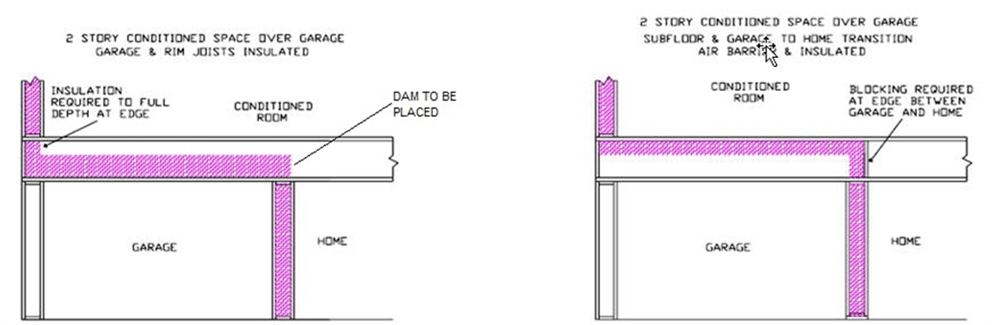
Figure RA3.5-1 Homes with Conditioned Space Over Garage – Batt and Blanket Insulation
The band joist where the garage transitions to an attic above conditioned space shall have an air barrier installed in contact with the edge of the attic insulation.
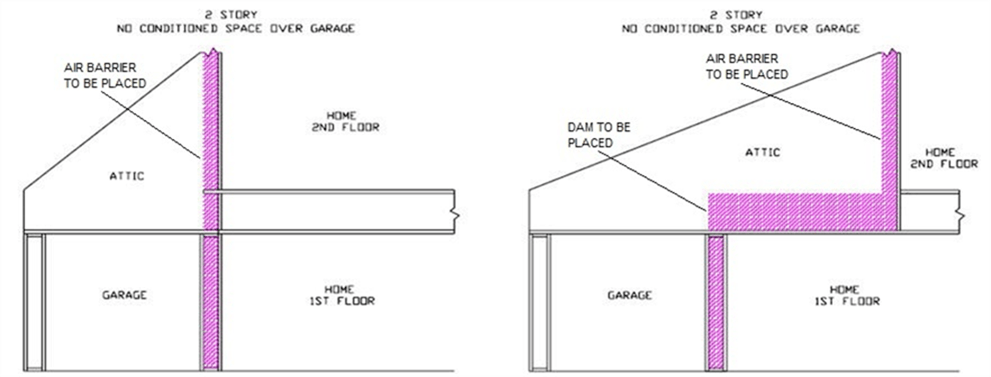
Figure RA3.5-2 Homes with No Conditioned Space Over Garage – Batt and Blanket Insulation
These procedures detail the installation and inspection protocols necessary to qualify for Quality Insulation Installation (QII) of loose-fill insulation. These procedures must be field verified before the building construction permit is finalized.
These procedures are to be followed by the insulation installer and an ECC-rater must verify conformance to meet the requirements of Sections 150.1(c)1E or 170.2(a)6, and 110.7 of the Standards.
This insulation type is manufactured to be blown or sprayed into framed cavity walls, floors, and ceilings. It is installed with or without a net depending on the loose-fill type or in special installations where netting is required, such as below a roof deck or under floors. Its overall R-value is dependent on the installed density and installed thickness. Specific product R-values are readily available from the manufacturer for the specific materials being installed. R-value and coverage chart of the product is typically marked on the bag which the insulation was drawn from and from the manufacturer's product data sheet or product specification information. The installed insulation must meet the R-value stated on the compliance documentation.
- Materials shall comply with, and be installed in conformance with, all applicable building codes for building. California Building Code (including, but not limited to, California Electric Code Section 719) and installed to meet all applicable fire codes.
- Materials shall meet California Quality Standards for Insulating Material, Title 24, Part 12, Chapter 4, Article 3, listed in the California Department of Consumer Affairs Consumer Guide and Directory of Certified Insulating Materials.
- Materials shall comply with flame spread rating and smoke density requirements of Chapter 26 and Section 706 of the Title 24, Part 2: all installations with exposed facings must use fire retardant facings which have been tested and certified not to exceed a flame spread index (FSI) of 25 and a smoke development index (SDI) of 450. Insulation facings that do not touch a ceiling, wall, or floor surface, and faced batts on the undersides of roofs with an air space between the ceiling and facing are considered exposed applications.
- Materials shall be installed according to manufacturer specifications and instructions.
- Hard covers or draft stops shall be placed over all drop ceiling areas and interior wall cavities to keep insulation in place and stop air movement. If hard covers or draft stops are missing or incomplete, they shall be completed before insulation is installed.
- Required eave ventilation shall not be obstructed - the net free-ventilation area of the eave vent shall be maintained.
- Eave vent baffles shall be installed to prevent air movement under or into the batt.
- Insulation shall cover all recessed lighting fixtures. If the fixtures are not rated for insulation contact (IC) and air tight, the fixtures shall be replaced.
- All recessed light fixtures that penetrate the ceiling shall be listed for zero clearance insulation contact (IC), have a label that certifies it as airtight with leakage less than 2.0 cfm @ 75 Pa when tested to ASTM E283, and shall be sealed with a gasket or caulk between the light's housing and the ceiling.
- Loose-fill insulation shall be must completely fill the framed cavity.
- Loose-fill insulation shall be installed so that they will be in contact with the air barrier.
The ECC-rater shall measure the installed thickness and density of insulation in at least 6 random locations on walls, roof/ceilings, and floors (i.e., 6 measurements per opaque surface type: wall, roof/ceiling, or floor) to ensure minimum thickness levels and the installed density meets the R-value specified on the Certificate of Compliance, and all other required compliance documentation. For walls, measurement areas shall include low and high areas of the insulated assembly and the ECC-rater shall verify density measurements are consistent with the manufacturer's coverage chart.
- All provisions of Residential Appendix RA2 shall be met. All Insulation Certificates of Installation signed by the insulation installer shall be provided stating the installation is consistent with the Certificate of Compliance, plans and specifications for which the building permit was issued. The insulation installer shall complete all applicable sections of the Certificate of Installation form and attach a bag label or a manufacturer's coverage chart for every different type of loose-fill insulation material used.
- For loose-fill insulation, compliance information shall include the minimum installed weight-per-square-foot (or the minimum weight per cubic foot) consistent with the manufacturer's labeled installed-design-density for the desired R-value, and the number of inches required to achieve the desired R-value.
All provisions of Residential Appendix RA2 shall be met. The Insulation Certificate of Installation, with insulation material bag labels or coverage charts attached, signed by the insulation installer, shall be available on the building site for each of the ECC-rater's verification inspections.
Note: The ECC-rater cannot verify compliance credit without these completed forms.
- Wall stud cavities shall be caulked, foamed, or otherwise sealed to provide a substantially air-tight envelope to the outdoors, attic, garage and crawl space. Special attention shall be paid to plumbing and wiring penetrations through the top plates, electrical boxes that penetrate the sheathing, and the sheathing seal to the bottom plate. All gaps in the air barrier shall be caulked or sealed with expansive, or minimally expansive, foam.
- Bottom plates of framed and non-framed assemblies shall be sealed to the ground subfloor or slab, and above ground subfloor.
- Insulation shall uniformly fill the cavity side-to-side, top-to-bottom, and front-to-back.
- Loose fill insulation shall be installed to fill the cavity and be in contact with the sheathing on the back and the wallboard on the front - no gaps or voids.
- Loose fill wall insulation shall be installed to fit around wiring, plumbing, and other obstructions.
- Non-standard-width cavities shall be filled with insulation fitted into the space without excessive compression.
- The installer shall certify on the Certificate of Installation forms that the manufacturer's minimum weight-per-square-foot requirement has been met.
- Non-standard width cavities shall be filled with insulation to snuggly fit into the space, or with minimally expansive foam sealing material.
- Narrow spaces less than 1 inch in width at windows and door jambs, shall be filled with minimally expansive foam sealing. In cases where the manufacturer's warranty would be void if minimally expanding foam is used to seal the gap between the window frame or door jamb, the cavity must be airtight and filled with insulation snuggly fitted (with limited compression) in the space.
- Narrow spaces less than 2 inches in width, such as between studs at building corners, and at the intersection of interior partition walls to exterior walls, shall be filled with insulation snuggly fitted in the space, or with minimally expansive foam sealing.
- Hard to access wall stud cavities, such as; corner channels, wall intersections, and behind tub/shower enclosures shall be insulated to the proper R-value. In most cases this can only be completed prior to the installation of the tub/shower enclosure, the exterior sheathing, or the exterior stucco lath.
- An air barrier shall be installed on the inside of the exterior wall(s) directly adjacent to the tub/shower enclosure.
- Insulation shall completely fill around wiring and plumbing without compression.
- Insulation shall fill between the sheathing and the rear of electrical boxes and phone boxes.
- In cold climates, where water pipes may freeze (such as Climate Zones 2, 11-14 and 16) pipes shall have at least 1/2 of the insulation between the water pipe and towards the outside surface of the exterior wall. As much insulation as possible shall be placed between the pipe and the outside (without compression), and remaining insulation shall be placed between the pipe and the interior assembly material.
- All rim-joists shall be insulated to the same R-value as the adjacent walls.
- The insulation shall be installed without gaps, voids, or excessive compression.
- Framing for kneewalls and skylight shafts that separate conditioned from unconditioned space shall be insulated to meet or exceed the wall R-value specified on the Certificate of Compliance, and all other required compliance documentation.
- The insulation shall be installed without gaps or compression.
- Steel-framed kneewalls and skylight shafts, shall meet or exceed the mandatory minimum insulation requirements and external surfaces of steel studs shall be covered with continuous insulation unless otherwise specified on the Certificate of Compliance using correct U-factors from Joint Appendix JA4, Table 4.3.4 (or U-factors approved by the Commission Executive Director).
- The backside of air permeable insulation exposed to the unconditioned attic space shall be completely covered with a continuous air barrier.
- The house side of the insulation shall be in contact with the drywall or other wall finish.
- The insulation shall be supported so that it will not fall down by using support such as netting.
- Insulation for all kneewall and skylight shafts shall be completely enclosed by vertical and horizontal framing, including horizontal plates at top and bottom of the insulation.
Walls of interior closets for HVAC and/or water heating equipment, which require combustion air venting, shall be insulated to at least the same R-value as other demising walls (i.e., walls separating conditioned space and attached garage), or as specified on the Certificate of Compliance.
- Insulation shall fill the entire cavity; or, an additional air barrier shall be installed inside the double wall or bump-out and in contact with the insulation so that the insulation fills the cavity formed with the additional air barrier.
- Entire double walls and framed bump-outs shall be air-tight.
- Framing and bracing used for structural purposes shall be identified on plan documents with diagrams and/or design drawings.
- Insulation shall be installed in a manner that restricts thermal bridging through the structural framing assembly.
- Insulation shall be applied to fully enclose and/or adhere to all sides and ends of structural assembly framing that separate conditioned from unconditioned space.
- The structural portions of assemblies shall be air tight.
- All single-member window and door headers shall be insulated to a minimum of R-3 for a 2x4 framing, or equivalent width, and a minimum of R-5 for all other assemblies. Insulation is to be placed between the interior face of the header and inside surface of the interior wall finish.
- No header insulation is required for single-member headers that are the same width as the wall, provided that the entire wall has at least R-2 insulation.
- In unvented attics, where insulation is applied directly to the underside of the roof deck, framing for gable ends that separate the unvented attic from unconditioned space shall be insulated to meet or exceed the wall R-value of the adjacent exterior wall construction as specified on the Certificate of Compliance.
- The backside of air permeable insulation exposed to the unconditioned attic space shall be completely covered with a continuous air barrier.
- Hard covers or draft stops shall be placed over all drop ceiling areas and interior wall cavities to keep insulation in place and stop air movement. If hard covers or draft stops are missing or incomplete, they shall be completed before insulation is installed or the entire drop area shall be filled with loose-fill insulation level with the rest of the attic.
- Baffles shall be placed at eaves or soffit vents of vented attics to keep insulation from blocking eave ventilation and prevent air movement under or into the insulation. The required net-free ventilation shall be maintained.
- Attic rulers appropriate to the material shall be installed and evenly distributed throughout the attic to verify depth: one ruler for every 250 square feet and clearly readable from the attic access. Attic rulers shall be scaled to read inches of insulation and the R-value installed.
- Insulation shall be applied underneath and on both sides of obstructions such as cross-bracing and wiring.
- Insulation shall be applied all the way to the outer edge of the wall top plate.
- All recessed light fixtures that penetrate the ceiling shall be listed for zero clearance insulation contact (IC), have a label that certifies it as airtight with leakage less than 2.0 cfm @ 75 Pa when tested to ASTM E283, and shall be sealed with a gasket or caulk between the light's housing and the ceiling.
- Insulation shall cover recessed lighting fixtures. Fixtures that are not rated for insulation contact (IC), and airtight, shall be removed and/or replaced.
- Insulation shall be kept away from combustion appliance flues in accordance with flue manufacturer's installation instructions or labels on the flue.
- Insulation shall be blown to a uniform thickness throughout the attic with all areas meeting or exceeding the insulation manufacturer's minimum requirements for depth and weight-per-square-foot.
- The installer shall certify on the Certificate of Installation forms that the manufacturer's minimum weight-per-square-foot requirement has been met.
- The ECC-rater shall verify that the manufacturer's minimum weight-per-square-foot requirement has been met for attics insulated with loose-fill insulation. Verification shall be determined using the methods of the Insulation Contractor’s Association of America (ICAA) Technical Bulletin #17 or #33 except that only one sample shall be taken in the area that appears to have the least amount of insulation. The rater shall record the weight-per-square-foot of the sample on the Certificate of Verification.
- The ECC-rater shall verify that the manufacturer’s minimum insulation thickness has been installed. For cellulose insulation, this verification shall take into account the time that has elapsed since the insulation was installed. At the time of installation, the insulation shall be greater than or equal to the manufacturer’s minimum initial insulation thickness. If the ECC-rater does not verify the insulation thickness at the time of installation, and if the insulation has been in place less than fourteen days, the insulation thickness shall be greater than the manufacturer’s minimum required thickness to achieve the given R-value at the time of installation, less 1/2 inch to account for settling. If the insulation has been in place for fourteen days or more, the insulation thickness shall be greater than or equal to the manufacturer’s minimum required settled thickness to achieve the given R-value.
- An air space shall be maintained between the insulation and roof sheathing as specified by California Building Code Sections 1203.2 and R806.2, or as specified by the local building department.
- Insulation installed in unvented rafter ceilings or to the underside of unvented roofs with an attic below shall have an R-value conforming to compliance documentation and the air barrier shall be uniform across the transition of roof to wall. The insulation shall be in contact with the air barrier.
- Loose-fill insulation shall be placed below any platform or catwalk for HVAC equipment installation and access.
- Loose-fill insulation shall be installed so that it will be in contact with the air barrier.
- Loose-fill insulation shall be installed under HVAC platform to the full depth and rated R-value as specified on the Certificate of Compliance, without gaps or compression. If necessary, HVAC platform shall be raised to accommodate ceiling insulation.
Permanently attach rigid board insulation or batt or blanket insulation with the appropriate R-value to the access door using adhesive or mechanical fastener. The bottom of the attic access shall be gasketed to prevent air leakage of conditioned air to the unconditioned attic.
- Below roof deck loose-fill insulation shall be netted and installed per manufacturer's specifications.
- For vented attics, below deck loose-fill insulation shall be installed in a manner that does not obstruct soffit, eave, ridge, or eyebrow vents to allow for adequate attic ventilation. Netting shall be installed in a manner that allows for the required net free area of soffit, eave, gable, and roof vents to be maintained after being filled. Eave vent baffles shall be installed to prevent air movement under or into the insulation.
- Netting shall be installed to seal around conduit, plumbing, roof penetrations and all other obstructions that penetrate the netting.
- Loose-fill insulation shall be installed uniformly in the netted cavity side-to-side, top-to-bottom, and front-to-back and be in continuous contact with the roof sheathing. Loose-fill insulation shall be installed to fit around wiring, conduit, plumbing, and other obstructions.
- The installer shall certify on the Certificate of Installation compliance documents that the manufacturer's minimum weight-per-square-foot requirement has been met.
- The ECC-Rater shall verify that the manufacturer's minimum insulation thickness and specified R-value has been installed.
- The ECC-Rater shall verify the minimum weight-per-square-foot requirement has been met. Verification shall be determined using manufacturer's recommended verification procedures. The ECC-Rater shall record the weight-per-square-foot of the sample on the Certificate of Verification.
- Box netted installations are where netting is suspended from the top of roofing framing member, or top chord, to provide a fill depth that completely encloses the top chord, creating a uniform insulation layer of loose-fill insulation across the entire underside of the roof deck. For these installations, netted insulation cavity thickness shall be uniform and meet the minimum insulation thickness.
- For draped netted installations, where netting is attached directly to the bottom of the roof framing member, the ECC-Rater shall verify that average insulation depth in the cavity meets the depth as specified by the Certificate of Compliance.
- Loose-fill insulation shall be in contact with the air barrier - usually the subfloor.
- Loose-fill insulation shall completely fill around wiring and plumbing.
- Loose-fill insulation shall be properly supported where necessary to avoid sagging, gaps, voids, and compression.
- Loose-fill insulation shall be in contact with the air barrier - usually the subfloor.
- On floors that are over garages, or where there is an air space between the insulation and the subfloor, the rim joist shall be insulated.
- Loose-fill insulation shall completely fill around wiring and plumbing.
- Loose-fill insulation shall be properly supported to avoid sagging, gaps, voids, and compression.
The separation between conditioned space (house) and the garage shall be insulated with fully supported loose-fill insulation to create a continuous thermal barrier. All rim and band joists adjoining conditioned space shall be airtight and insulated.
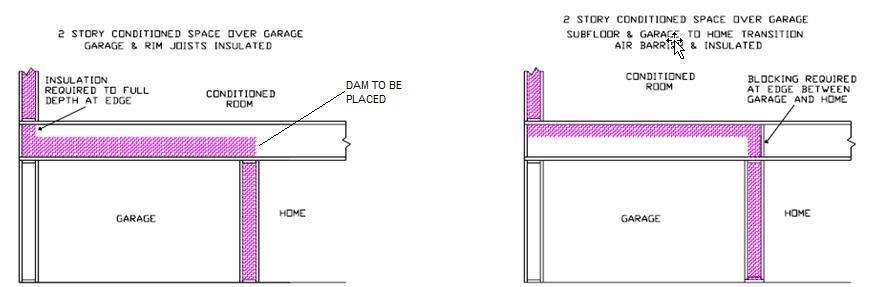
Figure RA3.5-3 Homes with Conditioned Space Over Garage – Loose Fill Insulation
The band joist where the garage transitions to an attic above conditioned space shall have an air barrier installed in contact with the edge of the attic insulation.
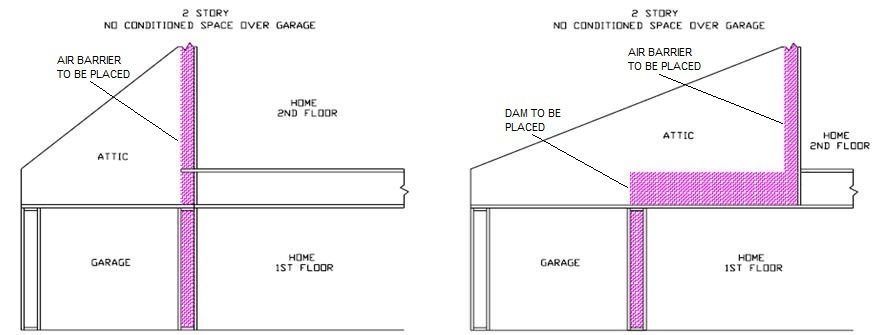
Figure RA3.5-4 Homes with No Conditioned Space over Garage – Loose Fill Insulation
These procedures detail the installation and inspection protocols necessary to qualify for Quality Insulation Installation (QII) of rigid board insulation sheathing material. These procedures must be field verified before the building construction permit is finalized.
These procedures are to be followed by the insulation installer and an ECC-rater must verify its conformance for meeting the requirements of Sections 150.1(c)1E or 170.2(a)6, and 110.7 of the Standards.
This insulation type is manufactured of different materials and is in sheet or board form. Rigid board insulation materials are typically used on the exterior side of framed wall assemblies and over the top of exterior roof decks. These products also may be used for special situations in rafter spaces of cathedral ceilings, floors, at floor rim joists, and within or on the outside of window and door headers. This insulation type may also be integral to exterior siding materials. Rigid board insulation material most often is used in conjunction with other insulation materials installed within the framed cavity. The R-value is dependent on the type of material and its thickness. Specific product R-values are readily available from the manufacturer for the specific materials being installed. R-value of the product is typically marked on the product. The installed insulation must meet the R-value stated on the compliance documentation.
- Requirements for Walls, Ceilings and Floors Materials shall comply with, and be installed in conformance with, all applicable building codes for building. California Building Code (including, but not limited to, California Electric Code Section 719) and installed to meet all applicable fire codes.
- Materials shall meet California Quality Standards for Insulating Material, Title 24, Part 12, Chapter 4, Article 3, listed in the California Department of Consumer Affairs Consumer Guide and Directory of Certified Insulating Materials.
- Materials shall comply with flame spread rating and smoke density requirements of Chapter 26 and Section 706 of the Title 24, Part 2: all installations with exposed facings must use fire retardant facings which have been tested and certified not to exceed a flame spread index (FSI) of 25 and a smoke development index (SDI) of 450. Insulation facings that do not touch a ceiling, wall, or floor surface, and faced batts on the undersides of roofs with an air space between the ceiling and facing are considered exposed applications.
- Materials shall be installed according to manufacturer specifications and instructions.
- Rigid board insulation shall be attached according to the manufacturer's specifications.
- Rigid board insulation may be used as the air barrier provided it has been tested to conform to the air barrier performance conditions of the Standards.
The ECC-raters shall verify the installed thickness of insulation in all assemblies and locations on walls, roof/ceilings, and floors, and to ensure that insulation levels and installation integrity meet the R-value specified on the Certificate of Compliance, and all other required compliance documentation.
All provisions of Residential Appendix RA2 shall be met. All Insulation Certificates of Installation signed by the insulation installer shall be provided stating the installation is consistent with the Certificate of Compliance, plans and specifications for which the building permit was issued. The insulation installer shall also complete the applicable sections of the Certificate of Installation form and attach a product specification or data sheet for every insulation material used.
All provisions of Residential Appendix RA2 shall be met. The Insulation Certificate of Installation, with insulation material labels or specification/data sheets attached, signed by the insulation installer, shall be available on the building site for each of the ECC rater's verification inspections.
Note: The ECC-rater cannot verify compliance credit without these completed forms.
- Wall stud cavities shall be caulked, foamed, or otherwise sealed to provide a substantially air-tight envelope to the outdoors, attic, garage and crawl space. All plumbing and wiring penetrations through the top and bottom plates and electrical boxes that penetrate the sheathing shall be sealed. All gaps in the air barrier shall be caulked or sealed with minimally expansive foam.
- Bottom plates of framed and non-framed assemblies shall be sealed to the ground subfloor or slab, and above ground subfloor.
- Installation shall uniformly fit across the plane of the wall and taping and/or caulking of all joints and seams of the insulation shall be maintained to be considered as the air barrier.
- Non-standard with cavities shall be filled with insulation to snuggly fit into the space, or with minimally expansive foam sealing material.
- Narrow spaces less than 1 inch in width at windows and door jambs, shall be filled with minimally expansive foam sealing material. In cases where the manufacturer's warranty would be void if minimally expanding foam is used to seal the gap between the window frame or door jamb, the cavity must be airtight and filled with insulation snuggly fitted in the space.
- Narrow spaces less than 2 inches in width, such as between studs at building corners, and at the intersection of interior partition walls to exterior walls, shall be filled with insulation snuggly fitted in the space, or with minimally expansive foam sealing.
- Hard to access wall stud cavities, such as corner channels, wall intersections, and behind tub/shower enclosures shall be insulated to the proper R-value. In most cases this can only be completed prior to the installation of the tub/shower enclosure, the exterior sheathing, or the exterior stucco lath.
- An air barrier shall be installed on the inside of the exterior wall(s) directly adjacent to the tub/shower enclosure.
- Penetrations and obstructions to the insulation shall be completely caulked and sealed.
- Insulation shall fill between the sheathing and the rear of electrical boxes and phone boxes.
- All rim-joists shall be insulated to the same R-value as the adjacent walls.
- The insulation shall be installed without gaps and voids.
- Framing for kneewalls and skylight shafts that separate conditioned from unconditioned space shall be insulated to meet or exceed the wall R-value specified on the Certificate of Compliance, and all other required compliance documentation.
- Steel-framed kneewalls and skylight shafts shall meet or exceed the mandatory minimum insulation requirements and external surfaces of steel studs shall be covered with continuous insulation unless otherwise specified on the Certificate of Compliance using correct U-factors from Joint Appendix JA4, Table 4.3.4 (or U-factors approved by the Commission Executive Director).
- The backside of air permeable insulation exposed to the unconditioned attic space shall be completely covered with a continuous air barrier.
Walls of interior closets for HVAC and/or water heating equipment, which require combustion air venting, shall be insulated to at least the same R-value as other demising walls (i.e., walls separating conditioned space and attached garage), or as specified on the Certificate of Compliance.
- Insulation shall fill the entire cavity; or, an additional air barrier shall be installed inside the double wall or bump-out and in contact with the insulation so that the insulation fills the cavity formed with the additional air barrier.
- Entire double walls and framed bump-outs shall be air-tight.
- Framing and bracing used for structural purposes shall be identified on plan documents with diagrams and/or design drawings.
- Insulation shall be installed in a manner that restricts thermal bridging through the structural framing assembly.
- Insulation shall be applied to fully enclose and/or adhere to all sides and ends of structural assembly framing that separate conditioned from unconditioned space.
- The structural portions of assemblies shall be air tight.
- All single-member window and door headers shall be insulated to a minimum of R-3 for a 2x4 framing, or equivalent width, and a minimum of R-5 for all other assemblies. Insulation is to be placed between the interior face of the header and inside surface of the interior wall finish wall material.
- No header insulation is required for single-member headers that are the same width as the wall, provided that the entire wall has at least R-2 insulation.
- In unvented attics, where insulation is applied directly to the underside of the roof deck, framing for gable ends that separate the unvented attic from unconditioned space shall be insulated to meet or exceed the wall R-value of the adjacent exterior wall construction as specified on the Certificate of Compliance.
- The backside of air permeable insulation exposed to the unconditioned attic space shall be completely covered with a continuous air barrier.
- Baffles shall be placed at eaves or soffit vents of vented attics to keep insulation from blocking eave ventilation and prevent air movement under the insulation. The required net-free ventilation shall be maintained.
- Hard covers or draft stops shall be placed over all drop ceiling areas and interior wall cavities to keep insulation in place and stop air movement. If hard covers or draft stops are missing or incomplete, they shall be completed before insulation is installed.
- Rigid board insulation installed above the roof deck shall be applied to the outer edge of the plane of the wall top plate.
- Insulation shall cover all recessed lighting fixtures. If the fixtures are not rated for insulation contact (IC) and airtight, the fixtures shall be removed and/or replaced.
- All recessed light fixtures that penetrate the ceiling shall be listed for zero clearance insulation contact (IC), have a label that certifies it as airtight with air leakage less than 2.0 cfm @ 75 Pa when tested to ASTM E283, and shall be sealed with a gasket or caulk between the light's housing and the ceiling.
- An air space shall be maintained between the insulation and roof sheathing as specified by California Building Code Section 1203.2 and R806.2, or as specified by the local building department.
- Insulation installed in unvented rafter ceilings or to the underside of unvented roofs with an attic below shall have an R-value conforming to compliance documentation and the air barrier shall be uniform across the transition of roof to wall. The insulation shall be in contact with the air barrier.
Insulation shall be placed below any platform or catwalk for HVAC equipment installation and access.
Permanently attach rigid board insulation or batt or blanket insulation with the appropriate R-value to the access door using adhesive or mechanical fastener. The bottom of the attic access shall be gasketed to prevent air leakage of conditioned air to the unconditioned attic.
Rigid board insulation shall be in contact with the air barrier - usually the subfloor.
- Rigid board insulation shall be in contact with the air barrier - usually the subfloor.
- On floors that are over garages, or where there is an air space between the insulation and the subfloor, the rim joist shall be insulated.
The separation between conditioned space (house) and the garage shall be insulated with fully supported rigid board insulation to create a continuous thermal barrier. All rim and band joists adjoining conditioned space shall be airtight and insulated.
The band joist where the garage transitions to an attic above conditioned space shall have an air barrier installed in contact with the edge of the attic insulation.
These procedures detail the installation and inspection protocols necessary to qualify for Quality Insulation Installation (QII) of spray polyurethane foam (SPF) insulation. These procedures must be field verified before the building construction permit is finalized.
These procedures are to be followed by the insulation installer and an ECC-rater must verify its conformance for meeting the requirements of Sections 150.1(c) and 110.7 of the Standards.
These procedures apply to two types of SPF used as building insulation: medium density closed cell SPF (ccSPF) and low-density open cell SPF (ocSPF). Most often, the same procedures will apply to both ccSPF and ocSPF. However, in some construction situations the procedures will be different.
NOTE: SPF insulation shall be field verified using these procedures whenever R-values other than the default R-value per inch are used for compliance (see "R-value" in sections RA3.5.6.1.1 and RA3.5.6.1.2 below).
A spray applied polyurethane foam insulation having a closed cellular structure resulting in an installed nominal density of 1.5 to less than 2.5 pounds per cubic foot (pcf).
R-value: The total R-value shall be calculated based on the nominal required thickness of the insulation multiplied by a thermal resistivity of 5.8 per inch. The R-value of ccSPF insulation shall meet or exceed the installed thickness specified in Table 3.5-1 below.
Alternatively, the total R-value may be calculated based on the thickness of insulation multiplied by the "tested R-value per inch" as certified by the Department of Consumer Affairs, Bureau of Household Goods and Services. Supporting documentation showing the certified R-value per inch shall be made available at the site for verification and noted on the Certificate of Installation. Based on this calculation, the overall assembly U-factor shall be determined by selecting the assembly type, framing configuration, and cavity insulation from the appropriate Reference Joint Appendix JA4 table or other approved method specified in Section JA4 of the Reference Appendices.
The R-value of the installed insulation shall be based on the verified thickness at an R-value of 5.8 per inch unless supporting documentation is provided that verifies use of other values. Approved compliance software shall make appropriate adjustments to account for the R-value and U-factor effects of the ccSPF assembly.
Nominal Thickness: ccSPF sprayed into framed cavities or on flat surfaces will expand with variable thicknesses, visibly appearing as undulations on the surface of the insulation. The average thickness of the foam insulation must meet or exceed the required R-value. Depressions in the foam insulation’s surface shall not be greater than 1/2-inch of the required thickness at any given point of the surface area being insulated.
Filling of Framed Assemblies: ccSPF insulation is not required to fill the cavities of framed assemblies provided the installed thickness of insulation conforms to compliance documentation and that the bottom and top plates of vertical framing and both ends of horizontal framing, including band and rim joists, are sprayed to completely fill the cavity adjacent to and in contact with the framing to a distance of 2.0 inches away from the framing for ccSPF insulation, or filled to the thickness meeting ASTM testing as an air barrier.
Air Barrier: ccSPF installed as an air barrier shall be a minimum of 2.0 inches in thickness; alternatively, ccSPF insulation shall be installed at a thickness that meets an air permeance no greater than 0.02 L/s-m2 at 75 Pa pressure differential when tested in accordance to ASTM E2178 or ASTM E283.
A spray applied polyurethane foam insulation having an open cellular structure resulting in an installed nominal density of 0.4 to less than 1.5 pounds per cubic foot (pcf).
R-value: The total R-value shall be calculated based on the nominal required thickness of the insulation multiplied by a thermal resistivity of 3.6 per inch. The R-value of ocSPF insulation shall meet or exceed the installed thickness specified in Table 3.5-1 below.
Alternatively, the total R-value may be calculated based on the thickness of insulation multiplied by the "tested R-value per inch" as certified by the Department of Consumer Affairs, Bureau of Household Goods and Services. Supporting documentation showing the certified R-value per inch shall be made available at the site for verification and noted on the Certificate of Installation. Based on this calculation, the overall assembly U-factor shall be determined by selecting the assembly that matches the assembly type, framing configuration, and cavity insulation from the appropriate Reference Joint Appendix JA4 table or other approved method specified in Section JA4 of the Reference Appendices.
The R-value of the installed insulation shall be based on the verified thickness at an R-value of 3.6 per inch unless supporting documentation is provided that verifies use of other values. Approved compliance software shall make appropriate adjustments to account for the R-value and U-factor effects of the ocSPF assembly.
Nominal Thickness: ocSPF sprayed into framed cavities or on flat surfaces will expand with variable thicknesses, visibly appearing as undulations on the surface of the insulation. The average thickness of the foam insulation must meet or exceed the required R-value. Depressions in the foam insulation surface shall not be greater than 1/2-inch of the required thickness provided these depressions do not exceed 10% of the surface area being insulated.
Filling of Framed Assemblies: ocSPF insulation shall completely fill cavities of 2x4 inch framing or less. Cavities greater than 2x4 inch framing dimensions may be filled to the thickness that meets the required R-value used for compliance provided that the bottom and top plates of vertical framing and both ends of horizontal framing, including band and rim joists, are sprayed to completely fill the cavity adjacent to and in contact with the framing to a distance of 5.5 inches away from the framing for ocSPF insulation, or filled to the thickness meeting ASTM testing as an air barrier.
Air Barrier: ocSPF installed as an air barrier shall be a minimum of 5.5 inches in thickness; alternatively, ocSPF insulation shall be installed at a thickness that meets an air permeance no greater than 0.02 L/s-m2 at 75 Pa pressure differential when tested in accordance to ASTM E2178 or ASTM E283.
| Equivalent R-Values for SPF insulation | 11 | 13 | 15 | 19 | 21 | 22 | 25 | 30 | 38 |
| Required thickness of ccSPF insulation @ R5.8/inch | 2.00 | 2.25 | 2.75 | 3.50 | 3.75 | 4.00 | 4.50 | 5.25 | 6.75 |
| Required thickness of ocSPF insulation @ R3.6/inch | 3.0 | 3.5 | 4.2 | 5.3 | 5.8 | 6.1 | 6.9 | 8.3 | 10.6 |
- Materials shall comply with, and be installed in conformance with, all applicable building codes for building. California Building Code (including, but not limited to, California Electric Code Section 719) and installed to meet all applicable fire codes.
- Materials shall meet California Quality Standards for Insulating Material, Title 24, Part 12, Chapter 4, Article 3, listed in the California Department of Consumer Affairs Consumer Guide and Directory of Certified Insulating Materials.
- Materials shall comply with flame spread index and smoke developed index requirements of the CBC, Title 24, Part 2, Section 2603.5.4.
- The installer shall determine, and the ECC-rater shall verify, that the manufacturer’s nominal insulation thickness has been installed and certified and that all requirements of the Certificate of Verification have been met.
- The installer shall determine, and the ECC-rater shall verify, that insulation is in substantial contact with the assembly air barrier. When SPF insulation is being used to provide air barrier control, the SPF insulation must cover and be in contact with the entire surface of the framing, filling the cavity to a distance away from the framing specified in "Filling of Framed Assemblies" above.
- SPF insulation shall be applied by SPF applicators trained and experienced in the use and maintenance of high-pressure, plural-component equipment. SPF applicators shall be certified by the SPF insulation manufacturer for the application of SPF insulation systems.
- SPF insulation shall be spray-applied to fully adhere to assembly framing, floor and ceiling the joists, and other framing surfaces within the construction cavity. When multiple layers of SPF material are applied, each foam lift (i.e., spray application) shall have adhesion at substrate and foam interfaces. SPF insulation shall not exhibit areas that:
- Have voids or gaps in the uniformity of the insulation
- Are extremely soft or spongy
- Show the presence of liquid
- Have blistering between lifts
- Show differences in coloration of adjacent foam layers
- Indicate the presence of other materials between lifts
- SPF insulation shall be installed in conformance with the manufacturer’s specifications, recommendations, and temperature/humidity limitations.
- Substrates to which SPF insulation is applied shall be secure and free of surface moisture, frost, grease, oils, dirt, dust, or other contaminants that would adversely affect SPF adhesion.
- SPF insulation shall meet all provisions of the CBC Title 24, Parts 2 and 2.5. SPF shall be separated from occupied spaces by an approved thermal barrier, such as 0.5 inch gypsum wallboard or other approved material, or show equivalence through testing in accordance with CBC, Title 24, Part 2, Section 2603, and Part 2.5, Section R316.
- SPF insulation may be used as the air barrier provided it has been tested to conform to the air barrier performance conditions of the Standards.
- The ECC-rater shall measure the installed thickness of insulation in at least 6 random locations on walls, roof/ceilings, and floors (i.e., 6 measurements per opaque surface type: wall, roof/ceiling, or floor) to ensure minimum thickness levels necessary to meet the R-value specified on the Certificate of Compliance, and all other required compliance documentation. Measurement areas shall include low and high areas of the SPF insulated surface.
- Probes for inspection of installed thickness of SPF insulation. The insulation thickness shall be verified by using a probe, gauge, or device capable of measuring the installed thickness of insulation. A pointed measurement probe or other gauge or device, capable of penetrating the full thickness of the insulation, shall be used having measurements marked by at least one-eighth inch increments. Insulation thickness measurement probes and gauges or devices shall be accurate to within ±1/8 inch and shall be designed and used in a manner to cause minimal damage to the insulation.
All provisions of Residential Appendix RA2 shall be met. The Insulation Certificates of Installation shall be signed by the SPF applicator stating that the installation is consistent with the Certificate of Compliance, plans and specifications for which the building permit was issued shall be provided. The SPF applicator shall also make available supporting documentation showing the certified R-value per inch.
All provisions of Residential Appendix RA2 shall be met. All compliance documentation shall be completed, signed by the SPF applicator, and a measuring probe or similar device shall be available at the building site for the ECC-rater's verification inspection. Note: The ECC-rater shall not verify compliance credit without these completed forms.
- SPF insulation shall be applied to provide an air-tight envelope to the outdoors and between adjoining cavity surfaces of conditioned and unconditioned space, such as the: attic, garage, and crawl space. Special attention shall be paid to plumbing and wiring penetrations through the top plates and bottom plate framing, and electrical boxes that penetrate the sheathing and the sheathing seal to the top and bottom plate framing.
- Bottom plates of framed and non-framed assemblies shall be sealed to the ground subfloor or slab, and above ground subfloor.
- SPF insulation installation shall uniformly cover the cavity side-to-side and end-to-end and shall be installed to cover and form an air barrier on the framing at the top, bottom and sides of each cavity.
NOTE:
Filling of Framed Assemblies: ccSPF insulation is not required to fill the cavities of framed assemblies provided the installed thickness of insulation conforms to compliance documentation and that the bottom and top plates of vertical framing and both ends of horizontal framing, including band and rim joists, are sprayed to completely fill the cavity adjacent to and in contact with the framing to a distance of 2.0 inches away from the framing for ocSPF insulation, or filled to the thickness meeting ASTM testing as an air barrier.
Filling of Framed Assemblies: ocSPF insulation shall completely fill cavities of 2x4 inch framing or less. Cavities greater than 2x4 inch framing dimensions may be filled to the thickness that meets the required R-value used for compliance provided that the bottom and top plates of vertical framing and both ends of horizontal framing, including band and rim joists, are sprayed to completely fill the cavity adjacent to and in contact with the framing to a distance of 5.5 inches away from the framing for ocSPF insulation, or filled to the thickness meeting ASTM testing as an air barrier.
Air Barrier: ccSPF installed as an air barrier shall be 2.0 inches in thickness. ocSPF installed as an air barrier shall be a minimum of 5.5 inches in thickness. Alternatively, ccSPF and ocSPF insulation shall be installed at a thickness that meets an air permeance no greater than 0.02 L/s-m2 at 75 Pa pressure differential when tested in accordance with ASTM E2178 or ASTM E283.
- Non-standard width cavities shall be filled with SPF insulation at a depth consistent with the SPF thickness required to achieve the specified R-value.
- Narrow spaces less than 1 inch in width at windows and door jambs, shall be filled with minimally expansive foam sealing material or SPF insulation. In cases where the manufacturer's warranty would be void if minimally expanding foam is used to seal the gap between the window frame or door jamb, the cavity must be airtight and filled with a different insulation product snuggly fitted (with limited compression) in the space.
- Narrow spaces less than 2 inches in width, such as between studs at building corners and at the intersection of interior partition walls, shall be filled with insulation snuggly fitted into the space, with minimally expansive foam, or SPF insulation.
- Hard to access wall stud cavities, such as corner channels, wall intersections, and behind tub/shower enclosures shall be insulated to the proper R-value. In most cases, this can only be completed prior to the installation of the tub/shower enclosure, the exterior sheathing, or the exterior stucco lath.
- An air barrier shall be installed on the inside of the exterior wall(s) directly adjacent to the tub/shower enclosure.
- SPF insulation shall be applied to fully seal around wiring and plumbing.
- SPF insulation shall be applied to fully seal between the sheathing and the rear of electrical boxes and telephone boxes.
- In cold climates, where water pipes may freeze (Climate Zones 14 and 16), pipes shall have at least 2/3 of the insulation between the water pipe and the outside surface of the exterior wall. If the pipe is near the exterior finish assembly layers, as much insulation as possible shall be placed between the pipe and the exterior assembly material.
- All rim-joists shall be insulated to the same R-Value as the adjacent walls.
- The insulation shall be installed without gaps or voids.
- Framing for kneewalls and skylight shafts that separate conditioned from unconditioned space shall be insulated to meet or exceed the wall R-value specified on the Certificate of Compliance, and all other required compliance documentation.
- Kneewalls within conditioned space do not need to be insulated.
- Steel-framed kneewalls and skylight shafts shall meet or exceed the mandatory minimum insulation requirements and external surfaces of steel studs shall be covered with continuous insulation unless otherwise specified on the Certificate of Compliance using correct U-factors from Joint Appendix JA4, Table 4.3.4 (or U-factors approved by the Commission Executive Director).
- The backside of air permeable insulation exposed to the unconditioned attic space shall be completely covered with a continuous air barrier.
- The house side of the insulation shall be in contact with the drywall or other wall finish.
- Insulation for all kneewall and skylight shafts shall be completely enclosed by vertical and horizontal framing, including horizontal plates at top and bottom of the insulation.
- SPF insulation shall be installed without gaps.
- SPF insulation shall be fully adhered and self-supporting so that it will remain in place.
NOTE:
Filling of Framed Assemblies: ccSPF insulation is not required to fill the cavities of framed assemblies provided the installed thickness of insulation conforms to compliance documentation and that the bottom and top plates of vertical framing and both ends of horizontal framing, including band and rim joists, are sprayed to completely fill the cavity adjacent to and in contact with the framing to a distance of 2.0 inches away from the framing for ocSPF insulation, or filled to the thickness meeting ASTM testing as an air barrier.
Filling of Framed Assemblies: ocSPF insulation shall completely fill cavities of 2x4 inch framing or less. Cavities greater than 2x4 inch framing dimensions may be filled to the thickness that meets the required R-value used for compliance provided that the bottom and top plates of vertical framing and both ends of horizontal framing, including band and rim joists, are sprayed to completely fill the cavity adjacent to and in contact with the framing to a distance of 5.5 inches away from the framing for ocSPF insulation, or filled to the thickness meeting ASTM testing as an air barrier.
Air Barrier: ccSPF installed as an air barrier shall be 2.0 inches in thickness. ocSPF installed as an air barrier shall be a minimum of 5.5 inches in thickness. Alternatively, ccSPF and ocSPF insulation shall be installed at a thickness that meets an air permeance no greater than 0.02 L/s-m2 at 75 Pa pressure differential when tested in accordance with ASTM E2178 or ASTM E283.
Walls of interior closets for HVAC and/or water heating equipment that require combustion air venting, shall be insulated to at least the same R-value as the other demising walls (i.e., walls separating conditioned space and attached garage), or as specified on the Certificate of Compliance.
- Insulation shall fill the entire cavity; or, an additional air barrier shall be installed inside the double wall or bump-out and in contact with the insulation so that the insulation fills the cavity formed with the additional air barrier.
- Entire double walls and framed bump-outs shall be airtight.
- Framing and bracing used for structural purposes shall be identified on plan documents with diagrams and/or design drawings.
- Insulation shall be installed in a manner that restricts thermal bridging through the structural framing assembly.
- Insulation shall be applied to fully enclose and/or adhere to all sides and ends of structural assembly framing that separate conditioned from unconditioned space.
- The structural portions of assemblies shall be air tight.
- All single-member window and door headers shall be insulated to a minimum of R-3 for a 2x4 framing, or equivalent width, and a minimum of R-5 for all other assemblies. Insulation is to be placed between the interior face of the header and inside surface of the interior wall finish.
- No header insulation is required for single-member headers that are the same width as the wall, provided that the entire wall has at least R-2 insulation.
- In unvented attics, where insulation is applied directly to the underside of the roof deck, framing for gable ends that separate the unvented attic from unconditioned space shall be insulated to meet or exceed the wall R-value of the adjacent exterior wall construction as specified on the Certificate of Compliance.
- The backside of air permeable insulation exposed to the unconditioned attic space shall be completely covered with a continuous air barrier.
- SPF insulation shall be applied to fully adhere to the substrate of the ceiling or roof deck.
- SPF insulation shall be applied to fully adhere to the joist and other framing faces to form a complete air seal within the construction cavity.
- SPF insulation shall be spray-applied to fully adhere to and seal around wiring and plumbing.
- Hard covers shall be placed over all drop ceiling areas and interior wall cavities to keep insulation in place and stop air movement. If hard covers, they shall be in place before insulation is installed.
- In vented attics, required eave ventilation shall not be obstructed; the net free-ventilation area of the eave vent shall be maintained.
- In unvented attics where SPF is applied directly to the underside of the roof deck, all gable end areas shall be insulated to the same R-value as the walls and as specified on compliance documentation. It is not necessary to place hard covers over drop ceilings and interior wall cavities in this situation.
- All recessed light fixtures that penetrate the ceiling shall be listed for zero clearance insulation contact (IC), have a label that certifies it as airtight with leakage less than 2.0 cfm @ 75 Pa when tested to ASTM E283, and shall be sealed with a gasket or caulk between the light's housing and the ceiling.
- SPF insulation shall not be applied directly to recessed luminaires unless the recessed luminaire is rated for SPF insulation contact (SPCL) appropriate for use with polyurethane spray foam in accordance with NEMA LE 7-2015. Recessed light fixtures not rated for SPF insulation contact (SPCL) and insulated with SPF insulation shall be separated from the spray foam by a suitable barrier or box as directed in NEMA LSD 57-2018. In a cathedral ceiling installation, where SPF is applied above the luminaire, but not encasing it with foam, the luminaire shall have a minimum 1⁄2-inch air space between the two components.
- SPF insulation shall be kept away from combustion appliance flues in accordance with flue manufacturers' installation instructions or labels on the flue for clearance.
SPF insulation installed in unvented rafter ceilings or to the underside of unvented roofs with an attic below shall have an R-value conforming to compliance documentation and the air barrier shall be uniform across the transition of roof to wall. The insulation shall be in contact with the air barrier.
In attics where entry is made for the service of utilities, SPF shall be protected from ignition in accordance with CBC, Part 2, Section 2603, and Part 2.5, Section R316.
A minimum of 3 inches of ccSPF insulation or 5.3 inches of ocSPF shall be placed below any platform or cat-walk access ways installed in vented attics for HVAC equipment or other needs. The overall assembly R-value shall meet the required R-values specified in the compliance documentation.
A minimum of 3 inches of ccSPF or 5.3 inches of ocSPF insulation shall be applied to the access door assuring good adhesion to the door surface. Alternatively, permanently attach rigid foam or batt insulation with adhesive or mechanical fastener. The overall assembly R-value shall meet the required values specified in the compliance documentation.
- SPF insulation shall be spray-applied to fully adhere to the bottom side of the floor sheathing.
- SPF insulation shall uniformly cover the cavity side-to-side and end-to-end.
- SPF insulation shall be spray-applied to fully adhere to the bottom side of the floor sheathing.
- SPF insulation installation shall uniformly cover the cavity side-to-side and end-to-end.
The separation between conditioned space (house) and the garage shall be insulated by spraying SPF insulation to create a continuous thermal barrier. All rim and band joists adjoining conditioned space shall be airtight and insulated.
Figure RA3.5-7 Homes with Conditioned Space Over Garage – Spray Polyurethane Foam Insulation
The band joist where the garage transitions to an attic above conditioned space shall have an air barrier installed in contact with the edge of the attic insulation.
Figure RA3.5-8 Homes with No Conditioned Space Over Garage – Spray Polyurethane Foam Insulation
These procedures detail the installation and inspection protocols necessary to qualify for Quality Insulation Installation (QII) of Structural Insulated Panel (SIP) systems. These procedures must be field verified before the building construction permit is finalized.
These procedures are to be followed by the SIP installer and an ECC-rater must verify its conformance for meeting the requirements of Sections 150.1(c) and 110.7 of the Standards.
This insulation type is a composite building material manufactured with an internal insulating layer of rigid insulation of sheet or board material, or from cured spray polyurethane foam insulation material. The internal insulation is sandwiched between two layers of structural board, usually referred to as a "panel." The result is "panelized" construction versus traditional framed construction. SIPs combine several components of conventional building, such as studs and joists, insulation, vapor retarder and air barrier. They can be used for different applications, such as exterior walls, roofs, and floors. Examples of common SIP sizes are panels ranging in length from 4x8 feet to 4x24 feet and having core thickness of 3 1/2 inches to 11 1/2 inches, depending on the manufacturer. Panels are typically cut at the manufacturing facility to precisely fit the building's design characteristics. Openings for windows and doors are cut into one or more panels, and often small chases are provided within the internal insulation for electrical wiring and plumbing.
SIPs can be used for the entire building envelope or for individual assemblies, such as for just walls or just floors. In these situations, the SIP system will used in conjunction with other traditional insulation materials installed within cavities of framed assemblies. The R-value of a SIP is dependent on the type of material used internally for insulation and the overall thickness of the panel. Specific product R-values are readily available from the manufacturer and for the specific materials being installed. The R-value of the product is typically marked on the product. The installed insulation must meet the R-value stated on the compliance documentation.
- Materials shall comply with, and be installed in conformance with, all applicable building codes for building. California Building Code (including, but not limited to, California Electric Code Section 719) and installed to meet all applicable fire codes.
- Materials shall meet California Quality Standards for Insulating Material, Title 24, Part 12, Chapter 4, Article 3, listed in the California Department of Consumer Affairs Consumer Guide and Directory of Certified Insulating Materials.
- Materials shall comply with flame spread rating and smoke density requirements of Chapter 26 and Section 706 of the Title 24, Part 2: all installations with exposed facings must use fire retardant facings which have been tested and certified not to exceed a flame spread index (FSI) of 25 and a smoke development index (SDI) of 450. Insulation facings that do not touch a ceiling, wall, or floor surface, and faced batts on the undersides of roofs with an air space between the ceiling and facing are considered exposed applications.
- Materials shall be installed according to manufacturer specifications and instructions.
- SIP systems are considered an air barrier; however extension of the air barrier shall be made across all interconnections of panels, at window and door openings, and at all adjoining surfaces of different panel areas (i.e., where SIP walls adjoin the floor and roof/ceiling).
The ECC-raters shall verify the installed thickness of insulation in all SIP panels and locations on walls, roof/ceilings, and floors, and to ensure that insulation levels and installation integrity meet the R-value specified on the Certificate of Compliance, and all other required compliance documentation.
All provisions of Residential Appendix RA2 shall be met. An Insulation Certificate of Installation signed by the installer shall be provided that states the installation is consistent with the Certificate of Compliance, plans and specifications for which the building permit was issued. The SIP installer shall also complete the applicable sections of the Certificate of Installation form and attach a product specification or data sheet for every insulation material used.
All provisions of Residential Appendix RA2 shall be met. The Insulation Certificate of Installation, with insulation material labels or specification/data sheets attached, signed by the SIP installer, shall be available on the building site for each of the ECC-rater's verification inspections. Note: The ECC-rater cannot verify compliance credit without these completed forms.
- Connections of wall panels shall be sealed, caulked, foamed, or taped (i.e., SIP tape) to provide a substantially air-tight envelope to the outdoors, attic, garage and crawl space. All plumbing and wiring penetrations through the top and bottom of panels, and electrical boxes that penetrate the SIP sheathing shall be sealed. All gaps in the air barrier shall be caulked, or sealed with minimally expansive foam or taped (i.e., SIP tape).
- Bottom connections of wall panels shall be sealed to the ground subfloor or slab, and above ground subfloor.
- Insulation shall uniformly fit across the plane of the wall and taping (i.e., SIPs tape), caulking or sealing of all joints and seams of panel joints (i.e., spline connections) shall be maintained to be considered as the air barrier.
- Penetrations and obstructions to the SIP shall be completely caulked and sealed.
- Insulation shall fill between the sheathing and the rear of electrical boxes and phone boxes.
- All rim-joists shall be insulated to the same R-value as the adjacent walls.
- The insulation shall be installed without gaps and voids.
- Framing for kneewalls and skylight shafts that separate conditioned from unconditioned space shall be insulated to meet or exceed the wall R-value specified on the Certificate of Compliance, and all other required compliance documentation.
- Steel-framed kneewalls and skylight shafts, shall meet or exceed the mandatory minimum insulation requirements and external surfaces of steel studs shall be covered with insulation unless otherwise specified on the Certificate of Compliance using correct U-factors from Joint Appendix JA4, Table 4.3.4 (or U-factors approved by the Commission Executive Director).
- The backside of air permeable insulation exposed to the unconditioned attic space shall be completely covered with a continuous air barrier.
Walls of interior closets for HVAC and/or water heating equipment, which require combustion air venting, shall be insulated to at least the same R-value as the other demising walls (i.e., walls separating conditioned space and attached garage), or as specified on the Certificate of Compliance.
- Insulation shall fill the entire cavity; or, an additional air barrier shall be installed inside the double wall or bump-out and in contact with the insulation so that the insulation fills the cavity formed with the additional air barrier.
- Entire double walls and framed bump-outs shall be airtight.
- Framing and bracing used for structural purposes shall be identified on plan documents with diagrams and/or design drawings.
- Insulation shall be installed in a manner that restricts thermal bridging through the structural framing assembly.
- Insulation shall be applied to fully enclose and/or adhere to all sides and ends of structural assembly framing.
- The structural portions of assemblies shall be airtight.
All single-member window and door headers shall be insulated to a minimum of R-3 for a 2x4 framing, or equivalent width, and a minimum of R-5 for all other assemblies. Insulation is to be placed between the exterior face of the header and inside surface of the finish wall material.
- In unvented attic, where insulation is applied directly to the underside of the roof deck, framing for gable ends that separate the unvented attic from unconditioned space shall be insulated to meet or exceed the wall R-value of the adjacent exterior wall construction as specified on the Certificate of Compliance.
- The backside of air permeable insulation exposed to the unconditioned attic space shall be completely covered with a continuous air barrier.
- Baffles shall be placed at eaves or soffit vents of vented attics to keep insulation from blocking eave ventilation and prevent air movement under the insulation. The required net-free ventilation shall be maintained.
- Hard covers or draft stops shall be placed over all drop ceiling areas and interior wall cavities to keep insulation in place and stop air movement. If hard covers or draft stops are missing or incomplete, they shall be completed before insulation is installed.
- In traditional framed attics, required eave ventilation shall not be obstructed for conventional attics – the net-free ventilation area of the eave vent shall be maintained. Eave vent baffles shall be installed to prevent air movement under or into the ceiling insulation of conventional attics.
- Insulation shall cover all recessed lighting fixtures. If the fixtures are not rated for zero clearance insulation contact (IC) and airtight, the fixture shall be removed and/or replaced.
- All recessed light fixtures that penetrate the ceiling shall be listed for zero clearance insulation contact (IC), have a label that certifies it as airtight with leakage less than 2.0 cfm at 75 Pa when tested to ASTM E283, and shall be sealed with gasket or caulk between the light’s housing and the ceiling.
Insulation installed in unvented rafter ceilings or to the underside of unvented roofs with an attic below shall have an R-value conforming to compliance documentation and the air barrier shall be uniform across the transition of roof to wall. The insulation shall be in contact with the air barrier.
Insulation shall be placed below any platform or catwalk for HVAC equipment installation and access, as specified on the Certificate of Compliance.
Permanently attach rigid board insulation, batt or blanket insulation, or SIP with the appropriate R-value to the access door using adhesive or mechanical fastener. The bottom of the attic access shall be gasketed to prevent air leakage of conditioned air to the unconditioned attic.
SIPs air barrier shall be maintained through use of SIP tape, or sealing and caulking between panels and at all spline joints.
On floors that are over garages, the rim joist shall be insulated.
The separation between conditioned space (house) and the garage shall be insulated to create a continuous thermal barrier. All rim and band joists adjoining conditioned space shall be airtight and insulated.
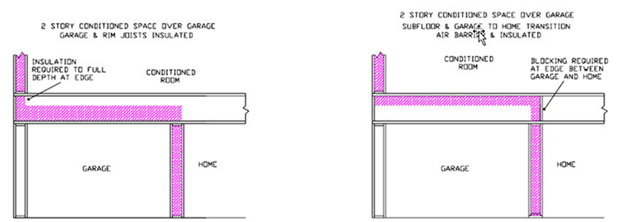
Figure RA3.5-9 Homes with Conditioned Space Over Garage – Structural Insulated Panel (SIP)
The band joist where the garage transitions to an attic above conditioned space shall have an air barrier installed in contact with the edge of the attic insulation.
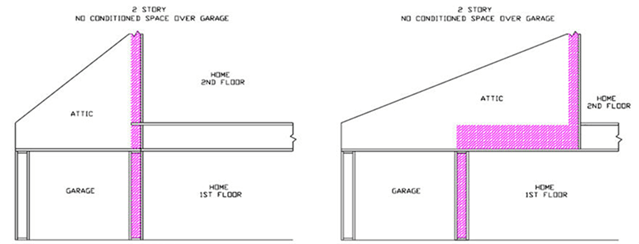
Figure RA3.5-10 Homes with No Conditioned Space Over Garage – Structural Insulated Panel (SIP)
These procedures detail the installation and inspection protocols necessary to qualify for Quality Insulation Installation (QII) of insulated concrete forms (ICFs). These procedures must be field verified before the building construction permit is finalized.
These procedures are to be followed by the insulation installer and an ECC-rater must verify its conformance for meeting the requirements of Sections 150.1(c) and 110.7 of the Standards.
Conventional concrete and concrete masonry unit (CMU) walls, floors and roofs can be insulated on the inside, on the outside, or have insulation between two layers of concrete (i.e., sandwich panel walls/block walls). ICFs are typically single forming masonry blocks with insulation to improve the thermal resistance of the material. ICFs are manufactured in conventional CMU dimensions of 6 inch, 8 inch, 10 inch, and larger widths. Insulated concrete forms (ICFs) typically have a layer of insulation located: (1) within the inner core of the concrete masonry unit; or, (2) on one or all sides surrounding an inner core of concrete.
A similar type of insulated concrete form system is autoclaved aerated concrete (AAC) which has an air void matrix rather than sand and gravel commonly used in conventional concrete. The density range of AAC is 30 to 50 pounds per cubic foot (pcf) compared to conventional concrete used with ICFs with a density of approximately 80 to 140 pounds per cubic foot (pcf).
The R-value of ICFs is dependent on the type of insulation material used and its thickness. Insulation used within the inner core of ICFs can be: (1) poured-in-place vermiculite or perlite; (2) foamed-in-place spray polyurethane foam insulation material; or, (3) standard molded insulation inserts of rigid board insulation material. Insulation used to make up one or more of the outer layers of the ICF is a rigid board insulation material. Specific product R-values are readily available from the manufacturer for the specific materials being installed. R-value of the product is typically marked on the product. The installed insulation must meet the R-value stated on the compliance documentation.
- Materials shall comply with, and be installed in conformance with, all applicable building codes for building. California Building Code (including, but not limited to, California Electric Code Section 719) and installed to meet all applicable fire codes.
- Materials shall meet California Quality Standards for Insulating Material, Title 24, Part 12, Chapter 4, Article 3, listed in the California Department of Consumer Affairs Consumer Guide and Directory of Certified Insulating Materials.
- Materials shall comply with flame spread rating and smoke density requirements of Chapter 26 and Section 706 of the Title 24, Part 2: all installations with exposed facings must use fire retardant facings which have been tested and certified not to exceed a flame spread index (FSI) of 25 and a smoke development index (SDI) of 450. Insulation facings that do not touch a ceiling, wall, or floor surface, and faced batts on the undersides of roofs with an air space between the ceiling and facing are considered exposed applications.
- Materials shall be installed according to manufacturer specifications and instructions.
- ICF systems are considered an air barrier; however, extension of the air barrier shall be made across all interconnections of window and door openings, and at all adjoining surfaces of exterior envelope assemblies of different materials (i.e., where ICF walls adjoin framed floors and roof/ceilings).
The ECC-raters shall verify the installed type and thickness of insulation in the ICF system being used for walls, roof/ceilings, and floors, and to ensure that insulation levels and installation integrity meet the R-value specified on the Certificate of Compliance, and all other required compliance documentation.
All provisions of Residential Appendix RA2 shall be met. An Insulation Certificate of Installation signed by the installer shall be provided that states the installation is consistent with the Certificate of Compliance, plans and specifications for which the building permit was issued. The ICF installer shall also complete the applicable sections of the Certificate of Installation form and attach a product specification or data sheet for every insulation material used.
All provisions of Residential Appendix RA2 shall be met. The Insulation Certificate of Installation, with insulation material labels or specification/data sheets attached, signed by the ICF installer, shall be available on the building site for each of the ECC-rater's verification inspections. Note: The ECC-rater cannot verify compliance credit without these completed forms.
- Connections of ICF walls shall be grouted and sealed meeting manufacturer's specifications. All plumbing and wiring penetrations through the top and bottom of the ICF, and electrical boxes that penetrate the plane of the ICF shall be sealed. All gaps between interconnecting envelope assemblies of different materials shall have air barrier caulked, or sealed with minimally expansive foam or taped.
- Bottom connections of ICFs shall be sealed to the ground subfloor or slab, and above ground subfloor.
- Insulation shall uniformly fit across the plane of the wall and taping, caulking or sealing of all joints and seams of the ICF shall be maintained to be considered as the air barrier.
- Penetrations and obstructions to the ICF shall be completely caulked and sealed.
- Insulation shall fill between the sheathing and the rear of electrical boxes and phone boxes.
- All rim-joists shall be insulated to the same R-value as the adjacent walls.
- The insulation shall be installed without gaps and voids.
- Framing for kneewalls and skylight shafts that separate conditioned from unconditioned space shall be insulated to meet or exceed the wall R-value specified on the Certificate of Compliance, and all other required compliance documentation.
- Steel-framed kneewalls and skylight shafts, shall exceed the mandatory minimum insulation requirements and external surfaces of steel studs shall be covered with insulation unless otherwise specified on the Certificate of Compliance using correct U-factors from Joint Appendix JA4, Table 4.3.4 (or U-factors approved by the Commission Executive Director).
- The backside of air permeable insulation exposed to the unconditioned attic space shall be completely covered with a continuous air barrier.
Walls of interior closets for HVAC and/or water heating equipment, which require combustion air venting, shall be insulated to at least the same R-value as the other demising walls (i.e., walls separating conditioned space and attached garage), or as specified on the Certificate of Compliance.
- Insulation shall fill the entire cavity; or, an additional air barrier shall be installed inside the double wall or bump-out and in contact with the insulation so that the insulation fills the cavity formed with the additional air barrier.
- Entire double walls and framed bump-outs shall be airtight.
- Framing and bracing used for structural purposes shall be identified on plan documents with diagrams and/or design drawings.
- Insulation shall be installed in a manner that restricts thermal bridging through the structural framing assembly.
- Insulation shall be applied to fully enclose and/or adhere to all sides and ends of structural assembly framing.
- The structural portions of assemblies shall be airtight.
All window and door headers shall be insulated to a minimum of R-3 between the exterior face of the header and inside surface of the finish wall material.
- In unvented attics, where insulation is applied directly to the underside of the roof deck, framing for gable ends that separate the unvented attic from unconditioned space shall be insulated to meet or exceed the wall R-value of the adjacent exterior wall construction as specified on the Certificate of Compliance.
- The backside of air permeable insulation exposed to the unconditioned attic space shall be completely covered with a continuous air barrier.
- Baffles shall be placed at eaves or soffit vents of vented attics to keep insulation from blocking eave ventilation and prevent air movement under the insulation. The required net-free ventilation shall be maintained.
- Hard covers or draft stops shall be placed over all drop ceiling areas and interior wall cavities to keep insulation in place and stop air movement. If hard covers or draft stops are missing or incomplete, they shall be completed before insulation is installed.
- In traditional framed attics, required eave ventilation shall not be obstructed for conventional attics - the net free-ventilation area of the eave vent shall be maintained. Eave vent baffles shall be installed to prevent air movement under or into the ceiling insulation of conventional attics.
- Insulation shall cover all recessed lighting fixtures. If the fixtures are not rated for insulation contact (IC) and airtight, the fixtures shall be removed and/or replaced.
- All recessed light fixtures that penetrate the ceiling shall be listed for zero clearance insulation contact (IC), have a label that certifies it as airtight with leakage less than 2.0 cfm @ 75 Pa when tested to ASTM E283, and shall be sealed with a gasket or caulk between the light's housing and the ceiling.
Insulation installed in unvented rafter ceilings or to the underside of unvented roofs with an attic below shall have an R-value conforming to compliance documentation and the air barrier shall be uniform across the transition of roof to wall. The insulation shall be in contact with the air barrier.
Insulation shall be placed below any platform or catwalk for HVAC equipment installation and access.
Permanently attach rigid board insulation, batt, or blanket insulation with the appropriate R-value to the access door using adhesive or mechanical fastener. The bottom of the attic access shall be gasketed to prevent air leakage of conditioned air to the unconditioned attic.
The outer and inner face, and all joints of the ICF air barrier, shall be maintain through use of tape, or sealing and caulking as needed.
On floors that are over garages, the rim joist shall be insulated.
The separation between conditioned space (house) and the garage shall be insulated to create a continuous thermal barrier. All rim and band joists adjoining conditioned space shall be airtight and insulated.
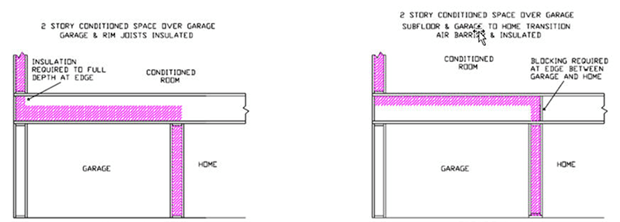
Figure RA3.5-11 Homes with Conditioned Space Over Garage – Insulated Concrete Form (ICF)
The band joist where the garage transitions to an attic above conditioned space shall have an air barrier installed in contact with the edge of the attic insulation.
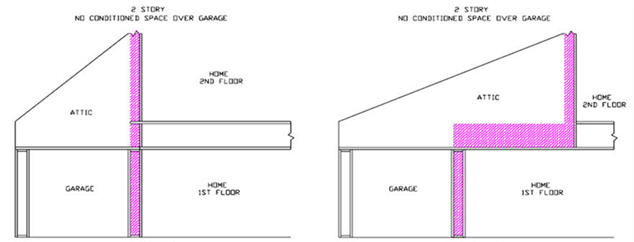
Figure RA3.5-12 Homes with No Conditioned Space Over Garage – Insulated Concrete Form (ICF)
Water Heating field verification offers credits for improved performance in terms of “quality” pipe insulation installation, for the installation of field-verified hot water distribution systems that are more compact and therefore perform better than typical hot water distribution systems and for the installation of specific circulation strategies. The listed measures can be completed on a sampling basis.
The ECC-rater shall verify that all domestic hot water piping meet the insulation requirements specified in §150.0(j). The rater shall visually verify the following:
- In attics and crawlspaces the insulation shall completely surround the pipe with at least 1 inch of insulation and the pipe shall be completely covered with at least 4 inches of insulation further away from the conditioned space.
- In walls, the insulation must completely surround the pipe with at least 1 inch of insulation.
For central systems with hot water piping serving multiple dwelling units, the heating plant and recirculation system piping insulation installation quality shall be field verified by a ECC-rater. The ECC-rater shall inspect the heating plant and horizontal supply header and return piping in accordance with the requirements in Title 24 Part 6 section 170.2(d). The rater shall use a sampling approach that one in seven DHW recirculation pipe risers and associated branches be inspected to verify the pipe insulation meet with the following requirements:
1. Insulation to be flush with pipe insulation or have minimum of one inch if appurtenance is bulkier.
2. Removable and re-installable for maintenance or replacement.
3. Pipe supports, hangers, and clamps shall be attached on the outside of rigid pipe insulation.
This measure expands on the requirements for parallel piping systems that use one or more central manifolds with individual runs from the manifold to each point of use. Visual inspection shall verify that all supply lines of the parallel piping system meet the specific installation requirements listed below:
- The measured length of pipe from the water heater to each central manifold shall not exceed 5 feet (measured to the nearest half foot).
- The hot water distribution system piping from the manifold to the fixtures and appliances must take the most direct path. For example, in a house with more than 1-story and the water heater in the garage, this requirement would exclude running hot water supply piping from the manifold to the attic, and then running the line back down to a first floor point of use.1. The hot water distribution piping must be separated by at least two inches from any other hot water supply piping, and at least six inches from any cold water supply piping.
- The ECC-rater shall also verify that other hot water piping is insulated and installed to meet the requirements of RA3.6.2.
To meet the Compact Hot Water Distribution System Expanded Credit eligibility requirements, the requirements in RA4.4.6 must be met. In addition, the following field verifications are required:
-
No hot water piping larger than 1 inch diameter is allowed,
-
Length of 1 inch diameter piping is limited to 8 ft or less,
-
Two and three story buildings cannot have hot water distribution piping in the attic, unless the water heater is also located in the attic, and
- Eligible recirculating systems must be Verified Demand Recirculation: Manual Control conforming to RA4.4.17.
Demand controlled recirculation systems shall operate “on-demand”, meaning that pump operation shall be initiated shortly prior to the hot water draw. The recirculation pump can be located external to the water heater or be integral to the water heater. The controls shall operate on the principal of shutting off the pump with a sensed rise in pipe temperature (Delta-T). For this verification process, a manual switch is required.
Verification shall include:
- When a dedicated return line has been installed the pump, controls and thermo-sensor are installed at the end of the supply portion of the recirculation loop (typically under a sink); or
- The pump and controls are installed on the return line near the water heater and the thermo-sensor is installed in an accessible location as close to the end of the supply portion of the recirculation loop as possible (typically under a sink), or
- When the cold water line is used as the return, the pump, demand controls and thermosensor shall be installed in an accessible location at the end of supply portion of the hot water distribution line (typically under a sink).
- After the pump has been activated, the controls shall allow the pump to operate until the water temperature at the thermo-sensor rises not more than 10ºF (5.6 ºC) above the initial temperature of the water in the pipe, or
- The controls shall not allow the pump to operate when the temperature in the pipe exceeds 102ºF (38.9 ºC).
Demand controlled recirculation systems shall operate “on-demand”, meaning that pump operation shall be initiated shortly prior to the hot water draw. The recirculation pump can be located external to the water heater or be integral to the water heater. The controls shall operate on the principal of shutting off the pump with a sensed rise in pipe temperature (Delta-T). For this verification process a sensor control is used to activate the pump rather than a manual control.
Verification shall include:
- When a dedicated return line has been installed the pump, controls and thermo-sensor are installed at the end of the supply portion of the recirculation loop (typically under a sink); or
- The pump and controls is installed on the return line near the water heater and the thermo-sensor is installed in an accessible location as close to the end of the supply portion of the recirculation loop as possible (typically under a sink), or
- When the cold water line is used as the return, the pump, demand controls and thermosensor shall be installed in an accessible location at the end of supply portion of the hot water distribution line (typically under a sink).
- After the pump has been activated, the controls shall allow the pump to operate until the water temperature at the thermo-sensor rises not more than 10ºF (5.6 ºC) above the initial temperature of the water in the pipe, or
- The controls shall not allow the pump to operate when the temperature in the pipe exceeds 102ºF (38.9 ºC).
A ECC-rater is required to obtain this credit. All DWHR unit(s) shall be certified to the Energy Commission according to the following requirements:
- Vertical DWHR unit(s) shall be compliant with CSA B55.2 and tested and labeled in accordance with CSA B55.1 or IAPMO IGC 346-2017. Sloped DWHR unit(s) shall be compliant with IAPMO PS 92 and tested and labeled with IAPMO IGC 346-2017.
- The DWHR unit(s) shall have a minimum rated effectiveness of 42 percent.
The ECC-rater shall verify that:
- The make, model, and CSA B55.1 or IAPMO IGC 346-2017 rated effectiveness of the DWHR unit(s) shall match the compliance documents. The DWHR unit(s) shall also be verified as a model certified to the Energy Commission as qualified for credit as a DWHR unit(s).
- The installation configuration (e.g., equal flow, unequal flow to the water heater, or unequal flow to the showers) and the percent of served shower fixtures shall match the compliance documents.
For water heating system serving a single dwelling, the DWHR system shall, at the minimum, recover heat from the master bathroom shower and must at least transfer that heat either back to all the respective showers or the water heater.
For central water heating system serving multiple dwellings, the DWHR system shall, at the minimum, recover heat from half the showers located above the first floor and must at least transfer that heat either back to all the respective showers or the water heater.
The DWHR unit(s) shall be installed within 1 degrees of the rated slope. Sloped DWHR shall have a minimum lengthwise slope of 1 degree. The lateral level tolerance shall be within plus or minus 1 degree.
The installation shall comply with any applicable California Plumbing Code requirements.
RA3.7 contains procedures for verification of heat recovery efficiency and fan efficacy, and for measuring the airflow rate for mechanical ventilation systems.
RA3.7 is applicable to mechanical ventilation systems in residential dwelling units.
RA3.7 provides required procedures for installers, ECC-raters and others who are required to perform field verification of mechanical ventilation systems for compliance with Part 6.
| Diagnostic | Description | Procedure |
| Whole-Building Mechanical Ventilation Airflow | Verification of whole-building ventilation system airflow rate . Continuous Operation | RA3.7.4.1 |
| Whole-Building Mechanical Ventilation Airflow | Verification of whole-building ventilation system airflow rate . Intermittent Operation | RA3.7.4.2 |
| Kitchen Local Mechanical Exhaust | Verification of vented range hood airflow rate or capture efficiency | RA3.7.4.3 |
| Heat Recovery Ventilation (HRV) or Energy Recovery Ventilation (ERV) Rated Performance Verification | Verification of the HRV/ERV fan efficacy (W/cfm) or heat recovery efficiency. | RA3.7.4.4 |
The instrumentation for the air distribution diagnostic measurements shall conform to the following specifications:
All pressure measurements shall be measured with measurement systems (i.e., sensor plus data acquisition system) having an accuracy equal to or better than ± 1% of pressure reading or ± 0.2 Pa (0.0008 inches water) (whichever is greater). All pressure measurements within the duct system shall be made with static pressure probes such as Dwyer A303 or equivalent.
All measurements of ventilation fan airflow rate shall be made with an airflow rate measurement apparatus (i.e., sensor plus data acquisition system) having an accuracy equal to or better than ± 10% of reading. The apparatus shall have an accuracy specification that is applicable to the airflow rates that must be verified utilizing the procedures in Section RA3.7.4. Airflows shall be measured at the mechanical ventilation fan’s inlet terminals/grilles or outlet terminals/grilles.
All instrumentation used for mechanical ventilation system airflow rate diagnostic measurements shall be calibrated according to the manufacturer’s calibration procedure to ensure the airflow measurement apparatus conforms to the accuracy requirement specified in Section RA3.7.2.2.
Ventilation system airflow rate shall be measured using one of the apparatuses listed in Section RA3.7.3. The apparatus shall produce airflow rate measurements that conform to the accuracy requirements specified in Section RA3.7.2 for measurements of residential mechanical ventilation system airflow at system inlet or outlet terminals, grilles, or registers for single or multiple branch ventilation duct systems.
The airflow rate measurement apparatus manufacturers shall publish in their product documentation, specifications for how their airflow measurement apparatuses are to be used for accurately measuring residential mechanical ventilation system airflow at system inlet or outlet terminals, grilles, or registers of single or multiple branch ventilation systems.
The airflow measurement apparatus manufacturers shall certify to the Energy Commission that use of the apparatus in accordance with the specifications given in the manufacturer's product documentation will produce measurement results that are within the accuracy required by Section RA3.7.2.2.
For the airflow measurement apparatuses that are certified to the Commission as meeting the accuracy required by Section RA3.7.2.2, the following information shall be posted on the Energy Commission website, making the information available to all people involved in the airflow verification compliance process:
-
The product manufacturers' model numbers for the airflow measurement apparatuses.
-
The product manufacturers' product documentation that gives the specifications for use of the airflow measurement apparatuses to accurately measure residential mechanical ventilation system airflow at system inlet or outlet terminals, grilles or registers of single or multiple branch ventilation systems.
A manufacturer's certification to the Commission of the accuracy of the airflow measurement apparatus, and submittal to the Commission of the product documentation that specifies the proper use of the airflow measurement apparatus to produce accurate airflow rate measurements shall be prerequisites for allowing the manufacturer's airflow measurement apparatus to be used for conducting the system airflow verification procedures in Section RA3.7 for demonstrating compliance with Part 6.
A flowmeter designed for measurement of residential exhaust airflows that meets the applicable instrument accuracy specifications in RA3.7.2 may be used to measure the mechanical exhaust ventilation airflow.
A powered and pressure balanced flow capture hood (subsequently referred to as a Powered Flow Hood3) that has the capability to balance the flow capture static pressure difference between the room and the flow capture hood enclosure to 0.0 ± 0.2 Pa (0.0008 inches water) and meets the applicable instrumentation specifications in Section RA3.7.2 may be used to verify the ventilation airflow rate if the powered flow hood has a flow capture area at least as large as the ventilation system inlet or outlet, terminal, register, or grille in all dimensions. The fan adjustment needed to balance the flow capture static pressure difference between the room and the flow capture hood enclosure to 0.0 ± 0.2 Pa (0.0008 inches water) shall be provided by either an automatic control or a manual control operated in accordance with the apparatus manufacturer's instructions specified in the manufacturer's product documentation.
[3] Also known as "active" flow hood, or "fan assisted" flow hood.
A traditional flow capture hood4 meeting the applicable instrumentation specifications in Section RA3.7.2 may be used to verify the ventilation system airflow rate if the non-powered flow hood has a capture area at least as large as the ventilation system inlet or outlet terminal, register or grille in all dimensions.
This section describes the procedures used to verify Mechanical ventilation system airflow.
If multiple fans are specified to operate simultaneously to provide the total required ventilation airflow, the measurements shall be made with all applicable fans operating simultaneously.
- A flow measuring device that meets the applicable instrumentation requirements given in Section RA3.7.2, and RA3.7.3 shall be used to measure the ventilation airflow(s).
- Measure and record the ventilation airflow(s).
- If the measured total airflow is greater than or equal to the ventilation airflow rate required by the Standards or the Certificate of Compliance, the mechanical ventilation system complies. Otherwise the mechanical ventilation system does not comply, and corrective action shall be taken.
-
Confirm that both the supply side and the exhaust side of the balanced system operate simultaneously in response to a shared system control.
-
Measure the airflow rate for the exhaust side of the system.
-
Measure the airflow rate for the supply side of the system.
-
Calculate the percent difference between the exhaust and supply airflow rates.
-
Calculate the average of the exhaust and the supply airflow rates.
-
If the exhaust and supply airflow rates are within 20% of each other, and the average of the exhaust and supply airflow rates is greater than or equal to the airflow rate required by the Standards or the Certificate of Compliance, the balanced ventilation system complies. Otherwise, the system does not comply, and corrective action shall be taken.
- If the balanced system is an HRV or ERV and compliance with a recovery efficiency or fan efficacy specification is required, then also perform the verification specified in RA3.7.4.4.
[4] Also known as “non-powered flow hood, "standard" flow hood, "commercially available" flow hood, or "passive" flow hood.
The Executive Director may approve intermittent mechanical ventilation systems, devices, or controls for use for compliance with field verification and diagnostic testing requirements for mechanical ventilation airflow, subject to a manufacturer providing sufficient evidence to the Executive Director that the installed mechanical ventilation systems, devices, or controls will provide at least the minimum ventilation airflow required by the Standards, and subject to consideration of the manufacturer's proposed field verification and diagnostic test protocol for the ventilation system(s). Ventilation airflow of systems with multiple operating modes shall be tested in all modes designed to comply with the required ventilation airflows.
Approved systems, devices, or controls, and field verification and diagnostic test protocols for intermittent mechanical ventilation systems shall be listed in directories published by the Energy Commission.
The verification shall utilize certified performance rating data from the Home Ventilating Institute (HVI) Certified Home Ventilating Products Directory at https://www.hvi.org/hvi-certified-products-directory/, the Association of Home Appliance Manufacturers (AHAM) Certified Products Directory at https://www.aham.org/AHAM/What_We_Do/Kitchen_Range_Hood_Certification, or another directory of certified product performance ratings approved by the Energy Commission for determining compliance. The verification procedure shall consist of visual inspection of the installed kitchen range hood to verify and record the following information:
- The manufacturer name and model number.
- The model is listed in the HVI, AHAM, or other CEC-approved directory.
- The rated airflow value or rated capture efficiency value listed in the HVI, AHAM, or other CEC-approved directory.
- The sound rating value listed in the HVI, AHAM, or other CEC-approved directory.
- If the value for the rated airflow or rated capture efficiency given in the directory is greater than or equal to the airflow or capture efficiency requirements specified in the Standards, and if the value for the sone rating given in the directory is less than or equal to the sone rating requirements specified in Standards, then the kitchen range hood complies. Otherwise, the kitchen range hood does not comply. If the kitchen range hood is not listed in the HVI, AHAM, or other CEC-approved directory, then the system does not comply.
The verification shall utilize certified performance rating data from the Home Ventilating Institute (HVI) Certified Home Ventilating Products Directory at https://www.hvi.org/hvi-certified-products-directory/, or another directory of certified product performance ratings approved by the Energy Commission for determining compliance. The verification procedure shall consist of visual inspection of the installed system to verify and record the following information:
-
Record the manufacturer make and model from the installed system nameplate.
-
Verify the model is listed in the HVI or other CEC-approved directory.
-
If compliance with a fan efficacy performance rating (w/cfm) is required, then determine and record the fan efficacy rating for the installed model using the model details in the energy ratings in the HVI, or other CEC-approved directory in accordance with steps a, b, and c below.
-
Record the required ventilation airflow (cfm) for the installed HRV/ERV as specified on the certificate of compliance.
- From the energy ratings in the HVI or other CEC approved directory, determine, and record the rated Power Consumed (Watts) at 32 degrees Fahrenheit, at the closest Net Airflow (cfm) listed in the directory that is greater than or equal to the ventilation airflow (cfm) required on the certificate of compliance. Alternatively, linear interpolation of the directory ratings at 32 degrees Fahrenheit shall be allowed if the interpolated value is calculated based on a Net Airflow (cfm) that is equal to the ventilation airflow (cfm) required on the certificate of compliance. Interpolation shall be in accordance with equation RA3.7-1. Extrapolation of the directory ratings at 32 degrees Fahrenheit shall not be allowed.
Equation RA3.7-1
pc = pc1 + [(na – na1) / (na2 – na1)] X (pc2 – pc1) -
Divide the value for Power Consumed (Watts) recorded in step b, by the Net Airflow (cfm) used in step b to determine the Power Consumed.
where:
na is the known value for Net Airflow equal to the ventilation airflow required on the certificate of compliance.
pc is the unknown value for Power Consumed (Watts) at 32 degrees Fahrenheit.
na1 and pc1 are the closest rated values at 32 degrees Fahrenheit for Net Airflow (cfm) and Power Consumed (Watts) respectively that are below the known na value.
na2 and pc2 are the closest rated values at 32 degrees Fahrenheit for Net Airflow (cfm) and Power Consumed (Watts) respectively that are above the known na value.
-
Record the required ventilation airflow (cfm) for the installed HRV/ERV as specified on the certificate of compliance.
-
If compliance with a sensible recovery efficiency (SRE) performance rating (%) is required, then determine and record the SRE rating for the installed model using the model details in the energy ratings in the HVI or other CEC-approved directory in accordance with steps a, and b below.
-
Record the required ventilation airflow (cfm) for the installed HRV/ERV as specified on the certificate of compliance.
-
From the energy ratings in the HVI or other CEC approved directory, determine, and record the rated SRE (%) at 32 degrees Fahrenheit, at the closest Net Airflow (cfm) listed in the directory that is greater than or equal to the ventilation airflow (cfm) required on the certificate of compliance. Alternatively, linear interpolation of the directory ratings at 32 degrees Fahrenheit shall be allowed if the interpolated value is calculated based on a Net Airflow (cfm) that is equal to the ventilation airflow (cfm) required on the certificate of compliance. Interpolation shall be in accordance with equation RA3.7-2. Extrapolation of the directory ratings at 32 degrees Fahrenheit shall not be allowed.
Equation RA3.7-2
sre = sre1 + [(na – na1) / (na2 – na1)] X (sre2 – sre1)
where:
na is the known value for Net Airflow equal to the ventilation airflow required on the certificate of compliance.
sre is the unknown value for SRE at 32 degrees Fahrenheit.
na1 and sre1 are the closest rated values at 32 degrees Fahrenheit for Net Airflow (cfm) and SRE respectively that are below the known na value.
na2 and sre2 are the closest rated values at 32 degrees Fahrenheit for Net Airflow (cfm) and SRE respectively that are above the known na value.
-
-
Determining Compliance.
-
If the value determined for SRE by one or both of the alternatives in step 4 for the installed system is greater than or equal to the SRE required for compliance, then the system complies with the sensible recovery efficiency rating requirement. Otherwise the system does not comply.
-
If the value determined for fan efficacy (W/cfm) by one or both of the alternatives in step 3 for the installed system is less than or equal to the fan efficacy required for compliance, then the system complies with the fan efficacy rating requirement. Otherwise, the system does not comply.
-
If compliance with both fan efficacy and sensible recovery efficiency ratings are required, then both ratings shall comply at the same Net Airflow (cfm), otherwise the system does not comply.
-
If the system is not listed in the HVI or other CEC-approved directory, then the system does not comply.
-
The purpose of this test procedure is to measure the air leakage rate through a building enclosure or a dwelling unit enclosure.
The measurement procedure shall be based on the specifications of Residential Energy Services Network's (RESNET) Standard for Testing Airtightness of Building, Dwelling Unit, and Sleeping Unit Enclosures; Airtightness of Heating and Cooling Air Distribution Systems; and Airflow of Mechanical Ventilation Systems (ANSI/RESNET/ICC 380-2019) (RESNET 380) as further specified in Subsections RA3.8.2, RA3.8.3, RA3.8.4 below.
This enclosure leakage procedure is applicable to:
- Single family building enclosures
- Multifamily dwelling unit enclosures
The instrumentation for the enclosure leakage measurements shall conform to the specifications in RESNET 380 Section 4.1.
The enclosure leakage measurement procedure shall conform to the following specifications:
- The procedure for preparation of the building or dwelling unit for testing shall conform to the applicable requirements in RESNET 380 Section 4.2.
- The procedure for installation of the test apparatus, and preparations for measurement shall conform to the applicable requirements in RESNET 380 Section 4.3.If compliance requires the results of the test to be reported in cubic feet per minute per ft2 of dwelling unit enclosure surface area at 50 Pa (0.2 inch water) (CFM50/ft2 of enclosure), the dwelling unit enclosure interior surface area in ft2 (compartmentalization boundary area) shall be recorded.
- The procedure for the conduct of the enclosure leakage test shall conform to the One-Point Airtightness Test specified in RESNET 380 Section 4.4.1 or the multi-point airtightness test specified in the RESNET 380 Section 4.4.2
The results of the test shall be determined as follows:
- The leakage airflow in CFM50 if determined by the One-Point Airtightness Test specified in RESNET 380 Section 4.4.1 shall be adjusted using RESNET 380 Section 4.5.1, equation (5a).
- If compliance requires the results of the test to be reported in air changes per hour at 50 Pa (0.2 inch water) (ACH50), the leakage results determined by RESNET 380 Section 4.5.1, equation (5a) shall be converted to ACH50 using RESNET 380 Section 4.5.2, equation (7a).
- If compliance requires the results of the test to be reported in CFM50/ft2 of enclosed the leakage results determined by RESNET 380 Section 4.5.1, equation (5a) shall be converted to CFM50/ft2 of enclosure using RESNET 380 Section 4.5.2, equation 10.
If the applicable value(s) for CFM50, ACH50, or CFM50/ft2 of enclosure determined in Section RA3.8.4 are less than or equal to the enclosure leakage compliance criterion specified by the Standards or the Certificate of Compliance, the enclosure complies. Otherwise, the enclosure does not comply.
RA3.9 contains procedures for measurement of WHF systems in single-family buildings:
- Measurement of WHF airflow rate to confirm compliance with the airflow rate requirements specified in the performance standards set forth in Standards section 150.1(b).
- Measurement of WHF Watt draw.
- Calculation of WHF efficacy (w/cfm) utilizing simultaneous measurement of WHF Watt draw and airflow rate.
The instrumentation for the diagnostic measurements shall conform to the following specifications:
All pressure measurements shall be performed with measurement systems (i.e., sensor plus data acquisition system) having an accuracy of ± 1% of pressure reading or ± 0.2 Pa (.0008 inches water) (whichever is greater).
All measurements of WHF airflow rates shall be made with an airflow rate measurement apparatus (i.e., sensor plus data acquisition system) having an accuracy of ± 7% of reading or ± 5 cfm whichever is greater.
All measurements of WHF watt draws shall be made with true power measurement systems (i.e., sensor plus data acquisition system) having an accuracy of ± 2% of reading or ± 10 watts whichever is greater.
WHF airflow rate shall be measured using one of the apparatuses listed in Section RA3.9.3. The apparatus shall produce airflow rate measurements that conform to the accuracy requirements specified in Section RA3.9.2 for measurements of residential WHFs.
The airflow rate measurement apparatus manufacturers shall publish in their product documentation, specifications for how their airflow measurement apparatuses are to be used for accurately measuring WHF airflow rates.
The airflow measurement apparatus manufacturers shall certify to the Energy Commission that use of the apparatus in accordance with the specifications given in the manufacturer's product documentation will produce measurement results that are within the accuracy required by Section RA3.9.2.
For the airflow measurement apparatuses that are certified to the Commission as meeting the accuracy required by Section RA3.9.2, the following information will be posted on the Energy Commission website, making the information available to all people involved in the airflow verification compliance process:
- The product manufacturers' model numbers for the airflow measurement apparatuses.
- The product manufacturers' product documentation that gives the specifications for use of the airflow measurement apparatuses to accurately measure WHF airflow.
A manufacturer's certification to the Commission of the accuracy of the airflow measurement apparatus, and submittal to the Commission of the product documentation that specifies the proper use of the airflow measurement apparatus to produce accurate airflow rate measurements shall be prerequisites for allowing the manufacturer's airflow measurement apparatus to be used for conducting the system airflow verification procedures in Section RA3.9 for demonstrating compliance with Part 6.
The apparatus for measuring the system airflow rate shall consist of a building pressurization and airflow measurement device (subsequently referred to as a fan flowmeter) that meets all applicable instrumentation specifications in Section RA3.9.2, and a static pressure measurement device that meets the specifications in Section RA3.9.2.1. The fan flowmeter shall be attached at the inlet to a WHF from the conditioned space. The fan flowmeter shall be attached at a point where all the airflow through the system will flow through it. All WHF dampers shall be in their normal operating condition. The static pressure probe(s) shall be fixed to locations inside and outside the dwelling such that they will not be moved during this test.
A powered and pressure balanced flow capture hood (subsequently referred to as a Powered Flow Hood5) that has the capability to balance the flow capture static pressure difference between the room and the flow capture hood enclosure to 0.0 ± 0.2 Pa (.0008 inches water) and meets the applicable instrumentation specifications in Section RA3.9.2 may be used to verify the system airflow rate at the WHF inlet if the powered flow hood has a flow capture area at least as large as the WHF inlet in all dimensions. The fan adjustment needed to balance the flow capture static pressure difference between the room and the flow capture hood enclosure to 0.0 ± 0.2 Pa (.0008 inches water) shall be provided by either an automatic control or a manual control operated in accordance with the apparatus manufacturer's instructions specified in the manufacturer's product documentation. All WHF dampers shall be in their normal operating position. Measurement(s) shall be taken at the inlet of the WHF.
5. Also known as "active" flow hood, or "fan assisted" flow hood.
A traditional flow capture hood6 meeting the applicable instrumentation specifications in Section RA3.9.2.2 may be used to verify the system airflow rate at the WHF inlet if the device has a capture area at least as large as the WHF inlet grille in all dimensions. All WHF dampers shall be in their normal operating position. Measurement(s) shall be taken at the inlet of the WHF.
6. Also known as "non-powered" flow hood, "standard" flow hood, "commercially available" flow hood, or "passive" flow hood
The air handler watt draw shall be measured using one of the following apparatuses.
The apparatus for measuring the WHF watt draw shall consist of a wattmeter meeting the applicable instrumentation specifications in RA3.3.1. The measuring device shall be attached to measure the WHF watt draw. All WHF dampers shall be in their normal operating condition.
When required to measure fan watt draw on WHF equipment that is wired directly to an electrical junction box, it is recommended to use portable true power clamp-on meters to provide flexibility for isolating the correct fan wires serving the WHF.
The apparatus for measuring the WHF watt draw shall consist of a utility revenue meter meeting the applicable instrumentation specifications in RA3.9.2.3 and a stopwatch that provides measurements in units of seconds. All WHF dampers and access panels shall be in their normal operating condition.
The apparatus for measuring the WHF watt draw shall consist of a digital utility revenue meter meeting the applicable instrumentation specifications in RA3.3.1 that provides direct digital display of the watt draw. All WHF dampers and access panels shall be in their normal operating condition.
When required for compliance, the installed WHF airflow shall be diagnostically tested using one of the methods specified in this section.
The measured airflow rate shall be expressed in cubic feet per minute of standard air (standard air has a density of 0.075 lb/ft³). When the airflow measurement is made at altitudes significantly different from sea level or at temperatures significantly different from 70°F, the airflow indicated on the device gauge may differ from the standard CFM by as much as 15 percent. Corrections from indicated to standard CFM shall be made using the procedure specified by the airflow measurement device manufacturer.
When multiple WHFs are used to comply with the required WHF airflow rate for the dwelling unit, all WHFs in the dwelling unit shall be operated simultaneously and the sum of the airflow rate measurements of the simultaneously operating WHFs for the dwelling shall be determined.
When flow capture hood devices are used, the capture area shall be at least as large as the WHF inlet grille in all dimensions.
WHF airflow shall be measured with the dwelling unit window openings configured such that when the WHF(s) are operating, a dwelling unit pressure of negative 10 Pa ± 5 Pa with reference to (WRT) outside is attained. This is the WHF operating pressure (WHF-OP).
- Open the window(s) that are typically opened during WHF operation.
- Place a pressure sensing probe/tube in the attic. If necessary, use a suitable means such as cardboard sheets and tape to facilitate sealing off the access opening between the attic and the dwelling unit's conditioned space to allow the pressure sensing probe/tube to be inserted into the attic space without crimping or restricting the pressure sensing probe/tube. There shall be no leakage of air from the attic through the attic access opening into the dwelling unit during this verification procedure.
- Attach the attic pressure sensing tube to a digital pressure gage such that it will measure the pressure difference between the dwelling unit conditioned space and the attic.
- Turn on all WHFs required to meet the dwelling unit WHF airflow rate required for compliance. If applicable, adjust multiple WHFs or variable speed WHFs to operate at a total airflow rate greater than or equal to the WHF airflow rate required for compliance.
- Adjust the dwelling unit window openings to bring the dwelling unit to the WHF-OP of negative 10 Pa ± 5 Pa WRT outside.
- Measure and record the pressure difference (Pa) between the attic and the dwelling unit conditioned space (Pattic) while the dwelling unit is at the WHF-OP.
- Turn off the WHF.
- Do not change the window openings. The same dwelling unit window opening configuration used to establish the WHF-OP used for the measurement in step (f) shall be used for the pressure matching procedure specified below.
- Attach the fan flowmeter to the inlet grille of the WHF. The fan flowmeter's capture enclosure or ductwork shall cover the WHF intake grille completely.
- Turn on all WHFs that were used during the measurement in step (f). The speed of the WHFs shall be the same as used for the measurement in step (f).
- Turn on the fan flowmeter. Adjust the fan flowmeter speed until the pressure difference (Pa) between the attic and the dwelling unit conditioned space matches Pattic determined in step (f).
- Record the flow through the fan flowmeter. When multiple WHFs are used to meet the required airflow, repeat steps (g) through (l) for each WHF, then sum the airflow measurements for all WHFs to arrive at the total WHF airflow for the dwelling unit.
The WHF airflow measurement shall be performed using the following procedures:
- Open the window(s) that are typically opened during WHF operation.
- Turn on all WHFs required to meet the dwelling unit WHF airflow rate. Adjust multiple or variable speed WHFs to operate at an airflow rate that will be greater than or equal to the rate required for compliance.
- Adjust the dwelling unit window openings to bring the dwelling unit to the WHF-OP of negative 10 Pa ± 5 Pa WRT outside.
- Measure the airflow rate(s) at the inlet grille(s) in accordance with RA3.9.3.2 with a calibrated powered flow hood to determine the total WHF airflow for the dwelling unit.
No part of the WHF intake shall be blocked or masked off to accommodate an undersized hood.
Operation of the powered flow hood shall conform to the specifications in the manufacturer's product documentation.
The WHF airflow measurement shall be performed using the following procedures.
- Open the window(s) that are typically opened during WHF operation.
- Turn on all WHFs required to meet the dwelling unit WHF airflow rate. Adjust multiple or variable speed WHFs to operate at an airflow rate that will be greater than or equal to the rate required for compliance.
- Adjust the dwelling unit window openings to bring the dwelling unit to the WHF-OP of negative 10 Pa ± 5 Pa WRT outside.
- Measure the airflow rate(s) at the inlet grille(s) with a calibrated traditional flow capture hood to determine the total WHF airflow for the dwelling unit.
No part of the WHF intake shall be blocked or masked off to accommodate an undersized hood.
Operation of the flow hood shall conform to the specifications in the manufacturer's product documentation.
When multiple WHFs are used to comply with the required WHF watt draw for the dwelling unit, all WHFs in the dwelling unit shall be operated simultaneously and the sum of the watt draw measurements of the simultaneously operating WHFs for the dwelling shall be determined.
When required for compliance, the WHF watt draw shall be measured using one of the following methods:
The WHF watt draw measurement shall be performed using the following procedures.
- The WHF(s) shall be operating at the WHF-OP used for the airflow rate measurement procedures specified in Section RA3.9.4.1.
- Measure the watt draw(s) to determine the total WHF watt draw for the dwelling unit.
When measuring watt draw of units that are wired directly to an electrical junction box, it is recommended to use portable true power clamp-on meters to provide flexibility for isolating the correct fan wires.
The WHF watt draw measurement shall be performed using the following procedures.
- Turn off every circuit breaker except the one exclusively serving the WHF(s).
- The WHF(s) shall be operating at the WHF-OP used for the airflow rate measurement procedures specified in Section RA3.9.4.1.
- Record the Kh factor on the revenue meter, count the number of full revolutions of the meter wheel over a period exceeding 90 seconds.
- Record the number of revolutions (Nrev) and time period (trev, seconds).
- Using the following equation, compute the WHF watt draw (Wfan).
Equation RA3.9-1
WHF Fan Watt DrawWfan = (Kh x Nrev x 3600) / trev - Return all circuit breakers to their original positions.
The WHF watt draw measurement shall be performed using the following procedures:
- Turn off every circuit breaker except the one exclusively serving the WHF(s).
- The WHF(s) shall be operating at the WHF-OP used for the airflow rate measurement procedures specified in Section RA3.9.4.1.
- Read the Watt draw from the digital utility meter digital display.
- Return all circuit breakers to their original positions.
Demonstrating compliance with WHF efficacy requirements requires simultaneous measurement of the WHF airflow rate using Section RA3.9.4.1 procedures and fan watt draw using Section RA3.9.4.2 procedures. The results of the simultaneous airflow rate and fan Watt draw measurements are used for calculation of a value for the WHF efficacy as follows:
The measured value for fan watt draw (watt) shall be divided by the measured value for airflow rate (cfm) to determine the fan efficacy (watt/cfm).
In order for the WHF to comply, the requirements in both subsections (a) and (b) below shall be met.
- The measured WHF airflow (cfm) shall meet or exceed the WHF airflow compliance criterion specified on the Certificate of Compliance.
- The calculated value for fan efficacy (watt/cfm) shall be less than or equal to the WHF efficacy compliance criterion specified on the Certificate of Compliance.